• Skip to main content
  • Skip to secondary menu
  • Skip to primary sidebar
  • Skip to footer
World Tennis Magazine

World Tennis Magazine

Unique Tennis Perspectives

  • Home
  • World Tennis with Harry Cicma
  • Staff
  • About
  • Contact Us
  • Forum

masters cup

Murray’s Return of Serve Neutralizes Federer

October 18, 2010 by Charles Bricker

It’s easy to admire Andy Murray’s speed, his balance, his bludgeoning first serve and his ability to power backhand winners from almost any position on court.

But for me the greatest difference-maker in his arsenal is his return of serve, and I don’t think you’ll get any dissent from Roger Federer.

Why would there be after Murray frustrated Federer in game after game in last Sunday’, limiting the Swiss to three aces in 6-3, 6-2 triumph in the Shanghai Masters final. For Murray, the key to returning so well is his quickness and his ability to read the serve quickly, and that’s no small task against Federer, who gives opponents no “tell” off his service toss.

In 57 matches this year against players not named Andy Murray, Federer is averaging a shade under nine aces per match. In his 13 matches against Murray, of which he’s won five, he has exceeded that average just twice — with 11 in a straight-set win at this year’s Australian Open and 11 in a split-set loss at the 2008 Masters Cup.

Andy Murray

In Sunday’s win, Murray held Federer to just three aces for the third time. It’s a telling statistics for a couple of reasons. First, aces deflate opponents, and, second, they shorten the day and reduce the running the server has to do. They are the “free points” that every player chases in every match.

There are two ways to effectively channel a player’s aces and, while aces-per-match are important, there’s an even more efficient method — aces-per-service-games. By using that comparison, you eliminate the skewing effect of a player who goes five sets instead of three or three sets instead of two, which give him the opportunity to hit more aces.

But even by that method, it’s obvious how well Murray rebuffs Federer’s serving. Let’s look at a number of factors:

* In the Shanghai final, Federer had three aces in nine service games (33.3%), about one ace every three games.

* In his other four matches at Shanghai last week, he had 23 aces in 38 service games (60.5%).

* Federer’s season numbers for 57 matches, not including vs. Murray, is 433 aces in 622 service games (69.6%). That’s over twice the average Federer had in the Shanghai final vs. Murray.

* In his last two matches, both wins, against Federer, Murray has held Federer to seven aces in 21 service games.

Of course not all “free points” are aces. All unreturned serves are “free points,” but the ATP doesn’t keep statistics on unreturned serves and, in fact, Federer routinely gets a number of free points during matches in which opponents avoid an ace by getting a racket on the ball.

But it’s fair to conclude that players who are quick enough to avoid being aced a lot also are more effective returners, and certainly that applies to Murray.

He’s has risen to near the top of the rankings because he has a complete game, but nothing in his portfolio of shots is more complete than those service returns.
Federer’s First Season-Ending Championship

November 24, 2009 by WTM

Roger Federer
Roger Federer

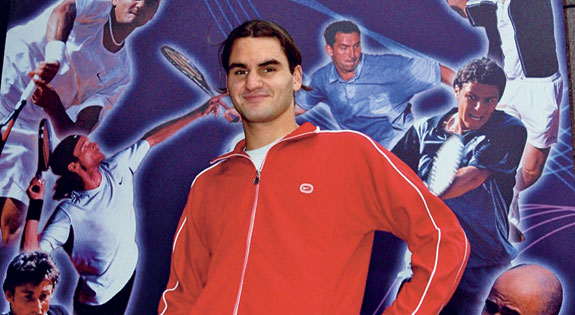
Roger Federer is playing in the ATP World Tour’s season-ending championship for an eighth time in 2009 at the O2 Arena in London. It was in 2002 when Federer first qualified for the ATP World Tour finale as a xx-year-old. Rene Stauffer, the respected Swiss tennis writer, chronicles Federer’s first appearance at the ATP World Tour Finals in this excerpt from his book THE ROGER FEDERER STORY, QUEST FOR PERFECTION ($24.95, New Chapter Press, www.RogerFedererBook.com). This chapter, chapter No. 14, is called “Red Dawn In China.”

Roger Federer’s title in Vienna represented a big step towards qualifying for the Tennis Masters Cup in China. Federer passed Albert Costa, Andy Roddick and Tommy Haas in Champions Race to rank No. 7 after his victory along the banks of the Danube. His ATP ranking, based on the 52-week results, also rose to a career-high No. 7—the career-high ranking that his countryman Jakob Hlasek achieved in 1989. After a quarterfinal finish at the Tennis Masters Series event in Madrid, Federer moved to No. 6 in the rankings—marking the highest ATP ranking ever achieved by a Swiss player. His trip to China was well within reach, but now he wanted to finally win “his” tournament—the Swiss Indoors in Basel. After finishing runner-up the last two years, Federer seemed poised to finally capture his hometown tournament. In the quar­terfinals, Federer faced Roddick for the first time in his career and defeated the 19-year-old American 7-6 (5), 6-1 in an exciting match that lasted until midnight. In the semifinals, the brawny David Nalbandian, Federer’s rival from junior days, spoiled Roger’s hometown title dreams, winning a 6-7 (2), 7-5, 6-3 decision after trailing 7-6, 3-1.

The final ATP event of the year is the Tennis Masters Series in Paris, played at the Palais Omnisports de Paris-Bercy, a majestic entertainment arena located on the north bank of the Seine featuring manicured grass-covered sides on its outside walls. The event usually decides the final qualifiers for the year-end Tennis Masters Cup and 2002 was no different. Federer of­ficially booked his ticket for Shanghai when Tim Henman lost in the third round to Nicolas Escude and Federer straight-setted Tommy Haas to reach the quarterfinals. With his goal achieved, Federer’s quarterfinal with Hewitt lacked the tension of his previous matches, and he lost to the world No. 1 in straight sets.

Federer traveled to Shanghai in November of 2002 as the No. 6 ranked player in the world. At age 21, he was the youngest player in the Tennis Masters Cup field, had nothing to lose as a first-time qualifier and there­fore, he was duly relaxed during the event. “Everything after this will be an encore,” he said. The Tennis Masters Cup took place in one of five gigantic exhibition halls that were reminiscent of airplane hangars in the Pudong district of Shanghai, a faceless area between the airport and downtown.

For Federer, his trip to the Tennis Masters Cup in China was unique. “This is no ordinary tournament; it’s an adventure,” he said juggling tennis balls in front of his hotel and parading up and down along the edge of a four-lane main road in a publicity photo shoot for photographers. He was playing in the Far East for the first time and immediately felt comfortable in his new surroundings. He enjoyed the unique atmosphere of the 11,500 square meter Expo-Hall, whose 10,000 spectators turned the place into an electric atmosphere.

The Tennis Masters Cup was the biggest, the most expensive and the most widely-covered professional sports event in China at the time. For most Chinese, tennis was relatively unknown. It was an undiscovered sport that they didn’t yet really understand. Whenever players double-faulted, the specta­tors would scream. Enthusiastic Chinese journalists would pose the strangest questions in press conferences. “Why are you always smiling, Mistel Fedelel? Because you are in such good shape?” a Chinese reporter asked Federer in broken English. Following another match, French Open Champion Albert Costa was asked by a Chinese scribe, “You always used to eat bananas when chang­ing sides. Why not today? Perhaps because you don’t like Chinese bananas?”

Federer, the Masters rookie who came to China with his mother Lynette and girlfriend Mirka, basked in the preferential treatment accorded to each of the eight participants. “I feel special here with the entire hullabaloo and the many body guards,” he said. “They read your every desire from your lips. It’s fortunate that there are so few players here.” At Shanghai, it became even more clear that Federer possessed a certain star quality and that he wasn’t blinded by the limelight. He loved the attention and flourished in it.

The Tennis Masters Cup is a round-robin event with the eight qualifying players paired in two round-robin groups of four. In his group, Federer ranked Andre Agassi as the favorite and himself and Juan Carlos Ferrero of Spain as the leading contenders for the No. 2 position. Federer’s assessment quickly proved to be wrong. Federer beat Ferrero in his opening round-robin match and then defeated Jiri Novak for a 2-0 round robin record. Federer then clinched his round-robin flight when Agassi lost to both Novak and Ferrero. No longer with a chance of making the semifinals, Agassi hastily left China in disappointment, using a hip injury as the reason for his withdrawal.

In the semifinals, Federer faced Hewitt, who already clinched the year-end No. 1 ranking for a second year in a row. The Australian barely qualified for the semifinals and benefited from Carlos Moya winning a three-hour mean­ingless match over fellow Spaniard Costa, where a Costa victory would have him reach the semifinals rather than Hewitt. Although Federer lost five of the last seven matches with Hewitt, he reasoned his chances of beating him and winning the first big championship of his career were very attainable.

Federer started his semifinal with Hewitt in furious fashion, taking a 3-0 and a 5-2 first-set lead, but Hewitt ran and fought as if his life were at stake. Hewitt fought off five set points and rallied for a 6-5 lead. Serving for the set, Hewitt staved off another five break points, before capturing the first set 7-5. Federer, however, was not ready to surrender. The second set turned into a wild back-and-forth struggle. Hewitt served for the match at 5-4 and held match point, but Federer broke back for 5-5. After holding serve for 6-5, Federer evened the match by breaking Hewitt’s serve, connecting on his fourth set point of the game.

The Chinese fans went wild—out of their seats, screaming and cheering. In the commentary booth high above the stadium, Heinz Günthardt and Stefan Bürer, the Swiss TV commentary team, described the tension and fast-paced action to the audience back in Switzerland, where it was Saturday morning and many people postponed their weekend shopping to watch the dramatic match with their new sports hero.

As the match extended into a third hour, the breaks seemed to fall in favor of Federer. Leading 4-3 in the final set, Federer held two break points to put him in the position to serve for the match. Both opportunities, however, were lost and Hewitt held for 4-4. Hewitt then subsequently broke Federer’s serve the next game to serve for the match at 5-4. The Australian reached his second match point—and shockingly double-faulted. Federer then broke Hewitt’s serve to square the match at 5-5. Serving with new balls in the next game, Federer committed two consecutive double-faults to allow Hewitt to break him back and gained another opportunity to serve for the match. It took Hewitt another four match points before he finally corralled Federer and advanced to the final with an epic 7-5, 5-7, 7-5 victory. Following the match, Hall of Fame journalist Bud Collins walked into the press room and asked his fellow scribes, “Have you ever seen a better match?”

In the craziest match of his career to date, Federer was aware that he let victory escape from his grasp. “I have no one to blame but myself,” he said to a small group of Swiss journalists who traveled to China. “Luck wasn’t on my side. I blew a big opportunity. That hurts.” A vacation in Phuket, Thailand helped heal the wounds.

Nadal and Davydenko reach Shanghai final

October 17, 2009 by WTM

Nikolay Davydenko
Nikolay Davydenko

Rafa Nadal reached the final of the Shanghai Masters when Feliciano Lopez retired on Saturday, the second evening in a row when the top seeded Spaniard’s opponent had to withdraw injured.

World number two Nadal was coasting at 6-1 3-0 when his compatriot Lopez, struggling with an ankle injury, became the ninth player to fail to finish a match at the $3.24 million tournament.

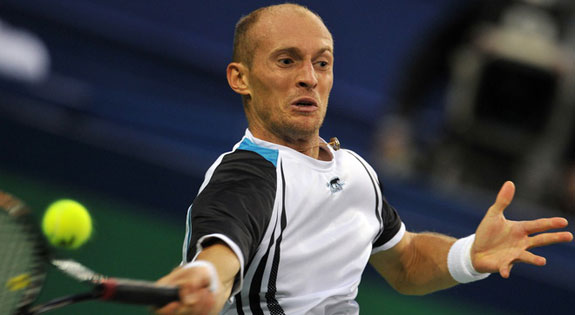
The 23-year-old will face Nikolay Davydenko in Sunday’s final after the Russian sprang an upset on second seed Novak Djokovic with a 4-6 6-4 7-6 victory.

Nadal, who benefited from Ivan Ljubicic’s withdrawal to reach the last four, has not played a tour final since May’s Madrid Masters as knee and abdominal injuries disrupted his season.

“I was playing well today,” he told reporters. “I’m in the final which is very good news for me. I’m very happy, it’s my first final since my comebcak from injury.”

Lopez found an ace to help him win the opening game of the match but from then on Nadal dominated, winning the next six in a row and claiming the first set when his opponent went long.

The world number 41 turned his right ankle on that point and the match was over as a contest, Lopez bringing it to its inevitable conclusion 21 minutes later.

Lopez’s retirement can only fuel the debate about the length of the men’s season, which was sparked on Monday when Andy Roddick branded it ‘ridiculous’ and said it threatened to shorten the careers of the top players.

Sixth seed Davydenko lost twice to Djokovic at the Masters Cup here last season but was an altogether different proposition on Saturday.

The 28-year-old kept Djokovic under pressure throughout the three-hour contest before running away with the deciding tiebreak 7-1.

“The match today was long and heavy,” Davydenko told reporters. “This was really difficult all match. I was lucky, he was lucky. In the tiebreak, I was more lucky.”

Serbian Djokovic, who was chasing back-to-back titles after his win in Beijing last Sunday, left the court dejected after falling to his first defeat in his last 11 matches in China.

“I’m disappointed because I think I played a great match but overall these two weeks have been great for me,” said the 22-year-old, who will move back to world number three next week.

After a string of errors gave Djokovic the first set, Davydenko mixed things up more in the second and earned his reward when he evened the match up with an ace.

The Russian kept up his pressure on his opponent’s serve in the decider without ever making the breakthrough but was 5-0 up in the tiebreak before his opponent registered a point.

He claimed victory with a crushing forehand winner to take his place in his fourth final of the year, two weeks after winning his third title of the season at the Malaysian Open.

Primary Sidebar

Search the site

Randy Walker

Michael Zheng Caps Historic Sports Weekend For Columbia With NCAA Singles Title (Played In The Fall This Year)

November 24, 2024 By Admin

The Winding Final Year of Rafael Nadal’s Career Meets Its End In The Davis Cup Finals

November 19, 2024 By Admin

Ukraine Wins BJK Cup Match In Texas On Same Day When Russia Slams Their Nation With Over 200 Missiles

November 18, 2024 By Admin

Daniel Nestor Snubbed For Tennis Hall of Fame One Year After Slightly Less-Accomplished Leander Paes Gets Inducted

October 24, 2024 By Admin

More Posts from this Category

Sell your home fast in New York

Recent Posts

  • Neale Fraser Achieved (And Experienced) Things At The U.S. Championships That May Never Be Repeated
  • Common Racquet Mistakes
  • Juan Martin del Potro Bids Goodbye To Competitive Tennis In Exhibition Against Novak Djokovic

Popular Links

  • ATP World Tour
  • Tennis Grandstand
  • USTA
  • WTA Tour

Footer

Contact Us

c/o Randy Walker

Owner

1175 York Ave

Suite #3s

New York, NY 10065

Recent

  • Neale Fraser Achieved (And Experienced) Things At The U.S. Championships That May Never Be Repeated
  • Common Racquet Mistakes
  • Juan Martin del Potro Bids Goodbye To Competitive Tennis In Exhibition Against Novak Djokovic
  • Patrick Mouratouglou Talks About New Zephyrhills, Florida Tennis Academy
  • Juan Martin del Potro “Farewell Match” Against Novak Djokovic Sponsored By Aleph

Search

Copyright © World Tennis Magazine 2021 and beyond