• Skip to main content
  • Skip to secondary menu
  • Skip to primary sidebar
  • Skip to footer
World Tennis Magazine

World Tennis Magazine

Unique Tennis Perspectives

  • Home
  • World Tennis with Harry Cicma
  • Staff
  • About
  • Contact Us
  • Forum

majors

An Assessment of American Men’s Tennis

December 13, 2010 by Charles Bricker

Andy Roddick will, presumably, begin the 2011 season in sharp physical condition after his year of maladies in 2010, and good buddy Mardy Fish, now at a career best No. 16, is expecting to remain in high form, too, when the ATP Tour begins again in January.

But for those who have a watchful eye on the future of U.S. tennis, Ryan Harrison should be getting most of the scrutiny.

Harrison won’t be 19 years old until just before the French Open, but in his first full year on tour this season he’s jacked his ranking up 185 points to No. 173 and, though he’s still playing with the usual fits and bursts one expects from a teenager, he’s exhibited enough of a flash to suggest there are a lot of good things ahead.

If you’re judging U.S. tennis on the basis of Grand Slam results, this wasn’t a successful year. No one, including Roddick, reached a semifinal and Fish, for all his well-publicized weight loss and 40-14 won/lost record, didn’t perform well at the majors.

Ryan Harrison

Still, this was, overall, a solid year for American tennis.

On the plus side: (a) Roddick is still top-10 at No. 8, (b) Fish is at an all-time best ranking, (c) the younger talent, Sam Querrey at No. 18 and John Isner at No. 19, seem entrenched now in the top 20, (d) and there is Harrison, a pugnacious young man who put on as good a show at the U.S. Open as we’ve seen from an American male teenager in a long time.

On the downside: (a) At 28, one has to wonder whether Roddick is at a point in his career where, no matter how hard he trains off-court, he’s going to pick up injuries, (b) Fish hasn’t proven he’s a force at the majors, (c) Isner didn’t play nearly as well in the second half of the season as he did in the first, (d) Querrey needs to find more consistency against the best players and (e) other than Harrison, there wasn’t much to cheer about among the younger U.S. players.

The U.S. began the season with nine players in the top 100 — Roddick, Querrey, Isner, James Blake, Fish, Taylor Dent, Rajeev Ram, Michael Russell and Robby Ginepri. There are five top-100s this week.

Time to break them all down.

* Roddick: Began 2010 at No. 7, will finish the year at No. 8 for a marginal -1. Splendid start to the year. Won Key Biscayne after a quarters finish at the Aussie Open. Didn’t play the clay season or Davis Cup in order to keep himself at a higher fitness level, but it all came apart with a case of mononucleosis and then joint problems. Had a 44-18 record overall with two titles. There was a bad round of 16 loss at Wimbledon, went out 3rd round at the French Open, second round at U.S. Open. It’s difficult to judge his year with the physical setbacks he’s had, but if he can minimize his inevitable injuries, I think he’s close to maximizing the talent he has.

* Fish: Up from No. 55 to No. 16 for a +39 jump this year. His weight loss has been well documented and no doubt it has improved his movement and confidence to stay in the longer rallies. Was 40-14 with two titles. In the majors, 1st round Aussie Open, 2nd French Open, 2nd Wimbledon, round of 16 at the U.S. Open. At 29 years old, he has to work harder than ever off-court to maintain what he’s achieved.

* Querrey: Q-Ball is +7, from No. 25 to 18 this year — 39-24 record with four titles and — this is significant — one on clay at Belgrade. At 23, it’s all in front of him. High moment came with a win over Andy Murray in theLos Angeles final, but he was smitten hard at the U.S. Open, losing a long, gripping five-setter to Stan Wawrinka in the round of 16. Other Slam results: 1st round at the Aussie Open and French Open, round of 16 at Wimbledon. One trouble statistic. He was only 3-8 against top 20s this year. Also, only 1-5 after the dejecting loss in New York.

* Isner: He’s a +15, going from No. 34 to No. 19. We all know what his big moment was this season, though it could be more accurately called a big 11-hour moment, if that makes sense. He defeated Nicolas Mahut in what will be one of the four or five most memorable matches in tennis history. And he played well two weeks later in Atlanta, where he lost in the final. But he seemed tired throughout the U.S. hardcourt season. He was 38-24 overall, but only 12-9 since Atlanta. At age 25, he’s often twinned with Querrey. Because of his bigger serve and his volleying ability, Isner can be top 10. He’s going to use this off-season to further strengthen himself off-court. One piece of advice: Stay out of 11-hour matches.

* Russell: He’s included here because he’s at No. 99, down 16 from last year. Mighty Mouse is 32 years old and has had more injuries than half these other players combined. But he’s still good enough to have made $322,000 this season, and no one is going to retire with that income potential. He was only 11-23 in ATP matches, but built his ranking and bank account in the Challengers, where he was 10-4 with a title. He’ll be in and out of the top-100 until he decides to start a second career.

Fallen top-100s.

* Blake: At 30 and with chronic knee problems, we’re not sure what sort of future James has in pro tennis. He’ll start next year at No. 135, a -91 fall from the start of 2010. Just 15-17 for the season. Had a good win over Tomas Bellucci at Stockholm a couple months ago, but then went down easily to Jarkko Nieminen two rounds later by 6-0, 6-2.

* Dent: Retired after a brave comeback from back surgery.

* Ram: Plunged 106 spots this year to No. 185. Reached top 100 with Challenger success, but you have to come back the next year and defend the points. He didn’t.

* Ginepri: At No. 144, it’s hard to see him playing much longer.

Three young players of note.

* Donald Young: Hard to believe he’s been part of the U.S. tennis consciousness for seven years now, but he’s only 21. He moved up 66 spots to No. 128 this year. Was 29-14 in Challengers, only 3-6 in ATP matches. He’s a complete mystery.

* Ryan Sweeting: Like Young, a junior Grand Slam titleholder. Up 38 spots to No. 116. At 23, there’s still time and he’s got a big enough game that he could make some inroads, but no one sees him any longer as an impact player in U.S. tennis.

* Harrison: Here is the key figure for U.S. tennis in 2011. If you look at his numbers, they’re not overwhelming — 4-9 in ATP matches, 13-12 in Challengers. But at 18, you’re looking for individual moments in his performances, not numbers. And at the U.S. Open, he upset Ivan Ljubicic, then lost to Sergiy Stakhovsky in five after holding three match points. That performance told us he can compete strongly with players in the 30-50 ranking range and that he’s not intimidated by big stages or big moments. What we’re looking for in 2011 is better week-to-week consistency at the Challenger level and spot brilliance when he plays regular ATP events. Don’t push this kid too hard. He’s young, he’s talented and while he doesn’t have Roddick’s big serve, he’s got Roddick’s bring-it-on attitude.

WTA Tour Rankings Under Scrutiny After Major-Less Wozniacki Clinches No.1

October 8, 2010 by Charles Bricker

On Monday, when the new rankings are official, Caroline Wozniacki will become the fifth woman to reach No. 1 without having won a Grand Slam singles title, but the Sony Ericsson WTA Tour has no plans “at this time” to redesign its ranking system.

That was the word from a spokeswoman from the women’s tour, who was unquestionably quoting someone very high in the organization.

There hasn’t been the slightest debate about Wozniacki having earned the No. 2 ranking weeks ago, but somehow the idea of her reaching No. 1 without a major is certain to bring the women’s rankings once again under scrutiny.

She’ll replace Serena Williams at No. 1, but does that make her a better player? That’s the question that will key the rankings debate, but, when you get to the bottom line, there’s very little the women’s tour can do to make the rankings more accurately reflect who’s No. 1.

Caroline Wozniacki

It has to be based on a point system so that it’s objective, and the more you win, the more points you get. If you win enough and the player who was No. 1 plays relatively little, the point system is going to reward the Wozniackis of the WTA Tour.

And Kim Clijsters, who was first to reach No. 1 (2003) without having won a major. Amelie Mauresmo (2004) was second, Jelena Jankovic third (2008) and Dinara Safina fourth (2009). Clijsters and Mauresmo eventually won majors, but Jankovic and Safina have not.

So, why is Serena Williams being demoted to No. 2? She has played only 14 tournaments in the last 52 weeks to Wozniacki’s 24. She has a 24-5 record for the year with titles at the Australian Open and Wimbledon — both worth 2,000 points. But because players have to “defend” the points they earned at that tournament 52 weeks earlier, Williams has been largely treading water with her wins, and she’s played only six events in 2010.

She began this season with 9,075 points and, despite her prodigious won/lost record, her point total has dropped because of injury and a personal choice not to play the point-rich event at Indian Wells, Calif., to 6,995 this week. She’ll also lose another 140 points from this week’s China Open, leaving her on Monday with 6,855. Plus, it’s unclear when she’ll be back on court following foot surgery right after Wimbledon.

Meanwhile, Wozniacki has gone from a No. 4 ranking at the beginning of the year with 5,875 points to at least 6,930 when the Monday rankings are announced. That’s really not much of an increase for someone with 56 wins (15 losses), but because of the way the rankings are organized she ascends to No. 1.

By reaching the quarters in China on Thursday, she is currently 75 points ahead of Serena, and of course can increase that if she continues to win.

Is it a fair system?

It’s hard to see what else the WTA can do. When you have a No. 1 who not only wins Grand Slams but plays a vigorous schedule, like Steffi Graf, the system seems eminently fair.

But when you have a No. 1 who has played only six tournaments this year, you can advance the argument that she may be, on paper, the better player, but that she has to continue justifying her No. 1 ranking by playing more.

There was a time when the WTA gave “quality points,” a bonus that was based on the ranking of the defeated player. They did away with that for a number of very good reasons, adopting essentially the same system used by the ATP Tour.

And while there will be those who complain that Wozniacki doesn’t deserve to be No. 1, no one is arguing that Pete Sampras, Roger Federer and now Rafa Nadal don’t deserve to be No. 1 among the men. There may be some marginal differences in the two ranking systems, but they’re essentially the same.

Nadal Silences Doubters with Historic US Open Victory

September 14, 2010 by Charles Bricker

He’ll never last. He plays too hard and his knees won’t hold up. Wrong.

He’s too young at 24 to win the career Grand Slam — titles at the Australian Open, French Open, Wimbledon and the U.S. Open. Wrong again, as of 10 p.m. Monday night.

He’ll never win the U.S. Open because the courts are too fast. Wrong again. And again and again.

You saw it. And if you didn’t. . .if you weren’t there to witness Rafa Nadal win his ninth major by 6-4, 5-7, 6-4, 6-2, you missed a momentous evening and more than three hours of power tennis and great shotmaking.

Rafael Nadal wins career Grand Slam

The match unfolded pretty much as I expected with Novak Djokovic playing very strong tennis through the first two sets. But when you play Nadal in a Grand Slam final, the match is seldom settled in the opening sets. If you’re going to beat Nadal, start fast, because he’s not often out-gutted in a four- or five-set match.

Right on form, midway through the third set Djokovic began to slow, just enough to give Nadal the edge he needed to take control. And then Nadal’s serve, which had been OK but not dominating in the early going, clicked in and he separated from his Serbian foe.

The final set was a rout with Djokovic playing riskier tennis, trying to end the points quicker and staying out of the long points that have a cumulative fatiguing effect on Nadal opponents.

And so Rafa at age 24 years and three months has his ninth Grand Slam title. Roger Federer won his ninth at age 25 years and one month. Could Nadal win three more majors by the time he reaches Federer’s birthday (Aug. 8).That would be a tough bet to take. But after what he’s done this year, why not.

He did it, and by doing so, educated a virtual army of doubters coming into this Slam.

* Remember “his knees won’t hold up?” He had effectively lost a year to tendonitis in 2009, beaten early at the French and unable to defend his Wimbledon title. But tendonitis is not a structural problem. It can be dealt with and Nadal and the team around him smartened up about how he practices and how often he plays.

He cut back his workouts, which became shorter but without any loss of intensity. After winning Monte Carlo this year, he decided not to play Barcelona — to rest his body. This could not have been an easy decision because Barcelona is the closest thing he has to a hometown tournament. But he did the right thing for his fitness.

After Wimbledon, he took three weeks off and played only the two ATP 1000s leading up to the U.S. Open — at Toronto and Cincinnati. He didn’t win either, leading some to believe that he wasn’t adequately ready for New York.

* Remember “he’s too young to win a career Grand Slam?” Why? You have to be a certain age to win it? He had already shown the world that he could go from clay court maven to grass court champion. How could you doubt his commitment to winning on any surface. The U.S. Open stadium court is faster than the stadium at the Aussie Open, but it’s still hardcourt tennis, and he had won the Australian. There was no reason why he couldn’t win the U.S. Open as well.

* Remember “the courts are too fast in New York?” Of all the reasons people gave why Nadal wouldn’t win the Open, that was the most confounding. The courts at the Open indeed are fast — probably the fastest of any ATP hardcourt tournament. But Nadal had won Wimbledon twice. Are the Open courts faster than Centre Court at Wimbledon?

He’s going to take a long rest after this one to recover both physically and emotionally and we’ll next see him somewhere indoors in Europe and then at the ATP Championships in November in London.

He came to New York as No. 1. He’ll leave as No. 1 and probably be No. 1 at the end of the year. If you didn’t realize tennis had moved into a new era with his second triumph at Wimbledon this year, you know it now.

Pressure flakes: The roller-coaster ride of highs and lows in pro tennis

August 24, 2010 by WTM

The U.S. Open is the last of the four majors in the calendar year, but only three-quarters of the roller coaster ride of professional tennis. Each day, players lose, players win and experience a wide variety of emotions in a sport where many of the competitors are in their early 20s and still learning to mature and grow into adults and still working out the travails of life.

Cliff Richey was the best American tennis player on the planet 40 years ago in 1970 and experienced the same pressures of the modern pro tennis player. Richey discusses these emotional fluctuations in the context of his suffering from a disease that affects millions around the world – depression.

In this exclusive excerpt from the book ACING DEPRESSION: A TENNIS CHAMPION’S TOUGHEST MATCH ($19.95, New Chapter Press, www.CliffRicheyBook.com) written by Richey and his daughter Hilaire Richey Kallendorf, Richey discusses the pressures of tennis in this excerpt from the chapter called “Pressure Flakes.”

From 1964 through 1970, I didn’t worry about my skills too much. Success is as intoxicating as a drug. It just feels great. You get instant approval. The crowd hollers. They give standing ovations. You walk away with a trophy. You go back to the locker room, and everyone congratulates you. You get headlines in the next day’s newspaper. You have confidence in yourself. You’re on a roll. It’s all the affirmation that kids (and later, adults) want in life. There’s an adrenaline rush. It’s a real thrill. It feels like drinking about eight cups of coffee. Ecstasy would be putting it mildly. You feel lit up. You can’t turn off your motor. It’s revved up and it stays revved.

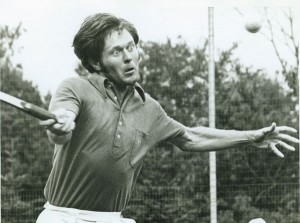
Cliff Richey

Once you’ve felt that, you want it again. You start chasing that next victory. Society puts its stamp of approval on winning. I’ve heard other athletes talk and they say once they retire, they can never find anything to match the thrill of the ball field. The cortisol, the “fight or flight” hormone, actually changes your brain chemistry. It also makes you more prone to disease: heart trouble, cancer, hypertension. You ride that crest during the “up” periods of accomplishment. You get addicted to the highs like a drug. I would like to know the percentage of how many ex-athletes become drug addicts and alcoholics.

At the start of the season in 1968, I pulled a rib muscle. It took a full month to heal. Once I could play again, I only had ten days to prepare for the U.S. Indoor Championships in Salisbury, Maryland. I beat Jan Leschly, Stan Smith and Clark Graebner to win the title. It was a huge win. But after winning the U.S. Indoors, I crashed very hard, very fast. It almost didn’t seem possible to sink that low after being so high. I’ve always experienced volatile emotional content. One of the problems with depression in general is that rather than recognizing it as a disease, you rationalize it as, “Oh, I’m just going through a difficult time right now.” That’s what happened with me after the U.S. Indoors. I would come back from a tournament, and it would take me 10 days to feel normal again. In hindsight, I think some of that was low-grade depression. Dad used to say: “As fit as you are, there’s something wrong if it takes you that long to recover.”

By the laws of physics, what goes up must come down. The cycle of competition and gearing up for a tournament fosters a crash after it’s over—much more than, say, a typical 9-to-5 job. There are performance anxieties, stage fright. With my drive and type-A personality, there was probably also a touch of bipolar there. When you lose a match, that insecure, anxious feeling takes away your self-esteem completely. You feel worthless. My drive for success on the court was in part a desperate attempt to ward off recurrent bad moods. I lived from one victory to the next.

I did let myself enjoy some of my victories on the tennis court. At least, I think so. But one of the bad things about any tour is, if you play more than just a few in a row, you’re never able to sit

back and enjoy it as much as you’d like. You certainly can’t enjoy it for very long. You know you have to get back to business, to begin training for the next one. I was always already thinking about the next match.

Normally, for a tournament, we had either a 32- or 64-man draw, so you had to win either five or six matches to win the title. That means you only had a few hours to enjoy each win. In that setting, if you don’t start immediately preparing for the next match, you’ll fall flat. Your job isn’t over. You have to play another one the next day, so you have to be disciplined. You don’t have time to gloat. You’d better not be thinking about your last win too long or too hard, because your matches only get tougher as you go.

“Adverse pressure” is the term Dad always used to describe the pressure to produce again once you’ve already succeeded. You can win two tournaments in a row and go on to the third and still have someone ask you, in essence, “What have you done for me lately?”

It’s like what I used to tell Jimmy Connors. Much later, in 1975, when we were practicing a lot together in England leading up to Wimbledon, he was feeling stressed out about defending his Wimbledon title. One evening over dinner I said, “Jimmy, here’s what you’ve got to do. You won it last year, and the trophy is in your trophy case. Now to win it this year, you have to psychologically take that trophy out of your case and put it back on the common shelf.

You ain’t defending shxx! The day Wimbledon starts, you’re competing for it all over again just like everybody else.” The up side to anxiety, if there is one, is that it drives you toward success. The moderate down moods even help too (they call this dysthymia, or low-level depression) by motivating you to get out there and succeed in order to feel better. You learn to counteract pain with the tonic of success. When dysthymia hits you, it drives you on. It tells you that you aren’t very good. You try to smother feelings of inadequacy by being creative and successful. Even when you win, that insecurity keeps telling you: “You still aren’t good enough.” It propels you into wanting to become even better. I had no bad depression before the age of 22. Perhaps that was at least partly due to the fact that up to that point, I had experienced very few losses. I still won most of the time. In 1969, I had some depression and some anxieties that were just awful. The absolute stark depression wasn’t there at the beginning, but there were some early warning signs: nervousness, extreme highs and lows, severe irritability.

It was a good year, play wise. In fact, it was the second-best year of my career. Winning the Canadian Open—beating Butch Buchholz in the final—was the highlight. The entire year was pretty much around-the-clock training and playing. If you’re playing well, you’re playing five matches a week. I always liked to be on the go. I’m an A-type. I have a lot of nervous energy. I think people with type-A personalities are, in general, more prone to depression. I have the agitated kind of depression, where your metabolism actually speeds up.

I also bite my nails. It’s a nervous habit. All the stress I was experiencing that year started to manifest itself in my sleep. I used to have very vivid dreams of winning one of the four Grand Slam tournaments. They felt so real that when I woke up, I was disappointed. I used to have a recurring dream where I was in the locker room, getting my court bag together. I was in the process of putting my tennis clothes on, or maybe taping a finger. All of a sudden, it would be just before the start of the match and I couldn’t get out of the locker room! They finally had to default me. That was one of my frequent anxiety dreams. In all probability, it was during those sorts of dreams that I first started grinding my teeth. It was during that period that I was diagnosed with temporomandibular joint syndrome, a jaw disorder known as TMJ. I clenched my jaw so hard, it started to crack my teeth. I had to get crowns. I sustained a lot of dental damage before it was properly treated. Most of the teeth in my mouth are cracked.

During the daytime, when I played tennis, the stress started to manifest itself in other ways. When I’m excited, my eyes get so big, they look like they’re about to pop out of their sockets. My eyes would dilate from the excitement of battle. I also tended to hyperventilate, another classic “fight or flight” response. Hyperventilation can produce leg cramps, because your system gets permeated by too much oxygen. I had those quite a few times in my career.

Cramping is an awful thing. It can hit you out of nowhere and basically incapacitate you. Any type of inactivity, a 10- or 15-minute break, can make the muscles start to spasm. I learned never to go into an air-conditioned locker room during the break between sets, because the cold air can also make you cramp.

But just because I was cramping, that didn’t mean I gave up. Only once did I not keep playing and finish the match even though I had muscle cramps. That happened in Paris. I was cramping so badly, I couldn’t even stand up! Five guys had to lift me up like a piece of lumber and carry me away. A little later in my career, when I was in the process of winning a five-set final match in Fort Lauderdale in 1971, I started to get leg cramps during the fourth set. Someone suggested to me that I should try breathing into a paper bag. I followed that suggestion, and it actually helped. The newspapers had fun with that incident as one of the headlines read: “Richey Paper-Bags it to Victory.”

A lot of amateurs think that if you put yourself under the heat enough times, eventually you get to a point where competition doesn’t vibrate your soul. That you get to a point where you’re not nervous any more. Well, guess what? It’s not like that. I played 1,500 competitive matches in 500 tournaments over 26 years. You get “up” and nervous for every single match—out of fear. Each one is life or death. You’re never immune to that pressure.

I’m a competitive person. That’s what I do. It would almost be more surprising if I didn’t scare people. You don’t just turn into this nice, friendly, non-combative, congenial person during your off time. It’s still bare-teeth competition. Mickie’s kid brothers used to say I ate “pressure flakes” for breakfast. If I could have found some, I would have eaten them, that’s for sure!

The tour was an escape mechanism, in a sense. It gave me places to go, places to run from my troubles and worries. Anxieties have a lot to do with constantly being on the move. That’s the definition of anxiety. You constantly feel like you could be doing more. Anxieties also create self-doubt. I practiced more than most people because I constantly doubted my abilities. Insecurity is a double-edged sword: it makes you more productive, but it also slices you up into tiny little pieces. You’re like a frog in a pot of boiling water. When the temperature is turned up, at first, you don’t notice; but the next thing you know it, baby, you’re cooked!

HINGIS TO COME BACK AGAIN?

June 10, 2010 by WTM

By McCarton Ackerman

After two retirements and a two year ban for testing positive for cocaine, tennis legend Martina Hingis still isn’t ready to walk away for good.

The Associated Press reported that World Team Tennis founder Billie Jean King said Hingis is “testing the waters” this summer for a doubles-only comeback to the WTA Tour.

Hingis is scheduled to compete in World Team Tennis this July, playing 14 matches for the New York Buzz. In addition to playing exhibition singles matches against Olga Savchuk and Michaela Krajicek at the Nottingham Masters event this week, Hingis is also scheduled to pair up with Anna Kournikova in the legends doubles event at Wimbledon.

Hingis, 29, is a winner of nine Grand Slam women’s doubles titles and one mixed doubles title, and completed a calendar slam in 1998, winning all four majors. She also held the No. 1 doubles ranking for a period of 35 weeks. Her last title came at Doha in 2007 with Maria Kirilenko.

LEANDER PAES DOUBLES TALK

March 26, 2010 by WTM

By Charles Bricker

When it’s time to compile a list of the top 10 players to interview, based on intelligence and candor, you cannot fail to put doubles maven Leander Paes near the top.

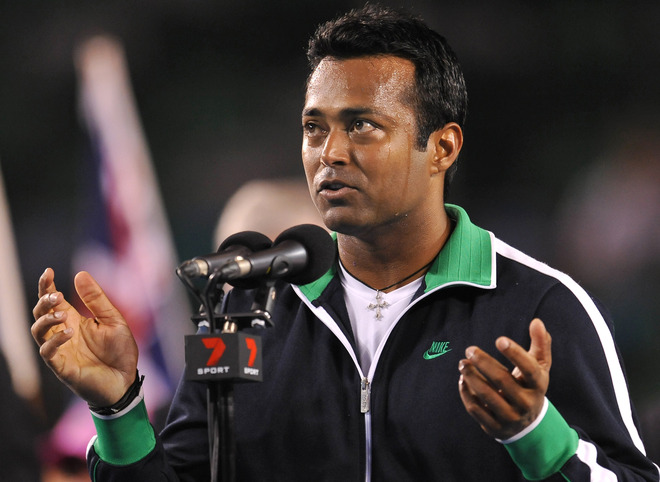
Leander Paes
Leander Paes

Twenty minutes with Paes unfailingly results in some of the most interesting conversation in tennis and any reporter with any smarts will spend time with him in the coming 10 days at the Sony Ericsson Open on Key Biscayne, where he is teaming with Lukas Dlouhy in a quest for a 43rd ATP title. Individually, Paes is No. 6 in the doubles rankings and he and Dlouhy, who won two majors in 2009, are No. 8 in team rankings.

Here’s a sample of Paes-isms:

* The third-set super-tiebreak, along with no-ad scoring, is into its third full year. Is it time for the tour to revisit the concept and perhaps go back to playing regular tennis? “No. The way the game of doubles is scored now is exciting for the fans. For sure, the super-tiebreak gives the lesser teams more of a chance. But I think the system is better for doubles. It gets us more night matches, more matches on the stadium court (because you can predict the matches will be over in approximately one hour and 15 minutes). It’s also getting more top singles players to play doubles, like Rafael Nadal at Indian Wells, and, yes, you are right. It is lengthening the career of doubles players. Exactly right.”

* Paes and Dlouhy had just blown a 9-4 lead in the super-tiebreak of the championship match at the BMW Challenger in Sunrise, Fla. How much longer can you play? “The fact that I can lose a tough match like that and still hate to lose. . .Well, hate is a strong word, but the point is I’m still OK to handle it. I can still take the attitude that sometimes that’s the way the cookie crumbles.”

* Do you accept that the Woodies (Mark Woodforde/Todd Woodbridge) and the Bryan twins are better doubles teams that when you and Mahesh Bhupathi were at the top of your game? “The Woodies definitely. They are much more the complete team. They don’t have any weaknesses. They could play from the baseline or at the net. They could play one up, one back or both back or both at the net.” What about the Bryans? “They are a hell of a team, and the fact that they are twins helps them know what the other is thinking.”

* So, who goes down in history as the greatest doubles team ever? “The Woodies or McEnroe/Fleming. One of those two.” Paes believes that Grand Slam titles is the key. The Bryans have eight, McEnroe/Fleming have nine and the Woodies 11. Bob Bryan has 58 tournament titles, brother Mike 60, McEnroe 71 and the Woodies 61. “For the Bryans to be considered, they have to pass the Woodies in Grand Slam wins.”

* Suppose you could pair up Pete Sampras and Roger Federer as a doubles team, give them a week of practice and then play them in a series of 10 matches against a doubles team that not only was at the top of the rankings but that had been together for years. Is doubles so specialized that two of the greatest tennis players couldn’t beat a couple of guys who could never make a real impact in singles? “Sampras and Federer? They wouldn’t have a chance. Federer could be a great doubles player, but Sampras . . . He wasn’t that good at it. I’ve played him in doubles four times and won every time. Maybe he didn’t care about it that much.”

* Somdev Devverman, the former University of Virginia player from India (current No. 120). . . how good will he be? “No problem top 100, but top 50? Only time will tell. He is a very hard worker. and his maturity is the best weapon he’s got. His mind is very stable and sound. But he needs more weapons — a bigger first serve and he could flatten out his forehand more.”

* Final question. Best Indian restaurant on the ATP tour outside of India? “Ah, Quilon in St. James Court in London. And right here in Fort Lauderdale is Woodlands.” I threw out one of my favorites and got slightly burned. What about 4,550 Miles To Delhi in Nottingham, England? “Not a bad one,” said Paes. “But it has dropped a bit recently.”

Charles Bricker can be reached at nflwriterr@aol.com

WHAT IF THE THE AUSTRALIAN OPEN FINAL WAS TODAY??!!

March 14, 2010 by WTM

By Randy Walker

How would you feel – and how would the tennis world be better or worse – if the finals of the Australian Open were played today? Well that was the case 39 years ago when the men’s and women’s singles finals at the 1971 Australian Open were played in Sydney. The following is the excerpt from the March 14 chapter of the book ON THIS DAY IN TENNIS HISTORY ($19.95, New Chapter Press, www.TennisHistoryBook.com)

1971 – Margaret Court and Ken Rosewall win singles titles at the Australian Open at White City in Sydney, Australia. Court defeats first-time major finalist and fellow Australian Evonne Goolagong 2-6, 7-6 (1), 7-5 to win her country’s national championship for the 10th time in the last 12 years. Goolagong leads 5-2 in the final set, before she is beset with cramping in her leg. Says Court of the final-set deficit, “I thought I’d had it. I don’t think I played particularly well, but when Evonne got the cramp, I took advantage.” Court’s title is her sixth straight major singles title on the heels of her 1970 Grand Slam sweep of all four majors. Rosewall defeats defending champion Arthur Ashe 6-1, 7-5, 6-3, benefiting from 13 Ashe double-faults. Ashe hits four double-faults alone in the sixth game of the match as Rosewall wins the first set in just 19 minutes. Says Rosewall, “I think Arthur lost confidence when his service was not going too well.”

Primary Sidebar

Search the site

Randy Walker

Michael Zheng Caps Historic Sports Weekend For Columbia With NCAA Singles Title (Played In The Fall This Year)

November 24, 2024 By Admin

The Winding Final Year of Rafael Nadal’s Career Meets Its End In The Davis Cup Finals

November 19, 2024 By Admin

Ukraine Wins BJK Cup Match In Texas On Same Day When Russia Slams Their Nation With Over 200 Missiles

November 18, 2024 By Admin

Daniel Nestor Snubbed For Tennis Hall of Fame One Year After Slightly Less-Accomplished Leander Paes Gets Inducted

October 24, 2024 By Admin

More Posts from this Category

Sell your home fast in New York

Recent Posts

  • Neale Fraser Achieved (And Experienced) Things At The U.S. Championships That May Never Be Repeated
  • Common Racquet Mistakes
  • Juan Martin del Potro Bids Goodbye To Competitive Tennis In Exhibition Against Novak Djokovic

Popular Links

  • ATP World Tour
  • Tennis Grandstand
  • USTA
  • WTA Tour

Footer

Contact Us

c/o Randy Walker

Owner

1175 York Ave

Suite #3s

New York, NY 10065

Recent

  • Neale Fraser Achieved (And Experienced) Things At The U.S. Championships That May Never Be Repeated
  • Common Racquet Mistakes
  • Juan Martin del Potro Bids Goodbye To Competitive Tennis In Exhibition Against Novak Djokovic
  • Patrick Mouratouglou Talks About New Zephyrhills, Florida Tennis Academy
  • Juan Martin del Potro “Farewell Match” Against Novak Djokovic Sponsored By Aleph

Search

Copyright © World Tennis Magazine 2021 and beyond