• Skip to main content
  • Skip to secondary menu
  • Skip to primary sidebar
  • Skip to footer
World Tennis Magazine

World Tennis Magazine

Unique Tennis Perspectives

  • Home
  • World Tennis with Harry Cicma
  • Staff
  • About
  • Contact Us
  • Forum

lawn tennis club

Mary Joe Fernandez and Jay Berger named coaches of 2012 U.S. Olympics tennis teams

June 5, 2012 by WTM

WHITE PLAINS, N.Y., June 5, 2012 – The USTA, the governing body for the sport of tennis in the U.S., announced today that U.S. Fed Cup Captain Mary Joe Fernandez and Jay Berger, USTA Player Development Head of Men’s Tennis, have been named as the women’s and men’s coaches for the 2012 U.S. Olympic Tennis Teams. In addition, Dan James, Head U.S. National Wheelchair Team Coach, has been named coach for the U.S. Paralympic Wheelchair Tennis Team.

Mary Joe Fernandez (L) and Jay Berger (R) named 2012 U.S. Olympic tennis team coaches

The 2012 Olympic Games will be held July 27 – August 12 in London, England, with the tennis competition being staged July 28 – August 5 at the All England Lawn Tennis Club at Wimbledon. The 2012 Paralympic Games will be held August 29 – September 9 in London with the tennis competition scheduled for September 1-8 at Eton Manor in the Olympic Park. The Olympic competition will begin 20 days after the completion of The Wimbledon Championships.

“With Olympic tennis being held at the hallowed grounds of Wimbledon, the Olympics add another dimension to what will be a memorable summer of tennis,” said Jon Vegosen, Chairman of the Board and President, USTA. “Tennis as a sport benefits greatly from being showcased on such a prestigious international stage as the Olympics. Each of the coaches who will be representing the U.S. brings experience as an accomplished player and coach, with a unique ability to connect with the athletes to lead our quest for 2012 gold.”

“I’m honored and thrilled to be selected as the Olympic coach,” said Fernandez, who led the U.S. Fed Cup team to the final in two of her first three years as Captain. “Some of my fondest tennis memories are from the Olympics and the incomparable thrill of winning a gold medal. I would like nothing more than to share in that Olympic experience with our team this summer.”

“We have some very strong players who should all be medal contenders in London,” said Berger, who has been the USTA Player Development Head of Men’s Tennis since 2008. “I know the American men have been looking forward to competing for gold at Wimbledon, and will relish the opportunity to compete on one of the biggest stages in sport.”

The 2012 U.S. Olympic Tennis Team will consist of up to six men and six women, with a maximum of four men and four women competing in the singles competition and a maximum of two men’s and two women’s teams competing in doubles. The U.S. will also be able to place a maximum of two mixed doubles teams in the competition, which will be contested at the Olympic Games for the first time. Olympic Team nominations will be made using the ATP World Tour and WTA rankings as of June 11. All team and staff nominations are subject to approval by the U.S. Olympic Committee.

The United States has won 17 Olympic medals in men’s and women’s tennis since its return as a full medal sport in 1988 – more than any other nation. U.S. players have won 12 medals at the Paralympic Games, including a gold and a bronze in 2008.

The 2012 U.S. Paralympic Wheelchair Tennis Team will consist of a maximum of four men and four women in the wheelchair singles competition, with no more than two doubles teams in the wheelchair doubles competition. In the quad wheelchair competition (limited movement or strength in at least three extremities), a maximum of three players may compete in the event, with a maximum of three in the singles event and one team in the doubles event. Team nominations will be based on ITF Wheelchair Tennis World Rankings as of May 21, 2012, and are subject to approval by the USOC.

“The Paralympics is the ultimate platform for worldwide competition among outstanding wheelchair athletes,” said James. “It is a tremendous privilege to coach at the highest level of international play and I am eager to begin our quest for medals.”

Wheelchair tennis was introduced to the Paralympic program in 1988 as an exhibition event before becoming a full medal sport at the 1992 Paralympic Games in Barcelona. Paralympic tennis is an open competition, eligible to those athletes with a mobility-related disability and all competitors must compete in a wheelchair.

The USTA was officially designated by the USOC as the national governing body for the Paralympic sport of wheelchair tennis in June 2002, becoming the first Olympic national governing body to earn this recognition. As the national governing body for wheelchair tennis, the USTA manages wheelchair tennis in the United States, including the sanctioning of tournaments, overseeing the ranking systems, creating and managing a High Performance program for developing elite disabled athletes and coaches. The U.S. Olympic Committee will approve all team and staff selections.

# # #

The USTA is the national governing body for the sport of tennis in the U.S. and the leader in promoting and developing the growth of tennis at every level — from local communities to the highest level of the professional game.  A not-for-profit organization with more than 785,000 members, it invests 100% of its proceeds in growing the game. It owns and operates the US Open, the highest attended annual sporting event in the world, and launched the Emirates Airline US Open Series linking 10 summer tournaments to the US Open. In addition, it owns the approximately 90 Pro Circuit events throughout the U.S, and selects the teams for the Davis Cup, Fed Cup, Olympic and Paralympic Games. The USTA philanthropic entity, USTA Serves, provides grants and scholarships and helps underserved youth and people with disabilities. For more information on the USTA, log on to usta.com, “like” the official Facebook page facebook.com/usta or follow @usta on Twitter.

Wimbledon primetime staying put on Tennis Channel through 2023: This Week in Tennis Business with Justin Cohen

October 19, 2011 by Justin Cohen

Wimbledon Primetime to air on Tennis Channel through 2023

According to a recently released press release, Tennis Channel and the All England Lawn Tennis and Croquet Club (AELTC) have agreed to a multi-year extension of Wimbledon Primetime, the network’s nightly program that brings its audience the day’s best tennis, encore matches, original features and coverage from in and around Wimbledon Village. Ian Ritchie, chief executive, AELTC; and Ken Solomon, chairman and CEO, Tennis Channel; announced the extension, which runs through 2023. Beginning in 2012, Wimbledon Primetime will air each evening of the two-week tournament. The network will also produce a 30-minute preview edition of the program that will run during the two weeks leading up to the event. This marks a significant broadening of Wimbledon Primetime’s nightly reach, which previously had started on the first day of tournament play and concluded midway through the second week. “We are most pleased to extend and expand our relationship with Tennis Channel,” said Ritchie. “Their nightly Wimbledon Primetime coverage has been a great success since its debut in 2008, bringing the best of the Championships, Wimbledon, to the largest possible American audience during the highest-viewer evening hours. The telecast allows fans to stay on top of everything that’s happened each day with the editorial scope and depth of an organization whose sole, year-round focus is the sport of tennis.” “We’re deeply honored to extend our relationship with the All England Lawn Tennis Club for the coming decade, one of the most beautiful and hallowed places in the world of athletic competition,” said Solomon. “Wimbledon Primetimehas become a nightly institution for both die-hard tennis fans as well as more casual viewers who watch and enjoy world-class sports.”

Wimbledon

Tennis Channel to feature 30 matches in 30 days in December

In December, Tennis Channel will countdown the 30 greatest matches of 2011. You can vote for which matches make the cut starting on October 30 by visiting Tennis Channel’s official website, www.tennischannel.com.

Doubles legends Bob and Mike Bryan to host “Bryan Brothers Slam Jam” on October 22 in Malibu

Benefiting the Bryan Brothers Foundation, ATP World Tour top-ranked doubles duo of Bob and Mike Bryan will host the annual “Bryan Brothers Slam Jam” on Saturday, October 22 at the Malibu Racquet Club at 23847 Stuart Ranch Road in Malibu, Calif. The event kicks off at 2 p.m. with a tennis Pro-Am featuring the Bryan Brothers and 14 other professional tennis players. The day will continue at 6 p.m. when Bob and Mike switch over to their musical side and join the Bryan Brothers Band, as well as special invited musical guests for a performance. Ticket prices for the event are $195 or $180 if you are a member of the Malibu Racquet Club. For more information and ticket purchases, call (310) 456-3314 Ext. 334.

Serena announces on Twitter that she will play Mixed Doubles with Roddick at 2012 Australian Open

Just last week, former world No. 1 and 13-time Grand Slam singles champion Serena Williams mentioned on her Twitter account that she will join forces with fellow American Andy Roddick in the mixed doubles tournament at the 2012 Australian Open in Melbourne. Roddick is a former world No. 1 and 2003 US Open singles champion.

Nadal will play Halle instead of Queen’s Club in prep for 2012 Wimbledon

According to the Daily Mail, world No. 2 and two-time Wimbledon champion Rafael Nadal will prepare for the only grass court Grand Slam by playing in the Gerry Weber Open in Halle, Germany, rather than competing at Queen’s Club in London, an event he traditionally participates in. “Rafa will not be with us next year,” said Chris Kermode, Queen’s Club Tournament Director. The Daily Mail is reporting that Nadal will earn a tournament appearance fee of around $1.2 million for playing in Halle.

Tennis Promoter says Venus Williams will be back in action in December during Barbados exhibition

The Tournament Director for the “Tennis Pon de Rock” exhibition in Barbados has been assured by a tennis promoter that Venus Williams will make her return to tennis at their event, which will be played from December 10-11. Williams has not played a competitive WTA match since withdrawing from her second round US Open match against Sabine Lisicki in September after being diagnosed with Sjogren’s syndrome. “I have spoken to Venus herself, I have spoken to her manager and I have had discussions with her doctors to get her full prescription for her specific autoimmune disease. In a short answer, yes, she will be fit,” said Kodi Lewis. “She is back on the court as we speak and she is very much looking forward to coming as well.” Williams recently said on Twitter that she is “absolutely planning on being in Australia” to participate in the Australian Open. Caroline Wozniacki, Victoria Azarenka, Gael Monfils and John Isner are also confirmed for the Spring Hill Tennis Resort event in Barbados.

Prince William and Duchess Catherine offered honorary membership to Queen’s Club in London

Prince William and Duchess Catherine have been offered an honorary membership to Queen’s Club in London, according to reports by the Daily Mail. The Queen’s Club annually hosts an ATP World Tour grass court tournament two-weeks before the start of Wimbledon. Membership to the club is said to be worth $22,000. Catherine’s sister Pippa Middleton is already a paying member at the club.

Daniel Nestor inducted into Canada’s Walk of Fame in Toronto

This past weekend at the Shanghai Rolex Masters, 39-year-old Canadian Daniel Nestor teamed with Max Mirnyi to save two match points en route to defeating Michael Llodra and Nenad Zimonjic for the title. The victory added to Nestor’s extremely impressive doubles resume. Nestor, who earlier this year became the first ever player to record 800 doubles wins in a career, is the only player past or present to have won all four majors, every ATP World Tour Masters 1000 event, a season-ending championship and an Olympic gold medal. The future Hall of Famer was recently inducted into Canada’s Walk of Fame with a star in Toronto.

Doubles specialist Ashley Fisher retires from professional tennis

Doubles specialist Ashley Fisher officially announced his retirement from the ATP World Tour following his first round loss at the China Open in Beijing. The 36-year-old Australian, who is now a resident of St. Petersburg, Fla., made the decision to retire after Skyping with his eight week old son Holden while in Asia. That moment made him realize he wanted to spend more time with his son and wife Kirsten. Fisher, who missed the latter part of the 2009 season and all of 2010 after having knee surgery for the fourth time, was a semifinalist at the US Open in 2006, as well as a quarterfinalist in 2004 at the Australian Open and at Wimbledon in 2006. Reaching a career-best doubles ranking of No. 19 in June 2009, Fisher won four titles, his last coming in Indianapolis in 2008 with American Tripp Phillips. He reached seven other ATP doubles finals, including the Sony Ericsson Open in Miami in 2009, and has served on the ATP Player Council since 2009. He states that his greatest match he ever played was when he and Stephen Huss beat Bob and Mike Bryan in the semifinals at the Sony Ericsson Open in 2009. He even claims he still gets goose bumps when he pictures match point. Fisher, who often times serves as a sideline reporter on Tennis Channel, won just over $850,000 in tournament prize money throughout his career that started in 1998.

USTA announces Men’s and Women’s Wheelchair Tennis Teams for 2011 Parapan American Games

The USTA recently announced the two men and two women who were invited to represent the United States in wheelchair tennis at the 2011 Parapan American Games in Guadalajara, Mexico from November 14-18. Four-time Paralympic medalist Steve Welch of Arlington, Texas and 2007 Parapan Am gold medalist Jon Rydberg of St. Paul, Minn., will play on the men’s team. Top ranked American wheelchair player Emmy Kaiser of Fort Mitchell, Ky., and 2007 Parapan Am gold medalist Kaitlyn Verfuerth of Port Washington, Wis., will play on the women’s team. During the event, Dan James will serve as Head Coach, while Jason Hartnett will be the Assistant Coach. Jeremiah Yolkut will be the Team Leader. Started in 1999, the Parapan Am Games are an international multi-sport event for athletes with a physical disability. The Games are held every four years in the year immediately prior to the Paralympic Games. This year, an estimated 1,500 athletes will compete in 13 different sports from 26 countries.

Too much toweling off and bouncing balls? Get over it!

July 5, 2011 by Charles Bricker

Time violation, warning . . . Wimbledon,

That’s right, you money-hungry honchos at the All England Lawn Tennis Club. You’re taking more than the alloted 90 seconds on changeovers.

There’s been the usual griping this past Wimbledon about players breaking the rules by not getting the point started within 20 seconds of the end of the preceding point, and much of the whining has been from television commentators whose networks are putting on the commercials that exceed the minute and a half rule on changeovers.

You will not, however, hear any commentators — at least those who want to keep their jobs — criticize their bosses for contributing to the time delays on changeovers. Their venom is tightly directed only at the players, most prominently the ball-bouncing of Novak Djokovic and the incessant towel-drying of Rafa Nadal.

So let’s go back for a moment to the Wimbledon final.

Djokovic is leading 3-2 in the opening set with Nadal to serve after the changeover. The rule says Nadal has to put the ball into play within 90 seconds after the last point of the 2-2 game was decided.

So, I hit the stopwatch as the two men walked toward their chairs. At the 1:45 mark, 15 seconds late, Nadal served the first point of the sixth game. Time violation warning? Not likely.

Naturally, I didn’t want to rush to judgment here, so I put the stopwatch on the changeover at 4-3 as well for a second opinion. This time, 1:48 elapsed. You don’t really have to ask why, do you. Several well-heeled corporations, whose products are attractive to the sort of people who watch tennis, needed time to get their commercials in.

Now don’t get the idea that I’m exorcised about this extra time, because I don’t care deeply if the players are 15 seconds late, or 18 seconds, in getting play started again after a changeover. And I also don’t care deeply if Nadal takes 26 seconds instead of 20 (it’s a 25-second rule at ATP events) during a game. I’ve got plenty to do and so do the fans who have a chance to talk some tennis with their buds without fear of a chair umpire glaring at them and demanding, “Quiet please.”

If you read the ITF rules that govern the majors or the ATP rules, they’re pretty thorough and clear. Chair umpires are told they “must” assess time violations or code violations if players don’t get the next point started, with the ump’s stopwatch beginning the instant or as close to the instant as possible when the ball went out of play on the preceding point.

That means the moment, for example, that a ball bounces twice on a drop volley. Or the moment a linesperson calls “out” on a play not overruled or challenged, and there isn’t any fudge factor involved here. It’s clearly spelled out.

But almost no one puts the next point into play within 20 seconds and the rule is winked at unless a player starts hitting 30 seconds or more consistently. My stopwatch says Nadal averaged about 27 seconds and Djokovic 25 seconds in the Wimbledon final. So one is seven seconds late and the other five. This is insignificant.

I suspect a lot of the griping is generated by Nadal’s toweling and Nole’s 18-bounce prep for serving a ball. How often have you seen Rafa, after losing a point, walk back to the baseline while waving his hand in front of his face, a signal to the ball kid to bring the towel. Nadal then touches the towel to his nose, hands the towel back and gets ready to serve the next point.

If there’s a drop on the end of his nose, of course he could wipe it with his wristband, but that’s just not his deal. Fine by me. But the more he uses his towel for some insignificant wipe, the more it grates on some people who think it’s all gamesmanship.

Then there’s Djokovic with his ball bouncing. Does he really need to bounce a ball 14, 15, 18 times before serving? Naturally, people focus in on all those bounces in the same way they focus on Nadal’s toweling. For me, he’s just steadying himself down. Big deal.

How significant is all this. Would you really be happier if they put the ball in play five or seven seconds earlier. To me, it’s meaningless, and certainly a lot less irritating that the wasted time in other sports.

Baseball: Guy steps into the batter’s box. Steps out. Adjusts his cup. Takes a couple practice swings. Steps back in. Pitcher goes into his stretch. Pitcher lobs a ball to first base, where a runner has no difficulty finding safety from a pickoff.

Basketball: Close game. The final two minutes on the clock takes about 15 minutes to play with deliberate fouls and time outs.

That’s what I call irritating, not some guy taking a few more seconds to start the next point and not some Grand Slam trying to wedge out a few more bucks worth of commercials on changeovers so the players can make more money.

I generally don’t like trendy little phrases like “get over it.” But if that ever applied to anything or anyone, especially griping TV analysts, this is the spot.

Toweling off too much? Bouncing the ball too many times. Get over it.

Rod Laver talks the magic of Wimbledon

June 24, 2011 by WTM

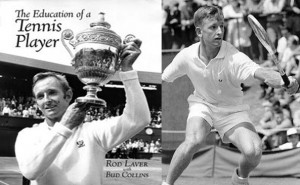
This year marks the 50th anniversary of Rod Laver winning his first of four Wimbledon titles. His 1962 and 1969 titles at the All England Lawn Tennis Club were the third legs of historic Grand Slams, the latter of which is chronicled in detail in Laver’s memoir THE EDUCATION OF A TENNIS PLAYER ($19.95, New Chapter Press, www.NewChapterMedia.com). The following is an excerpt from the Rocket’s memoir that discusses the magic of the grandest tournament in tennis. The book can ordered directly from Amazon.com here: http://www.amazon.com/dp/0942257626?tag=tennisgrancom-20&camp=14573&creative=327641&linkCode=as1&creativeASIN=0942257626&adid=1PMHX5TQXE64AFQMAZ5Q&

Wimbledon

That’s all you have to say. Everybody gets the idea. It’s not really the name of the tournament, although by this time it might as well be. Actually this world championship, regarded as the British championship, has been called the Lawn Tennis Championships since it began in 1877. It could be called The Tournament, and everybody would understand. The name Wimbledon comes from the London suburb where the All England Lawn Tennis and Croquet Club has its grounds. They are magnificent grounds, big league by any standard, dominated by a stadium that is Centre Court. When Centre Court is full, which is always, 15,000  spectators are there, 3,000 of them standing sometimes six and seven hours, packed like a cattle car (although that cozy custom has been abolished).

Rod Laver

“When they faints, they faints standing up,” an usher told me. “Somebody calls out to tell us there’s been a fainting, otherwise we’d never know, and somehow we push through and get the person.”

Nobody minds. You brought your lunch and entered the standing areas at noon. It stays light well into the evening in England, so that you might still be wedged into that fresh-air hole of Calcutta watching tennis at 9:15 p.m.

Faintings are not passed off casually at Wimbledon. Statistics are compiled and are announced every year by St. John Ambulance Brigade, the medical unit in attendance, and in 1969 the crowds obliged by setting an all-time Wimbledon fainting record. No fewer than 1,700 passed out during the twelve days.

A Grand Swoon, wouldn’t you say, old chap? St. John Ambulance gave that figure to the press as proudly as a football press agent trumpeting a scoring record. One customer out of every 190 was treated to St. John smelling salts. I have never keeled over at Wimbledon, but when I consider what a fashionable place it is to faint, and the efficiency of the care, I shall never fear when feeling queasy there.

Numerous changes have been made since I played there. A new Court 1 with 11,000 seats appeared in 1997. Copying the Australian Melbourne Park, Centre Court was fitted with a retractable roof in 2009 while the so-called “Graveyard” – intimate Court 2, burial ground of favorites – was rearranged. At the outside courts, it’s still a standing, jamming proposition with herds pressing against the fences that enclose the courts. During the first week when all the courts are in use, the crowds are over 30,000 daily, and surely they could sell 50,000 seats in Centre Court if they were available.

Considering the incredible success of Wimbledon, the men like Herman David, who ran the place, emerged as extremely principled blokes in their determination to stage an open Wimbledon in 1968 in opposition to the wishes of the International Lawn Tennis Federation. Wimbledon has always sold out regardless of the quality of the tennis. The British love it and the game so much they’d turn out to watch Ma and Pa Kettle play mixed doubles against the champions of Spearfish, South Dakota. But Wimbledon stood for the best, and insisted on being the best in more than name.

Wimbledon pressure has to do with the event itself. This is the world championship, a sports event that everybody pays attention to. For two weeks of the year Wimbledon is a big story on all the world’s sports pages, even in cities where tennis has little or no importance. There is no such thing at Wimbledon as an insignificant match because wherever you play, even on the most remote court, people will fill the spectator areas, whether there be grandstands or merely standing room.

The actor on Broadway, the singer at La Scala, the dancer at the Bolshoi Theatre understand what the tennis player at Wimbledon feels. So does the golfer at the Masters, the football player in the Super Bowl, and the baseball player in the World Series. It isn’t the money. The connoisseurs are here. We play for ourselves, and we perform and play because it’s in us and we must. We would do it whether or not anyone bothered to watch us. But we also play to be seen, to gain attention, to please and impress others. That’s an important part of it. My love for tennis goes to my depths, but when the time comes that I can’t play the Centre Court at Wimbledon, something vital will have gone out of that love.

The connoisseurs are the fans who pay to get in and the critics of the press, radio, and television who don’t. At Wimbledon, they’re the keenest in the world. We can feel the expertise of these people, even though they’re the quietest spectators and the least intrusive critics.

What’s Next for Historic Forest Hills Stadium After Club Votes to Reject Condo Sale

October 8, 2010 by WTM

By Bob Stockton

The membership of the West Side Tennis Club voted Thursday night not to sell its famed 87-year-old tennis stadium, the site of the modern day US Open from 1923 to 1977, to real estate developer Cord Meyer, who planned to tear down the structure and build condos.

WorldTennisMagazine.com learned the official vote among the voting members of the club was 123-123. Two-third vote was needed in order for the sale of the stadium to take place.

The club will likely restart the process and search for another buyer. Reports indicate that Cord Meyer offered between $8 million and $9 million dollars for the stadium property. Estimates indicate that fees of approximately $12 million would be needed to refurbish the stadium, money that the club does not have. The Wall Street Journal reported that a club newsletter that was sent to members last year, revenues from dues covered “less than fifty percent of the operating expenses of the club.”

West Side Tennis Club

New York City’s Landmarks Preservation Commission is currently reviewing whether the stadium deserves official protection from major renovations or demolition. The facility was last fully utilized with fans sitting in the bleachers for a tennis tournament in 1990. So what can this historic slice of American tennis be used for?

Preservationists would like to see some sort of top-level professional tennis played in the stadium, potentially mirroring what the other three Grand Slam cities do the week before the Australian Open, Wimbledon and the French Open. The Kooyong Lawn Tennis Club in Melbourne, the former home to the Australian Open, holds a high-level exhibition featuring players like Roger Federer and Andy Roddick called the Kooyong Classic. Prior to Wimbledon, a similar event called the “Boodles” Challenge is played at the Stoke Park Club in London, while the week before the French Open, the Paris Golf and Country Club hosts the Guinot Mary Cohr Masters exhibition event.

The club has also speaking with the New York Philharmonic about the stadium being its summer home. Other uses of the stadium structure discussed include a hospitality venue for corporate outings, weddings, high school graduations and other celebrations and community events as well as a potential tennis academy with a full-fledged gym and dorm facilities.

A venue for future Davis Cup, Fed Cup or other team events is another option. The horseshoe-shaped stadium was christened in 1923 with the playing of the Wightman Cup matches between Helen Wills and the United States team and Britain. The club has also hosted 14 U.S. Davis Cup matches, the most of any facility in the United States.

The future of the stadium was vigorously debated, striking a nerve with conservationists, tennis fans and historians who felt the stadium should be preserved. U.S. Congressman Anthony Weiner (Democrat, New York) lobbied for the stadium to be saved and asked for the U.S. Tennis Association to become more involved in preserving the stadium. Weiner asked USTA President Lucy Garvin to have one U.S. Open match a year be played at the stadium. USTA President Lucy Garvin and International Tennis Hall of Fame President Tony Trabert have had discussions with club members about how their organizations could help preserve the stadium.

The stadium capacity is 14,000 and has also hosted many legendary music acts through the years including The Beatles, Frank Sinatra, Bob Dylan and Diana Ross.

GRASS ROOTS EFFORT IN PLACE TO SAVE HISTORIC FOREST HILLS TENNIS STADIUM

August 7, 2010 by WTM

There is a grass roots effort to save and preserve the historic tennis stadium at the West Side Tennis Club in Forest Hills, N.Y.

The stadium is the historic tennis venue that hosted the U.S. Open/U.S. Nationals from 1920 to 1977, but has fallen in disrepair since it last seated spectators at a professional tennis event in 1990. The club’s membership is set to vote on August 19 on whether to sell the parcel of land that features the stadium to a real estate developer, who is planning to raze the stadium and construct condos on the hallowed ground of international tennis.

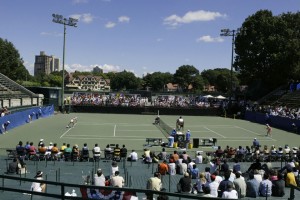
No history of American tennis can be told without including the West Side Tennis Club. Many of the greatest and most historic accomplishments in the sport occurred on these hallowed grounds. The idyllic setting features hard, clay, and plush grass courts, a famed Tudor-style clubhouse and a 14,000-seat stadium, making the venue the American version of Wimbledon and the All-England Lawn Tennis Club. The West Side Tennis Club is the tennis world’s version of baseball’s Wrigley Field. In the words of Hall of Famer Billie Jean King, “Sitting there and watching the sun go down behind the stadium – you’ll never see another sight like that in tennis.”

The West Side Tennis Club stadium was built in1923, christened with the playing of the Wightman Cup matches featuring Helen Wills. The stadium was the site of the first tennis “Grand Slam” in 1938 (Don Budge clinching over Gene Mako in the U.S. singles final) and also the site of the completion of Grand Slams by Maureen Connolly (1954), Rod Laver (1962, 1969) and Margaret Court (1970). The stadium also was the site of Althea Gibson breaking the color barrier in tennis (1950) and becoming the first black athlete to win the U.S. Nationals (1957, 1958) as well as venue of Arthur Ashe’s historic 1968 US Open title, becoming the first black man to win a major title. Many of the sports all-time great tennis greats, including Jack Kramer, Pancho Gonzalez, Helen Wills Moody, Tony Trabert, Billie Jean King, Chris Evert, Stan Smith, Jimmy Connors among many others won U.S. titles on this historic turf. The stadium has also hosted more U.S. Davis Cup matches than any other venue, while also serving as the site of many memorable musical performances from acts including The Beatles, The Rolling Stones, Bob Dylan, Frank Sinatra, Diana Ross among others.

Forest Hills

“Walking out to play Evonne Goolagong [in the 1974 Open final] and seeing the stadium full – SRO – for the first time at a women’s match. And it was a great place to sit on the clubhouse terrace and watch the sun set over that horseshoe stadium. They should find a way to use that stadium,” said Billie Jean King of Forest Hills in 2002. Said 1971 U.S. Open champion Stan Smith in 2001, “But I always tell people that I can say I won Forest Hills, and now when you say you won Flushing, it just doesn’t have the same ring.”

Wrote George Vecsey in the New York Times in 2001, The ancient stadium, where Bjorn Borg and the Beatles played — although not at the same time — is just a crumbling backdrop at the west end of the private club…Most of the old sports places get knocked down by the wrecking ball half an hour after the last fan totters out. In New York, people of a certain age get a knot in their stomach when they approach the buildings where the Polo Grounds, Ebbets Field and the previous Madison Square Garden once hunkered. The dingy old places were intimate in ways the new palaces are not. People in Chicago, Boston and New York must know how lucky they are to still be able to watch the Cubs, the Red Sox and the Yankees in their historic ballparks, despite the lack of amenities. …Forest Hills is a repository of the soul of tennis.”

Interested parties that wish to help try and prevent the sale of the stadium can participate in an urgent letter-writing campaign, which is now under way. Fans can write a letter supporting official landmark status for the stadium to Chair Tierney of the Landmarks Preservation Commission.

Many people feel that it is unfair that the board of directors of the West Side Tennis Club are alone responsible for making decision to destroy or preserve the tennis stadium while the greater public (for whom the stadium was conceived for) is being excluded. If restored and adaptively reused for concerts and smaller tennis matches, it would enhance the appeal of the Forest Hills neighborhood and preserve the historic iconic venue. Green “historic” space is rare in New York and city land-marking would preserve the historic Forest Hills Tennis Stadium, Clubhouse, grounds and interiors for future generations to cherish and increase the chances of funding for repairs.

Interested parties can e-mail the Landmarks Preservation Commission a letter requesting landmark status ASAP for the club. Contact:

– Chair Robert Tierney at rtierney@lpc.nyc.gov
– Dir of Research Mary Beth Betts at mbetts@lpc.nyc.gov
– General mailbox: comments@lpc.nyc.gov
– Rego-Forest Preservation Council Chair Michael Perlman: unlockthevault@hotmail.com

Photos, memorabilia, history (paste link into browser): http://www.flickr.com/photos/8095451@N08/sets/72157607136282297/

FEDERER’S FIRST MAGIC SUNDAY

June 20, 2010 by WTM

It was seven years ago in 2003 that Roger Federer first tasted victory at Wimbledon. The Swiss maestro, who is seeking a seventh Wimbledon title in 2010, finally broke through to win his first major title at the All England Lawn Tennis Club by beating Mark Philippoussis of Australia in the 2003 Wimbledon final. Rene Stauffer, the author of the book THE ROGER FEDERER STORY, QUEST FOR PERFECTION ($24.95, New Chapter Press, www.RogerFedererBook.com), reviews Federer’s first Wimbledon triumph in this book excerpt below.

Two weeks after his ill-fated appearance against Luis Horna at the 2003 French Open, Roger Federer was back on his saddle. The loss to Horna seemed like a surreal dream, but Federer’s fortunes quickly changed for the better. He reached the final of fashion entrepreneur Gerry Weber’s fancy pre-Wimbledon grass court tournament in Halle, Germany, where he faced Germany’s Nicolas Kiefer. Despite losing all three previous matches with Kiefer, Federer gave him no quarter and won his fourth title of the year—and his first on grass since he won the junior title at Wimbledon in 1998. “Prospects for Wimbledon are good,” he said after his win in Halle. “I know that I am going to England as the favorite and I am ready to win a big title. My chances on grass are better than on clay.”

In contrast to 2002, when he resided in a luxurious house, Federer, on Peter Lundgren’s advice, rented a small simple three-room apartment at 10 Lake Road in Wimbledon Village for the 2003 tournament. Federer lived in the modest apartment with Lundgren, his girlfriend Mirka Vavrinec and Pavel Kovac, his physiotherapist, who had to sleep in the living room because of the cramped conditions. Federer arrived early on the grounds of the All England Club, consciously keeping a low profile. He gave only obligatory interviews, didn’t read any newspapers and didn’t compete in doubles in order to concentrate only on the singles competition. “It wasn’t easy keeping him away from everyone because the telephone was constantly ringing. Everybody wanted something from him,” said Mirka, who meanwhile had officially taken over his management, organizing his appointments and travel schedule. Despite his dismal Grand Slam tournament record, most betting offices in Britain considered Federer one of the favorites to win the title at 5:1 odds—behind Andre Agassi and Andy Roddick.

Thanks to his good preparations and an improved attitude, Federer finally entered a Grand Slam tournament in positive and comfortable frame of mind. By contrast, defending champion Lleyton Hewitt was out of sorts and lost in the first round to the six-foot-10 inch Croatian Ivo Karlovic. Federer fought his way into the round of 16 with the loss of only one set to American Mardy Fish in the third round. In the traditional Monday playing of the round of 16 matches at Wimbledon, Federer faced Spaniard Feliciano Lopez on the cramped and notorious Court No. 2—dubbed the “Graveyard of Champions” due to its turbulent history of many of the all-time greats losing matches to unheralded challengers. The Spanish left-hander was ranked No. 52 in the world and certainly did not enjoy the fame of Sampras, whom Federer defeated two years ago in the same round. The Swiss player took it easy on the weekend prior to his round of 16 match. He trained for just an hour and felt rested and in top form. Then, suddenly, in the warm-up of his match with Lopez, he felt a stabbing pain in his lower back after hitting a practice serve. “I thought, my God, what’s this? I couldn’t move anymore. Everything had seized up,” he explained later. He began his match with Lopez without his usual dynamic. After the second game of the match, he sat down in his chair, even though it was not a changeover, and called for the trainer.

Anxious minutes ticked away. While he was being treated with a heat cream by the trainer during his injury timeout, he lay on the grass turf and looked up at the sky in desperation. “I thought about giving up,” he said. “But then I hoped for a miracle or that the next black cloud would bring rain again.” His wish for rain did not come true, but a minor miracle did happen. Federer was able to continue play and went on to win a hard-fought, but straight-set 7-6 (5), 6-4, 6-4 victory. He had no idea how he did it and couldn’t believe his luck. “Lopez had plenty of opportunities to beat me in three sets or drag out the match,” he said. Federer said he began to feel better as time passed—and thanks to the pain killers as well as the increasing temperatures that loosened the muscles in his back. “It also helped that we were playing on a grass court and that Lopez was constantly looking to win the quick point,” Federer said. He also admitted later that the pain was so strong that it not only adversely affected his serve and return but he could hardly sit during changeovers.

It was already certain before the quarterfinals that there would be a first-time Grand Slam tournament champion for the seventh year in a row. Following Hewitt’s defeat, French Open Champion Juan Carlos Ferrero as well as No. 1 seed Andre Agassi were eliminated. Mark Philippoussis, the unseeded Australian, dealt Agassi 46 aces in his five-set upset victory in the round of 16. On Tuesday, a day of rest in the men’s tournament, Federer was still in pain. “I am going to compete for sure,” he reassured Swiss journalists over the phone. But that evening, Dutch journalists hinted that Federer’s opponent, Sjeng Schalken, probably couldn’t compete as they reported that their countryman was at the hospital with a severe bruise and was having his foot X-rayed.

Rain gave Schalken some respite. The match was scheduled for Centre Court on Wednesday, but, due to the rain, was now scheduled for Thursday on Court No. 2. “Even with an injection, if I played on Wednesday, I would have had to throw in the towel after two games at the most,” Schalken said. It rained on Thursday as well, delaying the match by another three hours, but Federer was healthy once again and a negotiated a relatively routine 6-3,6-4, 6-4 victory over the No. 12-ranked Dutchman. Federer committed only eight unforced errors in a strong quarterfinal display played before half-empty grandstands.

To Federer’s relief, he was in the semifinals of a Grand Slam for the first time and joined Marc Rosset as the second man from Switzerland to reach the final four of a major tennis tournament (Rosset lost to Michael Stich in the semifinals of the 1996 French Open.) Federer’s semifinal match had the feel of a pre-determined final as fans and experts alike anointed the winner of his semifinal with Andy Roddick as the eventual winner of the Wimbledon title. Roddick was unbeaten on grass courts in his last 10 matches and was ranked No. 6 in the world. The other semifinal featured No. 14-ranked Sebastian Grosjean of France and Australia’s Mark Philippoussis, ranked No. 48.Roddick was considered the heir apparent to the American tennis throne held by Agassi and Sampras. He was the darling of the American tennis media and favored among them to defeat Federer—even though he lost all three

previous matches with his Swiss rival. Federer seemed unimpressed by this—“He’ll hardly be able to serve 200 aces.”

The match didn’t go as many had expected. Federer irritated Roddick by returning his serves, often clocked at over 135 miles per hour, as if it were standing still. Although the American trailed most of the first set, he held a set point at 6-5 in the first-set tie-break, which he squandered by hitting his trusty forehand into the net. It would be Roddick’s only opportunity against Federer all afternoon.

Federer won what was by far his best match of the tournament. His serve was unshakable and only faced break point twice in his 7-6 (6), 6-3, 6-3 victory. Federer was in a Grand Slam final for the first time. As he left Centre Court, he received a standing ovation by the fans who watched his brilliant shotmaking display. “The spectators had no other choice than to give a standing ovation,” London’s Daily Telegraph wrote the following day. “The tennis played by Federer that swept Roddick, favored by many, from the court, was as inspired and flawless as it could only be on grass.”

Roddick, who is more well-known for his powerful serve, only registered four aces in the match against Federer’s 17. Federer ranked his performance as one of the best of his career, “I don’t think I played a perfect match but it was definitely a very good match,” said Federer. Lundgren couldn’t remember a time when Federer played so well. Roddick was at a loss. “I don’t know if there’s anybody out there more talented,” said Roddick. “There’s not much he doesn’t have. He’s a great athlete. He’s so quick out there.”

Federer proved that he could finally rise to the occasion in a big match in the later rounds of a Grand Slam tournament. This was his trademark as a junior player, but had yet to demonstrate the ability on the biggest stages of professional tennis. However, the biggest match of his career still lay ahead—the Wimbledon final. His opponent was Philippoussis, who also won his semifinal in straight sets, defeating Grosjean 7-6, 6-3, 6-3 (the same score as the Federer-Roddick match). The Australian was once a top 10 player who reached the US Open final in 1998, losing to countryman Patrick Rafter. Philippoussis was known as much for his collection of expensive sports cars, fast motorcycles and his appetite for beautiful women as his tennis as his career took a turn for the worse with injuries and distractions. Following a third knee operation, Philippoussis was confined temporarily to a wheelchair but worked his way back to a No. 48 world ranking.

One of the few who believed in Philippoussis before the final was Pat Cash, the Wimbledon champion in 1987. “He can return better than Roddick and if he continues to serve as he has been, he’ll win,” Cash said. But the fellow Australian was mistaken. It would not be the only false prediction Cash would have regarding Federer’s career.

Federer appeared loose and optimistic when he walked into the Wimbledon interview room on Saturday, the day before the final, wearing jeans and a T-shirt after his practice. “It will be a completely different match compared to the one with Roddick,” he said. “Philippoussis charges the net after the serve and his serves are shallower. I’ll have to stand closer to the baseline and return differently. I can’t just block the serve like I did with Roddick. I’ll

have to try to return the balls at his feet so that he’ll have difficult returns to play.”

Federer’s preparations and tactic proved to be ideal. The physically superior Philippoussis, nicknamed “Scud,” began the final in fine form and scored 18 points directly off his serve in the first set, of which seven were aces. He attempted to intimidate Federer with stinging returns, but Federer was not impressed and didn’t show the slightest vulnerability. In the first set tie-break, Philippoussis hit an ill-timed double fault to give Federer two set-points at 6-4. Two points later, a Federer ace gave him the first set.

From this point forward, the man from Basel dominated almost at leisure and played at an even a higher level than he did against Roddick in the semifinals. He did not face a break point in the entire match and, like the Roddick match, out-aced his stronger serving opponent (21 aces against 14 for Philippoussis). All the while, Federer kept a clear head, even though the match became more complicated. In the third set, with a two-sets-to-love lead, he reached 15-40 on Philippoussis serve at 5-5—points that had the character of match points. Federer was unable to handle a Philippoussis serve on the first break point, and on the second break point, he missed a forehand beyond the baseline by the narrowest of margins that would have given him the crucial service break. It was like a soccer player who missed a penalty shot in the final minute of play without a goalie in the net.

Federer recovered immediately from the lost opportunity, forcing a tiebreak which he attacked with abandon quickly winning six of the first seven points. Federer stared at five match points to win the Wimbledon title. “You can see on TV that I was shaking my head,” he explained later. “It’s crazy, I thought. I’m so close. I had always dreamed about this. It went quickly after this, 6-2, 6-3. I served and knew that if I don’t do it now, I’ll be eternally sad.”

But he did it. On his third match point, Philippoussis returned his serve into the net. “Game, set and match Federer,” said Chair Umpire Gerry Armstrong. “Seven-six, six-two, seven-six.”

Federer, on his way to the net, sank to his knees, raised his arms, looked skywards and then to Peter Lundgren, Mirka Vavrinec and Pavel Kovac. They jumped up from the grandstands and fell into each others’ arms. Federer shook hands with his opponent and the chair umpire, waved to the public, held his left hand in front of his face and stepped back to his chair where he began crying. He cried profusely when Alan Mills, the referee, congratulated him and held him by both shoulders. He looked skywards once again, stood up and waved once again to an audience who gave him a standing ovation.

He sat back on his chair. The tears continued to flow. Hardly a minute elapsed since the last point of the match, but, to Federer, seconds turned into minutes. “I was relieved, exhausted, overwhelmed with emotions,” he said. “I thought I was on my knees longer than I really was.”

As the award ceremony was prepared, a dignified, almost pious calm settled over Centre Court. According to exact protocol, the Duke of Kent presented Federer with the 47 cm high “Challenge Cup,” the gold-plated silver trophy with two handles and the miniature pineapple on the top that had been used since 1887—certainly the most beautiful and important trophy in tennis. He raised the trophy high but didn’t yet have the heart to kiss it. It was still too early. The original trophy would remain in Wimbledon. Federer would be allowed to take home a 22 cm high replica.

In the official on-court champion’s interview with Sue Barker of Britain’s BBC television, Federer still was unable to control his emotions and his voice. He lost control of himself when the former British top player asked him if he knew that many of his friends came from Basel to watch the final. His voice broke—“Thanks to everybody…It’s great…” The tears flowed once again.

Federer suddenly belonged to an exclusive circle in his sport. Having also won the junior title at Wimbledon five years earlier, Federer became the 4th player to win both junior and gentleman’s singles titles at the All England Club, joining Björn Borg, Stefan Edberg and Pat Cash. When he left Centre Court following the photo sessions and victory laps, he walked into the entranceway of the club and found that his name had already been engraved on the 2003 silver championship plate located on the wall to the right.

FEDERER SEEDED NO. 1 AT WIMBLEDON, DESPITE BEING NO. 2

June 16, 2010 by WTM

Despite being ranked No. 2, Roger Federer will be No. 1 at Wimbledon.

The All England Lawn Tennis Club, using their prerogative to seed as they place, seeded the six-time Wimbledon champion Federer No. 1 in the men’s singles field, ahead of Rafael Nadal, who took over the top ranking from Federer on June 7.

Nadal won his only title at Wimbledon in 2008, defeating Federer 9-7 in the fifth set. He did not defend his title last year due to knee problems.

Wimbledon is the only Grand Slam event where seedings can differ from a player’s ranking. Organizers take into account a player’s performance on grass in the previous two years.

Nadal’ s return to the No. 1 spot, earned after winning a fifth French Open title on June 6, prevented Federer from surpassing Pete Sampras’s record of 286 weeks at the top. Federer has been No. 1 for 285 weeks.

Serbia’s Novak Djokovic was seeded third for Wimbledon, while Andy Murray of Britain was seeded fourth. Andy Roddick of the U.S., last year’s losing finalist, was named the No. 5 seed.

The women’s seedings follow the WTA Tour singles rankings list, the All England Club said. Top-ranked Serena Williams, the defending champion, is the top seed ahead of her sister Venus. Denmark’s Caroline Wozniacki is the No. 3 seed, followed by Jelena Jankovic of Serbia at No. 4.

French Open champion and sixth-ranked Francesca Schiavone of Italy was named fifth seed after world No. 5 and Olympic champion Elena Dementieva of Russia pulled out with a calf injury.

For full seeding and tournament information, go to www.Wimbledon.org

Primary Sidebar

Search the site

Randy Walker

Michael Zheng Caps Historic Sports Weekend For Columbia With NCAA Singles Title (Played In The Fall This Year)

November 24, 2024 By Admin

The Winding Final Year of Rafael Nadal’s Career Meets Its End In The Davis Cup Finals

November 19, 2024 By Admin

Ukraine Wins BJK Cup Match In Texas On Same Day When Russia Slams Their Nation With Over 200 Missiles

November 18, 2024 By Admin

Daniel Nestor Snubbed For Tennis Hall of Fame One Year After Slightly Less-Accomplished Leander Paes Gets Inducted

October 24, 2024 By Admin

More Posts from this Category

Sell your home fast in New York

Recent Posts

  • Neale Fraser Achieved (And Experienced) Things At The U.S. Championships That May Never Be Repeated
  • Common Racquet Mistakes
  • Juan Martin del Potro Bids Goodbye To Competitive Tennis In Exhibition Against Novak Djokovic

Popular Links

  • ATP World Tour
  • Tennis Grandstand
  • USTA
  • WTA Tour

Footer

Contact Us

c/o Randy Walker

Owner

1175 York Ave

Suite #3s

New York, NY 10065

Recent

  • Neale Fraser Achieved (And Experienced) Things At The U.S. Championships That May Never Be Repeated
  • Common Racquet Mistakes
  • Juan Martin del Potro Bids Goodbye To Competitive Tennis In Exhibition Against Novak Djokovic
  • Patrick Mouratouglou Talks About New Zephyrhills, Florida Tennis Academy
  • Juan Martin del Potro “Farewell Match” Against Novak Djokovic Sponsored By Aleph

Search

Copyright © World Tennis Magazine 2021 and beyond