• Skip to main content
  • Skip to secondary menu
  • Skip to primary sidebar
  • Skip to footer
World Tennis Magazine

World Tennis Magazine

Unique Tennis Perspectives

  • Home
  • World Tennis with Harry Cicma
  • Staff
  • About
  • Contact Us
  • Forum

ken rosewall

Rod Laver Got Pummeled In Pro Tennis After He Won His First Grand Slam In 1962

July 11, 2024 by Admin

There is a common misunderstanding in tennis with regard to the career of Rod Laver. The left-handed Australian legend is the only man to win the Grand Slam of tennis (winning all four major singles titles in a calendar year) twice. He first achieved the feat in 1962 as an amateur in the amateur era of tennis and then again in 1969 in the “Open Era” open to pros and amateurs.

After Laver won the Grand Slam in 1962, he turned professional and was thus not allowed play the Grand Slams until they became “open” to pros at the 1968 French Open. Many people have said that if pros were always allowed to play the Grand Slams from 1963 to 1968, or if the Open Era had started earlier and Laver would be allowed to play Grand Slams between 1963 and 1967, he may have won 20 or more major titles, not just the 11 that he did accrue.

However, when Laver won his 1962 Grand Slam, he was merely the best “amateur” player in the world, not the world’s best player, as players who turned pro before him, like Ken Rosewall, Lew Hoad and Pancho Gonzales, for example, were still better than him at the time.

The following is an excerpt from the book “The Pros: The Forgotten Era of Tennis” by Peter Underwood (for sale and download here: https://a.co/d/02g6w9tI) that discussed Laver’s rude awakening to professional tennis and how he was immediately reminded that he was not the best tennis player in the world at that time.

So it was that on January 5, 1963, in Lew’s hometown of Sydney, one of Hoad’s most fervent admirers came face to face with his boyhood idol. Laver described it this way: ‘Lew had been training for weeks to get ready for the match and right away he made me understand that all the pros jealously defend their reputations.’ Then Rod sharpens this statement with a graphic image: ‘The whole pro group descend on a newcomer like eagles on lambs back home in central Queensland.’

For Laver, this first outing as pro brought mixed news. The good part was that the tennis was great. It was four tough sets, and Laver played well, had his chances, and lost 8–6 in the final set. Further, Laver said that he ‘enjoyed that match more than any I had played in years’. So, he thought, had the big crowd. Ten thousand had come out to watch! On this occasion, the two were neither lepers nor trained seals, but a pair of tennis legends, giving their all. Even the papers, notoriously anti-pro, raved about the match, saying that after years of dullness and division tennis had once more become exciting.

And the bad news?

“Lew and I played until after 11 pm,” said Laver, “and by the time I got to bed … it was 3 am. I woke about noon and at 2 pm I had to go out [against] Rosewall. It was tough all right.”

Laver, feeling stiff and let down after lifting himself for Hoad, was no match for the Pro Champion. Without Hoad’s bravura, Rosewall, the delicate surgeon, took him apart. This time it was straight sets, and took less than an hour.

After the match, all he could say to the press was: “Playing against Ken is like hitting against a brick wall.” Later, Rod said that when he played Hoad for the first time he saw that he was up against the best player he’d ever faced. Then it was Rosewall — who was ‘a lot better’ than Hoad … Then everything got worse.

Laver put it this way:

Lew beat me in eight straight matches after that, and Ken did it in eleven out of thirteen. On the high level of the game, it was as though my tennis education was just beginning. The difference between pro and amateur tennis was so great it took me months to settle down. I felt the pressure … [of being] the top amateur, the man who had equalled Budge’s Grand Slam, and there was a psychological barrier to break through that the pros had created … On some occasions the ease with which they beat me, the constant travelling, and hard matches night after night … made me feel like quitting.

“The Pros” (available here via Amazon: https://www.amazon.com/Pros-Forgotten-Era-Tennis/dp/1937559912/ref=sr_1_1?keywords=The+Pros+Peter+Underwood&qid=1574131803&sr=8-1) describes the era through the stories of eight great tennis champions – Bill Tilden, Ellsworth Vines, Don Budge, Bobby Riggs, Jack Kramer, Pancho Gonzales, Ken Rosewall and Rod Laver – who dominated the pro arenas beginning in 1930 through to the start of the “Open Era” in 1968. Author Peter Underwood explains why these celebrated champions were forced into what was often called a traveling circus, and where these sporting outcasts played each other during long and rather tatty tours all over the world, far from the cushy confines of what was then the amateur game at Wimbledon, Forest Hills and Roland Garros.

The 10 Strongest Tennis Players In History

October 14, 2019 by Admin


Who are the 10 strongest tennis players in the history of this discipline? Those who you could be able to bet on for an almost certain victory on MI Sports Betting? We tried to make this list, even though it’s never easy to make a selection among the giants of this amazing sport…

10 – KEN ROSEWALL
Winner of 8 Grand Slam events, in the spectacular career of this very elegant player with one of the best backhands ever, only one title is missing at Wimbledon, despite 4 finals played. He had an exceptionally long career remaining steadily among the top 10 players in the world rankings from 1952 to 1975.

9 – ROD LAVER
He was the number one player in the world for seven consecutive years, winning on all surfaces of the time; above all, he was the only player in the history of tennis, including male and female, to complete two Grand Slams singles, first as an amateur in 1962 and then in the Open formula in 1969.

8 – JIMMY CONNORS
Jimmy Connors was first in the world rankings in the seventies and again in the eighties after the retirement of his great rival Björn Borg. He was number one in the world rankings for 268 consecutive weeks, winning eight Grand Slam games.

7 – BJORN BORG
The Swede was number one in the world and is considered one of the greatest tennis players in the history of tennis. Between 1974 and 1981, he was the first professional to win 11 Grand Slam titles: six at Roland Garros and five in a row at Wimbledon. The psychophysical wear and tear due to his long career led him to abandon tennis at the young age of 26.

6 – JOHN McENROE
John was the world’s number 1 for four years in a row from 1981 to 1984. He is famous for his style of play, for his hard-fought and spectacular matches with rivals like Björn Borg, Jimmy Connors and Ivan Lendl, and for his irritable character on the court.

5 – IVAN LENDL
Lendl holds the record for remaining at the top of the world rankings: 270 consecutive weeks. In his incredible career, the Czech, 8 times Slam winner and main protagonist of the eighties, has missed only the victory at Wimbledon.

4 – ANDRE AGASSI
Agassi won 60 ATP titles and 8 Slam tournaments. He held first place in the ATP ranking for 101 weeks and is one of the 8 players who in their career have managed to win all 4 titles of the Slam and the first to achieve the aforementioned Career Grand Slam on three different surfaces.

3 – PETE SAMPRAS
Sampras won 14 Grand Slam events, including 7 Wimbledon, 5 US Opens e 2 Australian Opens and was the last great interpreter of the pure Serve & Volley style: he beat with great power and often came to the net with extraordinary performances.

2 – ROGER FEDERER
Federer holds the overall record (17) of victories in Grand Slam tournaments in men’s tennis. Seven singles victories at Wimbledon, five at the US Open, four at the Australian Open and one at Roland Garros.

1 – RAFAEL NADAL
14 Grand Slam tournaments and record-breaking victories on red clay (49 titles), including nine titles at Roland Garros (absolute record).  At the 2016 Olympic Games in Rio de Janeiro, the tennis player, winning the gold medal in the men’s doubles with Marc Lopez, became the first tennis player to win all four Slam tournaments, the Davis Cup and the Olympic gold medal in both singles and doubles.


Rafael Nadal
Rafael Nadal

Grand Slam Spoilers! The Three Times Grand Slam Dreams Have Fallen One Leg Short

September 7, 2015 by Admin

By Randy Walker

@TennisPublisher


There is much talk about the five players who have completed the six Grand Slams in the history of tennis – Don Budge (1938), Maureen Connolly (1953), Rod Laver (1962, 1969), Margaret Court (1970) and Steffi Graf (1988). However, what about players who have failed in their attempts to achieve the ultimate in tennis?

The first player to fail in an attempt to win all four majors in a calendar year happened before the first Grand Slam was even achieved. It was 1933, and Jack Crawford from New South Wales, Australia won the Australian, French and Wimbledon championships and reached the final of the U.S. Championships at Forest Hills where he faced Fred Perry of Great Britain. Crawford led Perry two sets to one – one set from winning the first-ever Grand Slam – but won only one game in the final two sets, losing the final 6-3, 11-13, 4-6, 6-0, 6-1.

Budge, the first player to win the Grand Slam in 1938, five years after Crawford’s effort, wrote in his official biography “Don Budge: A Tennis Memoir” that, incredibly, Crawford drinking too much brandy was the reason for the one-sided scores in the final two sets.

“Jack was asthmatic, and particularly, on the hotter, muggier days – as this one was – the condition could begin to bother him,” wrote Budge of Crawford playing Perry in the final of the U.S. Championship on September 10, 1933. “To help his breathing in these circumstances, Crawford would often take a bracing shot of brandy before a match, or, if conditions warranted, even in the midst of one. Against Perry and, no doubt, also against a high autumnal pollen count, frankly, Crawford started hitting the brandy too hard. He had two or three ponies, and his coordination began to suffer. Fred, cold sober, lost only one game to Crawford in the last two sets and thus ended his chances for the first Grand Slam.”

While Crawford did not make history by becoming the first Grand Slammer, his effort helped coin the “Grand Slam” term as, leading into the U.S. Championships, John Kieran of the New York Times wrote in his column, “If Crawford wins, that would be something like scoring a grand slam on the courts.” As Bud Collins writes in his book “The Bud Collins History of Tennis,” a reporter with the less known Reading Eagle newspaper in Pennsylvania named Alan Gould also referred to a potential Crawford sweep as a Grand Slam just after Crawford won Wimbledon in July, but since his paper was not as prominent as the New York Times, Kiernan generally received the credit for first coining the term in tennis. Allison Danzig, the famed New York Times tennis reporter, wrote in his match of Crawford’s loss to Perry that “Crawford’s quest of the Grand Slam was frustrated.”

Connolly won the second Grand Slam in 1953, and three years later in 1956, Lew Hoad from Australia had the opportunity to be the third. He entered the U.S. Championships having won the Australian, French and Wimbledon titles and as the top-seed cruised into the final at Forest Hills to face his Davis Cup teammate and No. 2 seed Ken Rosewall, whom he beat in the Australian and Wimbledon finals earlier in the year. After winning the first set – only two sets from finishing up the Grand Slam – Hoad ran into a buzz-saw, as Rosewall caught fire and prevented history with a 4-6, 6-3, 6-3, 6-3 upset.

“A lot of people rubbed their eyes and took another look—even Hoad,” wrote Bill Talbert in Sports Illustrated. “Rosewall completely took charge once he got into the driver’s seat. Down 0-2 in the third set, he took 12 of the next 16 games. He was the master—a crafty tailor sewing a garment of defeat for his victim. Rosewall at the finish was so overpowering that in the final set, Muscles, as he’s called by his teammates, lost only three points on his own service.”

News footage and commentary on Hoad’s quest and failure can be seen here in this YouTube video: https://www.youtube.com/watch?v=Hl0D4Kt27Yk

Rosewall and Hoad’s fellow Australians Laver and Court won the next three Grand Slams – Laver turning in the four-major sweep in 1962 and again in 1969, when tennis became “open” to pros and amateurs. Court won all four majors in the 1970 year, one year after Laver’s second.

However, before Graf’s feat in 1988, Martina Navratilova had an opportunity to join this most elite group in 1984. The site of Navratilova’s near accomplishment, however, was not New York, but Melbourne, Australia as the Australian Open was in the early 1980s, the final leg of the Grand Slam, being played in late November, early December.

Navratilova won the French, Wimbledon and U.S. Open titles in 1984 and had won six straight major titles starting with Wimbledon in 1983. However, Navratilova was denied in her calendar-year Grand Slam quest, losing to a 19-year-old Helena Sukova 1-6, 6-3, 7-5 in the semifinals, ending her incredible 74-match win streak.

”How important is anything?” the 28-year-old Navratilova said after the loss. ”It hurts, but I’ll get over it. I still have two arms, two legs and a heart.”

”If I’d have won, I’d have done it all,” Navratilova said of her quest for the calendar-year Grand Slam. ”If I lost I had to start from scratch. Both are hard to cope with.”

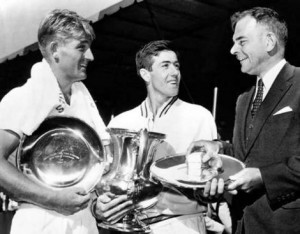
Lew Hoad and Ken Rosewall

The Only Player “From” Africa To Win A Wimbledon Singles Title

June 29, 2014 by Admin

By Randy Walker

@TennisPublisher


“I have a question for you” said the rough, Czech-accented voice of Ivan Lendl during a telephone news conference to promote his competing on the PowerShares Series tennis circuit. “Who is the only person to be a world ice hockey champion and a Wimbledon champion?”

The question was directed to Bill Simons of Inside Tennis Magazine in the waning minutes of the call with writers from around the United States.

“That’s a good question,” Simons responded. “I know Ellsworth Vines won ping‑pong and tennis.”

Being the promoter and moderator of this media call, I had an open phone line to speak when I wanted to all of the participants. Since I knew the answer to this trivia question, I chimed in.

“I think I might know the answer to that,” I interrupted. “Drobny?”

“Correct,” responded Lendl.

I remembered reading that Jaroslav Drobny was a standout hockey player in the former Czechoslovakia, the country where Lendl hailed from, during my readings and/or publishing of “The Bud Collins History of Tennis” or the Jan Kodes book of the history of Czech tennis called “A Journey To Glory From Behind The Iron Curtain.” It was a natural question for Lendl to ask, knowing that as a fellow Czech, Drobny was someone who he likely knew a lot about.

“What do I get?” I then joked with Lendl, proud of my correct answer, in a very public forum of a telephone news conference.

“Another question,” dead-panned Lendl in the deliberate voice everyone in tennis is accustomed to. “Who is the only person with an African passport to win a Wimbledon singles title?”

It was a great trick question, but I also knew the answer. It was the same as the first question.

“Drobny!” I answered.

“Correct again,” said Lendl.

“Well, I am the publisher of the Bud Collins History of Tennis,” I reminded Lendl.

“That would be why,” he said.

Collins in “The Bud Collins History of Tennis” wrote that Drobny had “a remarkable two-sport world class athlete: Hockey in winter, tennis the rest of the time. So good was Drob as a forward on the ice that he played a leading role in Czechoslovakia’s winning the world amateur championship in 1947 (he scored three goals in the final game against the U.S.), and gaining sil­ver at the 1948 Olympics. By 1949, though, tennis had become his life.” In 1949, Drobny defected from communist Czechoslovakia with Davis Cup teammate Vladimir Cernik during a Swiss tourna­ment at Gstaad. Egypt offered him a passport so he could continue to travel and play on the international tennis circuit.

Jan Kodes, the 1973 Wimbledon champion from Czechoslovakia, wrote in his “Jan Kodes: A Journey To Glory From Behind The Iron Curtain” book of Drobny, “He was an amazing player who won an unbelievable 133 tournaments and who was inducted into the International Hall of Fame in 1983 with many distinctions.” Drobny won the singles title at the French Championships in 1951 and 1952, but his greatest triumph came at Wimbledon in 1954.

Wrote Collins in his book of Drobny’s win at Wimbledon in 1954, “Drobny at 34 still had a punishing serve, though not as oppressive as it had been prior to a shoulder injury. He was seeded only No. 11 in his 11th appearance at Wimbledon, but upset No. 2-seed Lew Hoad in the quarterfinal, 6-4, 6-3, 6-3, and beat old rival Budge Patty in the semifinals, 6-2, 6-4, 4-6, 9-7. Ken Rosewall overturned top-seeded Tony Trabert in their semifinal, 3-6, 6-3, 4-6, 6-1, 6-1, but couldn’t get past Drobny in the final, 13-11, 4-6, 6-2, 9-7, in two hours, 37 minutes. Drob became only the second left-handed champion, following Norman Brookes in 1907. No one could have imagined that Rosewall, in the final for the first of four times at age 19, would never win the singles title he coveted most. The galleries loved Drobny, the expansive Czech refugee in dark prescription glasses. “No better final had been seen since Crawford and Vines 21 years before,” judged Lance Tingay. “The warmth of Drobny’s reception as champion could not have been greater had he been a genial Englishman. In a sense he was, for he had married an Englishwoman and lives in Sussex.”

Drobny’s final win over Rosewall lasted in 2 hours, 37 min­utes, making it the longest Wimbledon final at that time. Wrote Collins, “Drob was the Big W’s remotest-chance success then, although non-seeds Boris Becker (1985), Richard Krajicek (1996), Goran Ivanisevic (2001), 11th seed Pat Cash (1987) and 12th seed Andre Agassi (1992) were to join his long-shot club.” His win also gave him the distinction of being the first Czech-born player to win a Wimbledon singles title. Drobny became a British citizen in 1959, and lived in London until his death in 2001. He was inducted into the International Tennis Hall of Fame in 1983.

To pre-order the soon-to-be-updated and re-released edition of the “Bud Collins History of Tennis” click here: http://www.amazon.com/dp/1937559386/ref=cm_sw_r_tw_dp_oceStb0CA3ZHE8R6

To order the Kodes book about the history of Czech Tennis, “A Journey To Glory From Behind The Iron Curtain” click here: http://www.amazon.com/dp/0942257685/ref=cm_sw_r_tw_dp_MbeStb1HH130DNA2

Jaroslav Drobny
Jaroslav Drobny

Nadal Beats Federer In Australian Semis: “Like Watching The Same Movie Over And Over And Expecting A Different Ending”

January 24, 2014 by Admin

by Randy Walker

@TennisPublisher


With tennis legends Pete Sampras, Rod Laver and Ken Rosewall in the stands and tennis fans watching on TV in all time zones at all hours of the day and night, Roger Federer and Rafael Nadal contested a highly anticipated 33rd career meeting in the Australian Open semifinals.

But despite his newly-found confidence, his larger-faced racquet and new coach Stefan Edberg in his box, Federer was not able to exorcise the hex that Nadal has over him, losing for the 23th time to his left-handed Spanish tormentor.

“It’s like watching the same movie over and over and expecting a different ending” wrote a keen tennis observer on my Facebook wall of the Nadal vs. Federer rivalry that has seen the Spaniard win eight of the last 10 matches and all confrontations at Grand Slam events outside of two matches at Wimbledon in 2006 and 2007.

The 7-6 (4), 6-3, 6-3 win for Nadal places him into the Australian final to face Federer’s Olympic doubles partner Stan Wawrinka, who, with his run to his first Grand Slam final, overtakes Federer as the No. 1 ranked player in Switzerland.

A victory over Wawrinka in the final would give Nadal a 14th career major singles title, equaling the major title haul won by Sampras and only three behind Federer’s record of 17 major singles championships. A title would also give Nadal the distinction of winning “a double career Grand Slam” – winning all four major titles at least two times, a feat only achieved by Rod Laver and Roy Emerson.

“I played probably the best match of the tournament,” said Nadal. “I am very happy with the way I played tonight.”

While Federer was able to successfully implement serve-and-volley tactics against Jo-Wilfried Tsonga in the fourth round and Andy Murray in the quarterfinals, he was not able to find the same success against Nadal, winning only 23 of 42 points at the net, frequently watching Nadal blast passing shots or force volley errors. Against Murray, Federer won 74 percent of points at the net (49/66) while he won 83 percent of net points (34/41) against Tsonga.

Rafael Nadal
Rafael Nadal


Who Has The Best Volley In Tennis History?

June 27, 2013 by Admin


Sergiy Stakhovsky’s upset win over Roger Federer on Centre Court at Wimbledon showcased some of the best serve-and-volley displays seen at the All England Club in years.

His volleying prowess against the 17-time major champion – and seven-time Wimbledon champion – stirred up a debate as to who had the best volleys in the history of the sport.

Steve Flink, the well-respected tennis journalist and observer, rates the best volleyers of all-time in his book THE GREATEST TENNIS MATCHES OF ALL TIME ($28.95, New Chapter Press, available here www.NewChapterMedia.com and where ever books are sold)

Flink’s rankings – for both men and women, forehand and backhand volley – are excerpted below.


FOREHAND VOLLEY

Men

1. JACK KRAMER The Californian believed fervently that a good offense would always overcome a tough defense. That is why he designed his game to go to the net whenever he had an opportunity. From close range, he was convinced that on a fast surface no one could stop him. Kramer volleyed phenomenally off both sides and had no weaknesses in the forecourt. But his forehand volley was the guiding light of his game, punched with not only control but power. He could handle the high forehand volley, dig out the low ones and close in tight to put away the sitters. Kramer did this better than anyone else.

2. JOHN NEWCOMBE The Australian’s philosophy was not far away from Kramer’s. He made his living at the net. He was comfortable and confident in that territory. He trusted his volley thoroughly. The seven-time Grand Slam singles titlist was quick to read the battle plan of his opponents whenever he was up at the net and was decisive in his execution, particularly on the forehand volley. Confronting great rivals like Laver and Rosewall, Newcombe knew he would have to make more than his share of difficult low forehand volleys. He was seldom found wanting in that department.

3. ROY EMERSON The reason this proud Australian captured no fewer than twenty-eight major titles in singles, doubles and mixed doubles was because of his renowned fitness and his uncompromising serve-and-volley style. Emerson was a terrific athlete and once he got his hands on a volley, he was not often going to make a mistake. Emerson volleyed with firmness and conviction and he had an awfully good forehand volley that was one of his primary attributes as a player.

4. PATRICK RAFTER In his two U.S. Open championship runs, and his two journeys to the finals of Wimbledon, Rafter exhilarated the galleries in New York and London with the spring he had in his step. He would propel himself forward swiftly behind his kick serve to play his first volley—no one could surpass him in that endeavor. I will never forget Rafter’s forehand volley display in dissecting Michael Chang in the semifinals of the 1997 U.S. Open. Rafter cast aside Chang in straight sets and, in my mind’s eye, I still see him punching away one forehand volley after another with absolute assurance.

5. JOHN MCENROE The New Yorker did wondrous things on the volley, off either side. What I liked about his forehand volley was his incomparable feel. Not only would he make his signature drop volleys off that side, but his touch was so astounding that he could take the low forehand volley off his shoelaces and deposit it at impossible angles and improbable spots. He kept his volleys low, making it difficult for his rivals to pass him. McEnroe was inventive at the net, a master of finesse and a genius in many ways.


FOREHAND VOLLEY

Women

1. JANA NOVOTNA The 1998 Wimbledon champion became one of the most proficient players ever at the net. She was agile in the forecourt, her technique was excellent and she was decisive in her execution. I felt her forehand volley was the best ever among the women because she could punch it with speed, depth, and precision—and she did it all in textbook fashion.

2. LOUISE BROUGH The winner of six major singles titles, and another twenty-nine in doubles and mixed doubles, Brough was one of the great female players of the late 1940’s and 1950’s. The primary reason she was so successful was her prowess on the volley. She was solid off both sides. Her forehand volley was first rate. She could make the low forehand volley more regularly than just about anyone in her era.

3. MARTINA NAVRATILOVA Early in her career, the forehand volley could be a glaring weakness for Navratilova, but during the 1980’s she improved that shot significantly. From that juncture forward, it became almost technically flawless.

4. MARGARET COURT. In her heyday, Court was always among the best on the volley. She had remarkable range at the net, and it was exceedingly difficult for opponents to find openings to drive the ball past her with more than sporadic success. They nicknamed her “The Arm” because of her capacity to cover the net so thoroughly. Her forehand volley was exemplary in every way.

5. BILLIE JEAN KING Like Navratilova, King could have off days when her forehand volley would let her down. But the fact remains that, at her best, King could get down to make the forehand volley better than anyone. She was never lazy in her approach to volleying, sticking assiduously to the fundamentals and producing those volleys as if she had been born to make them. No one understood good technique on the volley better than the ever inquisitive King.


BACKHAND VOLLEY

Men

1. STEFAN EDBERG The Swede was his era’s best at the net, by a considerable margin. He was the quintessential serve-and-volleyer, with a heavy kick serve designed to allow Edberg to get exceedingly close to the net for his first volley. His forehand volley was awfully good, but his backhand volley was stupendous. Edberg was supremely confident on the backhand volley, which he could “stick” better than anyone. Either high or low on the backhand volley, Edberg always had all of the answers, displaying finesse, precision and the capacity to put it away whenever possible.

2. TONY ROCHE The formidable Australian’s backhand volley was virtually on a par with Edberg’s—some would say that Roche’s was even better. His shoulder turn and soundness were his enduring virtues as a player. No one wanted to allow Roche to hit that backhand volley if they had a choice because he invariably would keep the low ones deep and put the high ones away emphatically. Roche played the backhand volley with clinical efficiency.

3. KEN ROSEWALL While the understated Australian was more revered in some circles for his backhand ground stroke, the fact remains that his backhand volley was every bit as impressive. Rosewall altered his game when he left the amateur ranks and turned pro, realizing he had to approach the net more frequently. Once that change occurred, Rosewall put his stellar backhand volley on display with growing assurance. It was ineffably good.

4. ROD LAVER The two-time winner of the Grand Slam was spectacularly versatile, capable of taking his place alongside any of the great shot makers of all time. But I believe no one gave him the plaudits he deserved for his backhand volley. This deeply humble left-hander had good feel and great control on that side and he never wavered when he was set up for a backhand volley.

5. PETE SAMPRAS Over the second half of his career, the American became more committed to following his second serve in at almost all times. Sampras made serious strides in his ability to volley with the best in his business. He had a very good forehand volley as well, but his backhand volley was outstanding. Even when he was stretched out or reaching down to his shoelaces, he would make even the toughest backhand volleys look remarkably easy.


BACKHAND VOLLEY

Women

1. MARTINA NAVRATILOVA This outstanding left hander’s athleticism was displayed most convincingly when she was stationed up at the net. Her speed and anticipation was second to none and her long reach on the backhand volley was phenomenal. It seemed almost impossible to get a ball by her on that side. Navratilova could not only pound her volleys for winners at sharp angles but also could use her touch for some astounding drop volleys.

2. BILLIE JEAN KING Her technique and flair on the backhand volley was comparable to Navratilova’s. King had a much better backhand than forehand off the ground. On the volley she was highly skilled off both sides, but her backhand volley was more of a weapon. She would knife it away with total conviction, go down the line as well as crosscourt and her footwork and forward movement was outstanding.

3. EVONNE GOOLAGONG Goolagong was very comfortable at the net, relishing the challenge to end points with her dazzling athleticism and staggering grace. Goolagong’s backhand volley was awesome. Navratilova and King were more adept at making the low volley in many ways, but Goolagong was the best on high backhand volleys and backhand overheads. She would leave audiences gasping when she played that shot.

4. MARIA BUENO The Brazilian’s elegance and grace were reminiscent of Goolagong. This fierce competitor hit a heavy ball off the ground, but her forte was the volley. Bueno had wonderful touch and vision at the net, which made her such an estimable grass court player. She knew exactly what to do with the backhand volley and had one of the best ever.

5. VIRGINIA WADE The winner of three singles majors on grass courts—including Wimbledon in 1977—Wade possessed a terrific first serve. It was among the most potent of her time and she followed it in persistently. Up at the net, she was comfortable and usually in command, exhibiting very good lateral movement. Her backhand volley was first rate. Wade could knife that shot crosscourt with extraordinary regularity.

Stefan Edberg
Stefan Edberg

Last Home-Grown Aussie Men’s Champ’s Story The Makings Of A Hollywood Screenplay

January 3, 2013 by Admin

by Randy Walker


Mark Edmondson took firm hold of the pine-handled mop and dipped it into the soap-frothed bucket that lay in front of him.

It was 11:15 at night and the halls of the hospital were mostly abandoned, patients sleeping in their infirmary beds in their rooms and the nurses, one of them his sister, sitting quietly at their desks at the end of the hall.

Mark pulled the mop out of the bucket, the soapy water dripping off the yarn like the sweat off his brow during this humid Australian summer night.

He sloshed the soaking wet mop onto the tile floor and surveyed the hall at the task ahead. He moved the mop back and forth, not unlike how moved along the baseline of a tennis court, his other, more preferred, vocation.

Mark was a professional tennis player – at least that is what he considered himself even though his world ranking did not even rank him in the top 200 in the world. His tennis earnings were so paltry that he just took up a part-time as a cleaner at the hospital, on recommendation from his sister, just so he could pay his bills. You have to earn money to be a considered a “professional” tennis player. He was not looking to mop hospital floors for long, only until he could rustle up enough money to return to the tennis circuit to chase his athletic dreams.

No one could have imagined that in a matter of weeks, Mark would go from mopping hospital floors, to, in meteoric fashion, being the most unlikely men’s singles champion at any major tennis championship. The story of Mark Edmondson and his triumph at the 1976 Australian Open has all the makings of a Hollywood screenplay.

To date, Edmondson, the burly, mustached baller from Gosford, New South Wales, is the last Australian to win his national men’s singles title. In the semifinals, he took out the top-seeded legend Ken Rosewall in four sets and in the final defeated the defending champion – and three-time Wimbledon champion – John Newcombe in four sets.

Edmondson’s singles ranking at the time was No. 212 – making him the lowest-ranked man to ever win a major singles title, a distinction he still holds. This would be the equivalent if this week’s No. 212, Taiwan’s Ti Chen, would go on to win the Australian Open title in a few weeks at Rod Laver Arena.

Tennis is indeed a much different landscape now than when it was back in 1976. The Australian Open was then held on the grass courts of the Kooyong Tennis Club in Melbourne over the Christmas holiday, preventing many of the world’s top players from making the long trip “Down Under” to compete. The men’s singles field at the 1976 Australian Open featured only 64 players, 39 of them from Australia. Rosewall was the No. 1 seed – and the only top 10 player in the field – followed by Newcombe at No. 2. Missing from the field was world No. 1 Jimmy Connors, world No. 2 Guillermo Vilas, world No. 3 and reigning French Open champion Bjorn Borg, world No. 4 and reigning Wimbledon champion Arthur Ashe and world No. 5 and reigning US Open champion Manuel Orantes.

Edmondson didn’t exactly fall into oblivion after his long-shot victory. He went on to win five other ATP singles titles and 34 doubles titles, including four at the Australian Open. He also reached the Australian Open semifinals in 1981 and the final four at Wimbledon in 1982, losing to Jimmy Connors. He also helped Australia win the Davis Cup in 1983.

The following is the summary of Edmondson’s triumph Down Under from the January 4 chapter of the book ON THIS DAY IN TENNIS HISTORY ($19.95, www.TennisHistoryBook.com)

1976 – Twenty-one-year-old Mark Edmondson, who worked as a janitor three months earlier to supplement his tennis income, becomes the lowest-ranked player to win a major singles title when, ranked No. 212, he registers one of the biggest upsets in major tournament tennis in defeating fellow Australian and defending champion John Newcombe 6-7, 6-3, 7-6, 6-1 in the final of the Australian Open. Says Edmondson after the final, “I’m suffering from shock and exhilaration or something. It is just too good to believe. I think I might have a couple of bottles of bubbly tonight.” The two-and-half-hour final is delayed for 30 minutes due to a severe weather conditions which, according to the Associated Press, features 45 mile-per-hour wind gusts and a temperature drop “from 104 degrees in 79 in five minutes.”


Mark Edmondson
Mark Edmondson

Who Has The Greatest Backhand In The History of Tennis?

December 6, 2012 by Admin

Who has the greatest backhand in the history of tennis? Tennis historian and author Steve Flink throws out his thoughts on the debate ranking the top five men’s and women’s backhands of all time in his new book THE GREATEST TENNIS MATCHES OF ALL TIME, available on Amazon.com here: http://www.amazon.com/The-Greatest-Tennis-Matches-Time/dp/0942257936/ref=sr_1_1?ie=UTF8&qid=1354551927&sr=8-1&keywords=greatest+tennis+matches+of+all+time The except of the best backhands is excerpted below.

Men

1. DON BUDGE When he captured the Grand Slam in 1938—the first player ever to realize that feat—Budge had it all, but the single biggest strength in his game was his majestic backhand. Most of those players who preceded Budge at the top of tennis were better off the forehand, but his backhand was the first of its kind. His aggressiveness off that side was ground breaking in many ways. He drove the backhand essentially flat and all students of the game marveled at its magical simplicity.

2. KEN ROSEWALL The diminutive Australian’s backhand was legendary. He prepared early, turned his shoulders unfailingly, kept his eyes glued to the ball, but, most significantly, Rosewall’s backhand was a slice. Across the history of tennis, many slice backhands have been used primarily for defensive purposes, but not Rosewall’s. His slice backhand worked in every way: as a rally shot, as a passing shot, for the lob, and on the return of serve. It was multi-faceted. It was incredibly versatile. And above all else, it was unmistakably elegant.

3. JIMMY CONNORS Watching Connors launch into one of his two-handed backhand drives was one of the great joys for all erudite observers from the early seventies until the outset of the 1990’s. Connors retained the old fashioned flavor of a flat, one-handed backhand, producing flat and penetrating two-handers of unrelenting depth and immense power, yet gaining stability with his right hand. His backhand was the picture of purity. It was his signature shot.

4. NOVAK DJOKOVIC A mesmerizing athlete, Djokovic can be forced well off the court by wide balls to his two-handed backhand and still recover in time to play the shot with assertiveness and astounding control. He returns with unswerving authority off that side, and in long rallies from the baseline, his two-hander is rock solid. Djokovic finds just the right blend of flat and topspin shots with his two-handed backhand. This shot made him the great champion he became.

5. LEW HOAD and GUSTAVO KUERTEN One match away from winning the Grand Slam in 1956, Hoad at the height of his powers was impenetrable. The gifted Australian had every shot in the book, could perform brilliantly on any surface and was universally admired for his immense talent. Off the ground, his one-handed backhand was widely appreciated. He drove through the ball with an essentially flat stroke and was lethal off that side. To be sure, he was a streaky player, but when he was on, there was nothing he could not do on a tennis court, including cracking the backhand mightily. Kuerten’s one-handed backhand was the cornerstone of his game—a majestic, sweepingly beautiful, fluid, one handed stroke that carried him to three French Open crowns. Kuerten sparkled off that side, hitting winners at will, driving the ball both crosscourt and down the line with extraordinary pace and minimal topspin. His backhand was singularly inspiring in its time.


Novak Djokovic
Novak Djokovic

Women

1. CHRIS EVERT While both Connors and Borg made substantial contributions toward the cause of the two-handed backhand, it is safe to say that Evert’s impact was larger. Her success charted a new course for women’s tennis and the two-hander became a staple. But that did not mean it was easy to replicate the geometric precision of her backhand. The daughter of an outstanding teaching professional named Jimmy Evert, she worked diligently on her two-hander. It was the shot that never deserted her across the years. In rallies, her depth was unmatchable and she seldom missed. Her returns were crisp and solid and her passing shots were unimaginably precise and unerring. Meanwhile, the topspin lob was always at her disposal. In my book,  the Evert backhand was the best in the history of women’s tennis and the precursor for so many great two-handers to replicate.

2. MONICA SELES Just as Djokovic broke new ground by taming the Rafael Nadal forehand with his backhand, Seles did essentially the same thing with her lefty two-handed backhand against Graf. The German always was more comfortable running around her backhand to play the inside-out forehand, but if you could keep her pinned deep in her forehand corner, she was not able to control rallies in the same manner. Seles forced Graf to do that by virtue of the depth and speed of her two-handed backhand crosscourt, forcing Graf back on her heels. That was no mean feat. The Seles backhand was immaculately executed.

3. JUSTINE HENIN The Belgian brought an awful lot to the table of competition. She was a complete player with all of the tools to succeed in her trade. Yet her one-handed topspin backhand was her trademark. Henin’s backhand was sweepingly beautiful, a spectator’s dream, an opponent’s nightmare. She was willing to miss off that side because her goal was to make things happen off the backhand, and, if that meant making some aggressive errors, so be it. But she more than balanced the scales by sprinkling the court with clusters of topspin backhand winners, going down the line or crosscourt, long or short.

4. LINDSAY DAVENPORT At nearly 6’3,” Davenport was an imposing physical presence on a tennis court. Over the years, she became decidedly better as a tennis player and athlete by losing weight, gaining momentum in the process. Across time, her two-handed backhand was strikingly effective, particularly crosscourt. She kept it uncomplicated, going for one deep, penetrating and flat shot after another until she could break down the defenses of her adversaries.

5. EVONNE GOOLAGONG The Australian often looked like a ballerina on tennis court, but never more so than on the backhand side. She was very flexible, using the slice backhand to keep herself in rallies, raising the tempo whenever she saw an opening to release her glorious topspin backhand. She did not have to think when she hit a backhand— it was all flowing and instinctive. The Goolagong backhand remains frozen in the minds of tennis fans everywhere.


Chris Guccione’s Comeback Trail To Visit Vero Beach

April 21, 2012 by Admin

The name Chris Guccione came across my computer screen Friday.

Chris Guccione and fellow Aussie Lleyton Hewitt

His name was the one that popped out when I was reading though the list of direct entries into the $10,000 Vero Beach, Fla., USTA Futures event that runs April 30-May 6 at The Boulevard Club, run by local Vero Beach tennis pied piper Mike Rahaley.

Futures events are the minor leagues of tennis and normally feature young and upcoming talents, college players, juniors and early-year pros scrapping around the world looking for ATP tour points – and money – to help them escalate up the pro tennis ladder. Every now and again you will get a player of note who is trying to get back up to a position of higher status that they once enjoyed. The 26-year-old Guccione is a prime example of that.

The six-foot, seven-inch Australian left-hander might have the best resume of anyone playing in a USTA Futures event this year. His name is linked to legends such as Rod Laver, Ken Rosewall, John Newcombe and Lew Hoad as men to represent Australia in Davis Cup – the native of Melbourne wearing the green and gold for seven years, many alongside teammate Lleyton Hewitt. Just last year, he and Hewitt teamed up to defeat none other than Roger Federer and his gold-medal-winning partner from the 2008 Olympics Stan Wawrinka 2-6, 6-4, 6-2, 7-6 (5) in Australia’s loss to the Swiss. He has an impressive 15-6 match record as a Davis Cupper, including a perfect 6-0 slate in doubles. He even was an Olympian for the land Down Under, competing in Beijing in 2008, falling in the opening round to American James Blake. He won one career ATP doubles titles – Newport, R.I. in 2010 with fellow Aussie Carsten Ball – and he reached two career ATP singles finals including the pre-Australian Open tournament in Sydney in 2008. I remember watching Guccione in person crack 14 aces in a straight-set win against British No. 2 at the time Alex Bogdonovic at Wimbledon in 2007 alongside my pal Bill Mountford, then an executive with Britain’s Lawn Tennis Association.

Guccione’s career-high ranking was No. 67 in 2008, but now he stands at No. 416.

I can share two interesting anecdotes on Guccione — good for some cocktail party conversation for those in Vero Beach taking in some of the tennis. Guccione once served an incredible 50 aces in a three-set match – taking out Olivier Patience of France in a qualifying match at Wimbledon in 2005. The other is documented in my book ON THIS DAY IN TENNIS HISTORY (www.TennisHistoryBook.com), where Guccione was involved in perhaps the only professional tennis tournament final that did not feature a break point. In the 2008 Sydney final, played January 12, 2008, Russian Dmitry Tursunov defeated Guccione 7-6 (3), 7-6 (4) without either player facing a break point. Said Tursunov of the oddity after the final, “I’m not really surprised that there were no breaks, because that’s kind of his game. He goes for a lot of risky shots on the groundstroke on the returns, and he knows that he’s not going to get broken too often. That’s pretty much the scenario. That was very expected.”

Analyzing the Greatest Players of All Time

December 16, 2011 by WTM

Who is the greatest tennis player of all time?

This is a question that is discussed almost daily in the tennis world. But how does one compare players from different generations? How would Pete Sampras fair against Don Budge or Jack Kramer or Bill Tilden? What about Roger Federer and Rafael Nadal playing against Rod Laver or Ivan Lendl?

There was one tennis insider and Wimbledon champion who had a unique perspective on all of the all-time greats in men’s tennis mentioned above in that …he saw them all play! The man is Sidney Wood, who before his death in 2009 at the age of 97, wrote about and compared the greatest players of all-time and documented his thoughts in writing, that was published in 2011 in his post-humously published memoir called THE WIMBLEDON FINAL THAT NEVER WAS…AND OTHER TENNIS TALES FROM A BYGONE ERA ($19.95, New Chapter Press, available here: http://www.amazon.com/dp/0942257847/ref=as_li_tf_til?tag=tennisgrancom-20&camp=14573&creative=327641&linkCode=as1&creativeASIN=0942257847&adid=1MT614NGS4930R9YREE5&&ref-refURL=http%3A%2F%2Fwww.worldtennismagazine.com%2F)

Wood’s chapter called “Analyzing the Greatest Players of All Time” is excerpted below…


******

Bill Tilden vs. Pete Sampras or Andre Agassi? Given today’s immensely more power-packed racquets, who would pick up the marbles? And how about Rod Laver, Don Budge, Fred Perry, Jack Kramer, Pancho Gonzales, René Lacoste, Henri Cochet, Jean Borotra, Ellsworth Vines, Bobby Riggs, Lew Hoad, Tony Trabert, Frank Sedgman, Ken Rosewall, Arthur Ashe, Jimmy Connors, Bjorn Borg, John McEnroe, Boris Becker, Ivan Lendl or Stefan Edberg?

Such questions are constantly put to every player whose repute and venerable status give credence to one’s observations, and even present-day tournament players and chroniclers of the game have an abiding interest in the player-comparison opinions of those they consider eminently qualified.

In fact, at an International Tennis Hall of Fame dinner at Newport a few years ago, Bud Collins, the globe-trotting tennis sophisticate, who was aware that I’d qualified for my first Wimbledon at the unlikely age of 15 in 1927, surprised me with the Tilden-contra-the-world question. He told me the sport of tennis was in need of a book by someone who had seen all the great matches and played “everyone” and that I was also the only guy still around who could first-hand compare and record what every tennis buff would hope to know. Computers now spit out weekly rankings of over 1,000 players on a weekly basis, but back when punch cards were its high-tech breadwinners, national amateur rankings were determined by committees appointed by each country’s tennis association (no more than fifty players were ever rated in the United States) and rankings of the world’s top 10 were decided by a succession of self-appointed London sports columnists whose judgments sometimes appeared based as much on favoritism as fact. Add to this the fact that from 1930, when “Big Bill” Tilden departed the amateur ranks, until 1968, when Jack Kramer led the pro contingent into the “Promised Land of Open Tennis,” the pros were barred from all major tournaments and excluded from the world rankings. This rendered the rankings meaningless as a measurement of the world’s best. Also prior to 1968, virtually every newly-anointed amateur champion would be lured to the pay-for-play game, thereby stripping the amateur ranks of its marquee drawing cards and permitting as yet unproven contestants to be crowned No. 1 in the world of “officially-sanctioned” tennis.

The effect of this double standard? Just tote up the number of stadium-filling superstars lost to the major amateur events through the schism: Tilden in 1931, Cochet in 1933, Vines in 1934, Perry in 1937, Budge in 1939, Riggs in 1941, Kramer in 1948 (following the five-year World War II gap) and, during the next two decades, Gonzales, Sedgman, Hoad, Rosewall, Trabert and Laver all bid adieu to the trophy-only circuit.

With each season’s cumulatively diminished quality of competition, the paths to Grand Slam glories were measurably eased for the succeeding year’s hopeful. Put another way, with Wimbledon as our focus, Tilden would have been the bettors’ favorite to garner another two wins; Budge, at least another four or five; Riggs, Kramer and Gonzales, three to five each. As for Trabert, Hoad, Rosewall and Laver, who knows how many among them? Pre-1968 winners such as Wood (ouch, that’s me!), Ted Schroeder, Yvon Petra, Vic Seixas, Jaroslav Drobny, Bob Falkenburg, Budge Patty, Dick Savitt, Ashley Cooper, Alex Olmedo, Neale Fraser, Chuck McKinley, Roy Emerson and Manolo Santana all would have been hard pressed to squeeze out even an occasional win against their abdicated amateur opponents.

Three all-important extenuations bear on the records of our brightest of stars and we must comment on their merits in order that the reader may interpret their relative importance, vis-a-vis the overall picture of the half century under review. For example, the first U.S. airborne wayfarers to Wimbledon and Paris were in 1946. Before that time, the boat trip to Europe was a five-day affair plus the absolutely essential need of a week to find your land legs. Each year you could safely predict that half the top seeds who would debark from the boat from Wimbledon to the United States to compete, usually the next day, in the Meadow Club tournament, and would be out of the singles after the first or second round, would be left to quench their frustrations on the sunny Atlantic sands of Southampton. All in all, it took about eight weeks to make the scene at both Paris and Wimbledon, while from Australia, this period was more than doubled. Often the trip was economically or otherwise unfeasible for the reasonably-pure amateur of those days.

The second consideration was the advent of World War II, which resulted in a six-year championship hiatus from 1940 to 1946 at Wimbledon, Paris and Australia; and, with most of the players in the service, there was a low-level entry at Forest Hills. In virtually every sport, leading athletes lost out on the opportunity to enhance their records during their prime competitive years. In tennis, this especially affected players such as Don Budge, Bobby Riggs and Jack Kramer.

The final consideration has to be the development of pro tour tennis, which lured the leading performers to its ranks and prevented their participation in the four major events and Davis Cup. Until 1968, these men were precluded from defending their Wimbledon, Forest Hills and other crowns by the simon-pure rules in effect.

When Rod Laver went pro in 1963, he was fresh off winning his first Grand Slam, in which he dominated and beat everyone in the amateur kingdom. But, here again, there was quite a way to go before he would become a case-hardened touring pro. Though there were to be no more head-to-head professional barnstorming matches, Rod met Gonzales in meaningful tournament matches over a two-year span but could win only a few. How would he have fared after more seasoning and the years had cooled some of Pancho’s fire, we’ll never know.

Also until 1968, Davis Cup regulations prohibited professionals from competing for their countries and over the previous ten years, during which there was high-purse pro tennis decimating the upper reaches of the amateur lists, the world’s best were not participating. This is sad for such a long-recognized important goodwill-builder among nations to be only a minor factor in the considerations of the player’s individual world ranking.

A fair question would be to ask where I get the gall to take on this project. At the age of 14, and almost 90 pounds, I won the Arizona men’s singles, which earned me entry to that year’s U.S. Nationals, the modern-day US Open. The following spring, I was shipped to Paris for the French Championships and shockingly won two rounds to become the youngest ever male qualifier for Wimbledon. There, I played defending champion René Lacoste on the hallowed Centre Court on opening day. In 1931, I became the youngest-ever Wimbledon men’s singles champion at the age of 19 (Boris Becker broke my record in 1985 when he won the title at the age of 17). From that time on, through to the late 1970s (doubles only towards the end!), I was privileged to compete against virtually every top player in the world. At the start of the organized pro game, I invented and patented the cushioned, transportable Supreme Court, which is still used for indoor events, and I was not displeased to be reminded by an old AT P buddy that there was no way the pro indoor circuit could have gone full bore had I not dreamt up the concept.

It is these years of experience and fraternal relationships that permit me to confidently assess the pecking order and relative aptitudes of my tennis brethren in our star-studded galaxy from nearly the dawn of competitive tennis, my aim being not to determine who belongs in any year’s top 10, but how the best would stack up against the best, in any year, past or present.

I’m positively no misogynist, so why would I not have included all those richly deserving ladies in this discussion? I have been present, or have viewed on TV, virtually all important women’s matches going back to the Helen Wills (Moody) era, and I do indeed have opinions as to which stars of the gentler gender belong on which rungs of the all-time ladder of tennis greatness. However, it would not only be more appropriate, but a better qualified assessment if such an analysis were undertaken by one of their own leading ladies who has shared the competitive scene.

My rankings are based essentially on win/loss records in important events, primarily the four majors – the Grand Slams – and the pre-1968, head-to-head pro tours, with appropriate credits accorded Davis Cup competition and other important events. What lies behind the printed scores is what determines the placement of each of the world’s great players. For instance, for many years certain tournaments have traditionally counted more than others. After 1946, when the top-amateur turns-pro system resumed, the purely pro events such as the U.S. Pro Championships, Wembley, and the WCT Finals in Dallas became important. Finally, judgments have to be made of the relative value that should be attached to such factors as longevity, consistency, two-man tour results and the ability to win on the slow as well as the fast surfaces.

The Top Fifteen 

1. Don Budge: A no-brainer. In 1938, Don was the first winner of the Grand Slam and for six decades he has been recognized by his peers as the one player to have commanded not only every shot in the book for every surface, but also to have been blessed with the single most destructive tennis weapon ever—a bludgeon backhand struck with a sixteen ounce “Paul Bunyan” bat. All opposed? You might first want to check out Jack Kramer’s required reading, The Game. Jake knows all, tells all. Wrote Kramer in the book, published in 1979, “Don is still the best player I ever saw, and (Ellsworth) Vines is next. Right away a lot of people are going to say I’m an old timer, pushing the guys of my era. Don’t I know that the human body runs faster and jumps higher now than in the 1930s? And I say, yes, I know that, and will you please name me a better hitter than Ted Williams and a better singer than Caruso?… I feel fairly confident in saying that Budge was the best of all. He owned the most perfect set of mechanics and he was the most consistent…Day in and day out, Budge played at the highest level. He was the best.” 

2. Jack Kramer: The choice is clear to me, but may be less so to certain of today’s forty to fifty-year-olds; but even a scan of Jake’s professional stats tells you why he was a rung above Pancho Gonzales (who in turn handled all the rest).

3. Bill Tilden: Most sports fans know Bobby Riggs (thanks in part to Billie Jean King, who beat him in the famed 1973 “Battle of the Sexes” match), René Lacoste and Fred Perry (their shirt labels!), but poor Henri Cochet, Jean Borotra, Pancho Segura—even Budge, Kramer and Gonzales!—are becoming shadowier with time and better remembered by historically disposed fans. But everyone has heard of William T. Tilden. In his day, Big Bill was as world famous as Jack Dempsey, Bobby Jones—even Babe Ruth! He changed the game’s image from a side-court chair, standing-room sport to a stadium- packed, crowd-pleaser (it was Bill who paid the freight on America’s first tennis stadium at Forest Hills). The press named his pile-driver first serve “The Cannonball” and, allowing for the transformation of tennis racquets, no one other than Frank Shields and Ellsworth Vines ever owned one better. Bill’s enduring record on every surface—an absolute master of every shot in the book—make him a shoo-in for third on my list. Were there more witnesses around who’d seen Tilden play everyone in sight until the age of 48, I might well be sued for leaving him off the top. In spite of his constantly troubled lifestyle, Bill, together with his mighty contemporaries, Jones and Ruth, must go in the books as a once-in-a-century sports aberration. 

4. Pancho Gonzales: Other than for his nemesis Kramer, Pancho dominated the pro touring field after leaving the amateur ranks after winning the 1949 U.S. Championships. He had many one-sided win records against such Grand Slam event champions-turned-pro as Frank Sedgman, Tony Trabert and Ken Rosewall.

5. Rod Laver: He won the first of his double Grand Slams as an amateur in 1962, but in his 1969 win he had every active pro in the game to vanquish. His only significant tournament disappointment was his failure to win a WCT title, losing two finals to an inspired Ken Rosewall (their second match in 1972 was one of the greatest I’ve ever seen). There will understandably be many who can’t comprehend why I place a two-time Grand Slam titleholder midway among the first ten, but in my opinion, when comparing Laver’s strokes to these other great champions, this is the position in which I feel he belongs. 

6. Pete Sampras: You know all about those weeks without end as numero uno, his multiple Slam record, especially his virtual ownership of Wimbledon’s Centre Court. His understandably respectful peers were resigned to playing second fiddle to Pete, but they looked forward to ambushing him on slow clay. But it is Pete’s inability to capture a single French Championship – perhaps to equate with Ivan Lendl’s frustrating naughts at Wimbledon – that puts a hold on marking him ahead of other unbeatables who’ve done it.

7. Fred Perry: Where do you put a player who practically waltzed through three straight Wimbledons and two of our national singles, plus an Australian and French for sweeteners? This, of course, is Fred Perry who did his winning when all the big guns except Vines were around to test him. After he turned pro, Fred played a 61-match neck-and-neck tour with Vines, 1936-37 (Vines won, 32-29), but he began to sag a bit thereafter (Vines beat him head-to-head 49-35 in 1937-38). Barnstorming was not this Britisher’s cup of tea, but he belongs at no less than number seven among the splendid ones. 

8. Bjorn Borg: Bjorn practically toyed with everybody through an astounding six French Open wins, but none of us sage old timers gave him a chance to make it past the second round on Wimbledon’s fast grass. Yet overnight, our high-roller, backcourt habitue became a demon volleyer and for five consecutive years, he made mincemeat out of such grass-court winners as Ilie Nastase, Jimmy Connors and John McEnroe. Borg stood an impossible four to five feet behind the baseline to take first serves, but was so fast out of the blocks that few wide slices got past him. He was one hell of an athlete. Could he have continued his dominance on the hard courts of the US Open, Borg would have been a shoo-in to be ranked ahead of all others, but on the hard courts of Flushing Meadows, his second delivery lacked the weight to defend against McEnroe’s chip-and run-in tactics, and Bjorn had to settle for a runner-up role. 

9. Ivan Lendl: To me, Ivan was an enigma wrapped in a Centre Court frustration. He’d gladly have refunded Wimbledon’s first prize guineas several times over for just one win, but his best chance was in 1987, when he lost to the lower-ranked Pat Cash. Lendl beat all comers hollow on everything but grass, so why couldn’t he make it? Unlike Borg, no matter how many hours he ultimately spent striving to become a volleyer, habit was too strong. On crucial points, he couldn’t bring himself to leave the baseline and rush to the net, where Bjorn never feared to tread. Nonetheless, with three US Open titles, three French Open titles and two Australian Open titles and an astonishing 11 runner-up showings at majors (totaling 19 Grand Slam tournament finals), how can he not rate an upper berth-spot.

10. Jimmy Connors: Jimmy won eight major singles titles and was an eight-time runner-up. He failed to win only in France where he was unable to capitalize on his flat-hitting power. I was among those who urged Jimmy to stop feeling he had to bury every ball from the baseline, but it wasn’t until his waning years in the big time that the light finally dawned. In his later years, he was a born-again net rusher, but think how many of those lost finals he could have converted to victories had he unshackled his game and groundstroke fixation a decade earlier. 

11. John McEnroe: McEnroe’s most remarkable season was 1984. He lost just 13 games in two final-round, straight-set wins in major finals over Connors (Wimbledon) and Lendl (US Open). That’s incredible. At the French, he had Lendl nailed but admitted he blew it and lost after leading two-sets-to-love. If the TV could have been programmed to cut out all but John’s shots in play, you would have been admiring perhaps the most naturally gifted shot-maker ever to play tennis. McEnroe’s great record of three Wimbledon and four U.S. titles, plus four major runner-up showings, puts him high on our ladder, but with even a modicum of self discipline (and regard for our game’s image), I’d bet he could have traded his odorous court garbage for more than just a few more wins. 

12. Boris Becker: I’ve had a personal interest in Boris and his career ever since 1985 when he cleaned Kevin Curren’s clock to take the first of his three Wimbledon titles while erasing my 54-year span of being its youngest winner. Boris had a serve with an affinity for the Centre Court turf. He can give you a heavy whack with both his first or second, or slice it with wicked deception. He won one U.S. singles title and two in Australia, but Roland Garros refused to succumb to his power game.

13. Roy Emerson: When Roy wound up on his serve, he looked as if he were bowing to Wimbledon’s Royal Box, which could be habit-formed from having accepted the winner’s trophy there successively in 1964 and 1965. Elsewhere he walked off with two U.S., two French and a mere six Australian singles titles. Although these were before the Open era of tennis (1968), don’t knock it. Roy had what it takes. 

14. Stefan Edberg: Stefan is almost a throwback to bygone years when the big events were on grass and 80 percent of the game’s best were serve-and-volleyers. Edberg’s was not a big serve, but his sure-handed, superbly-reflexed and fearless net play won him two titles at Wimbledon, the US Open and the Australian Open, plus a runner-up showing at the French in 1989. How many more would be crowding his trophy room if he could have waltzed in behind such trenchant deliveries as McEnroe’s, Becker’s, Ivanisevic’s, Sampras’s and Krajicek’s? Double maybe?

15. René Lacoste: Inventor of the first ball-throwing machine, the metal racquet and, of course, the chemise Lacoste, René had a tennis game that was every bit as mechanical as his creative brain. As the leader of the Four Musketeers of the courts (with Henri Cochet, Jean Borotra and Jacques Brugnon), René combined his Maginot Line defense game with pinpoint angled, counter-attacking ripostes. His two Wimbledon, two U.S. and three French wins were against such toughies as Bill Tilden and his compatriots Cochet and Borotra.

 

You might notice that there are some major omissions from this list of top 15 players of all time. Of course missing are the greatest players of the current era, Roger Federer and Rafael Nadal, as well as Andre Agassi, a winner of eight majors, including a career Grand Slam. My father was fortunate to have the opportunity late in his life to watch these three compete, but was not able to put his thoughts down on paper as part of this compilation. However, he was a big fan of all three players and would no doubt have place them in at least the top 10 of this list. Of Federer, he said he was the most intelligent player he had seen in over 50 years. Of course winning more major singles titles than any other man would place him near the top of this list. Unfortunately, my father passed away just months before Federer won the 2009 French Open that completed his career Grand Slam, and his record-breaking 15th major singles title weeks later at Wimbledon. 

In addition to admiring Nadal’s ferocious physical game, my father admired Nadal’s great sportsmanship. My father came from an era in which sportsmanship was expected and the rule of the day. Nadal’s character and how he presents himself was not lost on him. While my father was not around to see Nadal clinch his career Grand Slam at the 2010 US Open, that milestone achievement would have rated him very high on this list. 

Agassi was a player who grew on my father. When he first burst on the scene, my father detested his long hair and look – preferring the clean cut style of his own era. In fact, he would often go out of his way to not watch Agassi play. Through the years, however, he began to appreciate him more and admired his strength, speed and the way he played and took great joy in watching him in action. If Agassi’s final body of work (established after my father’s writing) is considered, he too would rank well against the players mentioned in this list, especially with his eight majors that included at least one each of the Big Four.

– David Wood

Rod Laver: The Volley is Like a Punch in the Nose

February 17, 2011 by WTM

Hitting a good volley is like punching someone in the nose – at least that is the gospel from Rod Laver, who executed the stroke to near perfection while becoming the only player in the history of tennis to win the Grand Slam on two occasions (1962, 1969). In his updated and re-released autobiography THE EDUCATION OF A TENNIS PLAYER, Laver outlines many tennis tips to help amateurs – and pros – improve their games, including the key to hitting a crisp volley.

Rod Laver
Rod Laver

Written with Hall of Fame journalist and historian Bud Collins, THE EDUCATION OF A TENNIS PLAYER is Laver’s first-hand account of his famous 1969 Grand Slam season, capped off by his win over fellow Australian Tony Roche in the final of the U.S. Open. Laver also writes about his childhood and early days in tennis, his 1962 Grand Slam and offers tips on how players of all levels can improve their game. He also shares some of the strategies that helped him to unparalleled success on the tennis court.

Originally published in 1971, THE EDUCATION OF A TENNIS PLAYER ($19.95, www.NewChapterMedia.com) was updated by Laver and Collins with new content including his recovery from a near-fatal stroke in 1998 and helping Australia once again win the Davis Cup in 1973. The memoir features descriptions of Laver’s most suspenseful matches and memorable portraits of his biggest rivals Ken Rosewall, Lew Hoad, Tony Roche and Pancho Gonzalez.

Laver’s full tip on hitting a crisp volley is excerpted below…

A good punch in the nose—that’s the volley. A short, stiff jab with almost no backswing. You’re blocking the ball, not stroking it.

The wrist is firm and below the racket when you punch, and you use the pace from your opponent’s shot—if it’s a good shot. Occasionally when a shot sits there weakly to be volleyed away you have to supply a little of your own power.

By keeping your eye on the ball intently and blocking it you can become a pretty good volleyer and a terror at an ordinary level. There is more to it than that as you progress. You will want to level the racket slightly so that you are hitting slightly under the ball to create a slice or underspin. This gives you more control.

Then there’s footwork, without which you can’t become a really fine volleyer. As you jab with your racket you’re also taking a jab step into the ball. A right-hander steps in with his left foot for a forehand volley and with his right foot for a backhand. This insures that you’re hitting the ball out front where a good volley must be hit. That step is going to put more impact into your punch so that the volleys will gain length and fly to the corners and the baseline. Remember: you don’t need backswing to give you depth. Meeting the ball out front with your body moving behind that jab step will do it.

To take the step you have to be side-on to the net. Not always possible in a fast match. Frequently you’ll be caught head-on to the net. Then you pivot at the hips, like a baseball catcher who has to rush a throw to second base from his haunches. “Wrong-footing” was a favorite tactic of Kenny Rosewall, and it’s a good one for the volleyer once he feels he has control of the stroke. Wrong-footing is hitting to the place your opponent has just vacated, or will vacate to cover the next logical shot. He’s gone to his left corner, say, to return your shot and then he dashes to his right to cover the wide opening. You wrong-foot him by volleying right back to that left corner, and if your timing is right he can’t change directions to go back for the ball. But if you aren’t accurate it will backfire because you may hit the ball right back at the fellow, not behind him.

Rosewall liked to do this especially with his backhand. You hit a crosscourt shot and he got his backhand volley on it, and rather than place it in the open corner he came straight back at you with the angle, and this beat an awful lot of good players. If they can spin around and get to the ball they won’t do much with it and Kenny had a setup on the next shot.

When the ball is below the level of the net you’re going to have to bend to get down to it. The ideal is still to keep the wrist below the racket. This will help you keep your volleys low, even the defensive volleys. If you don’t bend and stay low you’re going to pop your volleys up, and that’s when the other guy gives you a punch in the nose with his volley.

Rod Laver Helps you with your Service Return

February 10, 2011 by WTM

What is the most important element of a service return? Getting the ball back over the net. It is that easy – and part of the simple gems of tennis knowledge that Rod Laver puts forth in his updated and re-released autobiography THE EDUCATION OF A TENNIS PLAYER.

Rod Laver

Written with Hall of Fame journalist and historian Bud Collins, THE EDUCATION OF A TENNIS PLAYER is Laver’s first-hand account of his famous 1969 Grand Slam season, capped off by his win over fellow Australian Tony Roche in the final of the U.S. Open. Laver also writes about his childhood and early days in tennis, his 1962 Grand Slam and offers tips on how players of all levels can improve their game. He also shares some of the strategies that helped him to unparalleled success on the tennis court.

Originally published in 1971, THE EDUCATION OF A TENNIS PLAYER ($19.95, www.NewChapterMedia.com) was updated by Laver and Collins with new content including his recovery from a near-fatal stroke in 1998 and helping Australia once again win the Davis Cup in 1973. The memoir features descriptions of Laver’s most suspenseful matches and memorable portraits of his biggest rivals Ken Rosewall, Lew Hoad, Tony Roche and Pancho Gonzalez.

Laver’s full tip on improving your service return is excerpted below…

Make up your mind on this: you’re going to get that serve back over the net. Consistent returning puts pressure on the server. Usually you’ll just block the first serve, since your opponent will probably have some pace on the ball.

Move in for the second serve and give that a good swat. Most people play too far back to return serve. You want to try to take the ball on the rise, and maybe you’ll find yourself standing inside the baseline to do this. Try it.

Pancho Segura, one of the cleverest guys to play the game, used to move up to take the second serve, like most players, but frequently he would delay that move until his opponent was into the service motion. “Maybe my move will distract him and he’ll double fault,” was Pancho’s reasoning.

Prepare.

May I repeat: prepare. Get that racket back as soon as you know whether the ball’s coming to your forehand or backhand. Too many players are late in preparing to make the stroke and getting the racket back. Remind yourself to prepare as your opponent makes his service toss.

Even a broken-down-looking return gives the server a problem. Once you’ve put the ball over the net you’ve got an even chance of winning the point. Try to keep the ball low, especially against an opponent who follows his serve to the net. Use a lob occasionally against a net rusher. It will startle him.

Don’t overhit. Nothing picks up your opponent more than ripping returns of serve—that slap harmlessly into the net.

Get that return over the net. Any way. Or go stand in the corner.

Next Page »

Primary Sidebar

Search the site

Randy Walker

Michael Zheng Caps Historic Sports Weekend For Columbia With NCAA Singles Title (Played In The Fall This Year)

November 24, 2024 By Admin

The Winding Final Year of Rafael Nadal’s Career Meets Its End In The Davis Cup Finals

November 19, 2024 By Admin

Ukraine Wins BJK Cup Match In Texas On Same Day When Russia Slams Their Nation With Over 200 Missiles

November 18, 2024 By Admin

Daniel Nestor Snubbed For Tennis Hall of Fame One Year After Slightly Less-Accomplished Leander Paes Gets Inducted

October 24, 2024 By Admin

More Posts from this Category

Sell your home fast in New York

Recent Posts

  • Neale Fraser Achieved (And Experienced) Things At The U.S. Championships That May Never Be Repeated
  • Common Racquet Mistakes
  • Juan Martin del Potro Bids Goodbye To Competitive Tennis In Exhibition Against Novak Djokovic

Popular Links

  • ATP World Tour
  • Tennis Grandstand
  • USTA
  • WTA Tour

Footer

Contact Us

c/o Randy Walker

Owner

1175 York Ave

Suite #3s

New York, NY 10065

Recent

  • Neale Fraser Achieved (And Experienced) Things At The U.S. Championships That May Never Be Repeated
  • Common Racquet Mistakes
  • Juan Martin del Potro Bids Goodbye To Competitive Tennis In Exhibition Against Novak Djokovic
  • Patrick Mouratouglou Talks About New Zephyrhills, Florida Tennis Academy
  • Juan Martin del Potro “Farewell Match” Against Novak Djokovic Sponsored By Aleph

Search

Copyright © World Tennis Magazine 2021 and beyond