• Skip to main content
  • Skip to secondary menu
  • Skip to primary sidebar
  • Skip to footer
World Tennis Magazine

World Tennis Magazine

Unique Tennis Perspectives

  • Home
  • World Tennis with Harry Cicma
  • Staff
  • About
  • Contact Us
  • Forum

international tennis federation

We Haven’t Seen The Last of Rafael Nadal (And Neither Has Paris)

May 28, 2024 by Admin

By Randy Walker

@TennisPublisher

Rafael Nadal’s almost unmatched tennis career was born at Roland Garros and has been largely defined by Roland Garros, but the 2024 edition of the tournament will likely not be where Nadal’s career will come to a close.

When Nadal announced that the 2024 season would likely be his last on tour, many wisely predicted that he would play his final match at the French Championships, the tournament that he has won an incredible 14 times – more than double the number of times that six-time champion Bjorn Borg won the title. Many great champions have a hard time letting go of their competitive careers and Nadal himself was cagey and evasive when confronted in conversations that the 2024 French Open would be his final event. As author and former New York Times tennis writer Christopher Clarey wrote in his Substack email article, Nadal “has been resisting the word retirement like it is a break point.” Earlier this year, the Laver Cup even announced that Nadal would be a member of Team Europe in its September event, perhaps indicating that Nadal would have a farewell in the team event like his greatest rival Roger Federer did in 2022.

In his post-match comments after his straight-sets first-round loss to No. 4 seed Alexander Zverev, Nadal seemed determined to return to Paris this summer to his favorite clay courts and compete for Spain in the Olympic Games. The International Tennis Federation, which oversees the Olympic tennis competition, confirmed via a social post on X (formerly Twitter) that Nadal’s ATP protected ranking of No. 9 could be used to gain entry into the Olympic Games, also played at Roland Garros. He could also be paired in doubles with his Spanish heir apparent Carlos Alcaraz. When asked if would consider another trip to play at Wimbledon in July, Nadal begged off saying that playing on the grass courts at the All England Club would not be wise if he wanted to play again on the clay at the Olympic Games.

So Nadal’s first-round loss to Zverev looks only to be the closing bookend to his career at the French Championships, which he won in his first visit there in 2005 as a 19-year-old. As Clarey wrote, “Nadal’s straight-set defeat to Alexander Zverev at the French Open did not quite feel like a full-circle moment….But full circle would also imply the end, and though the understandable assumption has been that this is Nadal’s farewell tour it is beginning to seem much more like a warmup act for the farewell tour.” And Clarey, perhaps more than anybody outside of Nadal’s family and his close inner circle, would know best as he has meticulously written and researched Nadal for his upcoming book “The Warrior.”

We will see him again.

Oh, and did we mention lucrative exhibition matches against Roger Federer as early as 2025???

Screenshot

Forest Hills Seeks More Pro Events After Post-U.S. Open Davis Cup Matches

October 3, 2021 by Admin

Davis Cup was played the week after the U.S. Open at the historic Forest Hills Stadium at the West Side Tennis Club for the first time since 1959.

The club hopes it won’t be another 62 years before it happens again.

South Africa defeated Venezuela 4-0 in the Davis Cup by Rakuten Group II Playoff Series, highlighted by victories in singles and doubles by rising ATP star Lloyd Harris, fresh off reaching the quarterfinals of the U.S. Open the previous week just three miles down the road also in Queens, New York. With the execution of this event under its belt, the long-time former home of the U.S. Open and U.S. Championships is in the market to host more Davis Cup matches or other big tennis events in the near future.

“We would love to host more Davis Cup matches or other big pro events at Forest Hills Stadium,” said Jason Weir-Smith, the club’s director of tennis. “The West Side Tennis Club has proven to be a suitable and enjoyable site for players and fans with an unparalleled tennis history in the United States. With New York, and specifically the borough of Queens, being one of the most ethnically diverse communities in the world, Forest Hills would be particularly attractive for national team events or tournaments with popular international tennis stars.”

The South Africa vs. Venezuela Davis Cup series was pulled together with just over one month of lead time. While Tennis South Africa, the host nation for the series, chose not to pay associated production and permitting fees to allow for the event to be ticketed for the general public, the club received almost a thousand email inquiries for tickets for the event. The event was attended by 200 enthusiastic invitation-only guests daily.

“People are nostalgic for tennis at Forest Hills and those who perhaps are too young to see pro tennis here have certainly seen videos and pictures that display the majesty, beauty and history of the club,” said Weir-Smith.

Following his opening singles victory over Venezuela, Harris, the South African No. 1 player, said competing on the Forest Hills Stadium court was “very special.”

“This is an incredible venue, so much history,” Harris said. “I learned so much about this venue and its history over the last few days. I’m obviously very, very honored to be playing and in a special place.”

“It’s a great honor for me to represent my country, especially at a place like this,” said South African No. 2 Philip Henning. “We love our sport, and this place is one of the places with the most history for tennis. I think a lot of big names played on this court.”

Said Venezuelan No. 1 player Ricardo Rodriguez following his singles loss to Henning, “As a player you always dream to be in the historic venues and the important sites and the most famous stadiums and arenas all over the world, and this is one of them. So, even though I lost, I still feel proud. I still feel lucky to be here.”

The South Africa vs. Venezuela match garnered the attention of the New York Times, which featured a major spread on the series in it’s Sunday paper on September 19, which you can read here: https://www.nytimes.com/2021/09/18/sports/tennis/davis-cup-forest-hills.html

The West Side Tennis Club features 40 tennis courts on five surfaces, grass, red clay, Har-Tru courts, DecoTurf hard courts and synthetic grass. The 13,000-seat horseshoe-shaped Forest Hills Stadium was christened on August 11, 1923 with the Wightman Cup matches and hosted the finals of the U.S. Championships and U.S. Open from 1923 to 1977. The stadium last hosted Davis Cup in 1959 when Rod Laver, Roy Emerson and Neale Fraser led Australia to the Davis Cup title with a 3-2 victory over the United States team led by Alex Olmedo, Butch Buchholz and Barry MacKay.

Tweaks Still Needed To New Davis Cup Format

September 14, 2018 by Admin

by Randy Walker

@TennisPublisher


Now that the new Davis Cup format has been passed – whether you like it or not – it will begin to be implemented starting next year.

I wrote about how the hypothetical format would unfold earlier this summer here: http://www.worldtennismagazine.com/archives/15622 To expand and repeat what I originally wrote, there still needs to be some tweaks to the format, based on the information that has been released.

One of my suggested changes is that this event has to happen in September, and Gerard Pique, his Kosmos group and the International Tennis Federation have already started to make motions to have this change implemented. The most important element of this is that the teams that have to play in the first round “qualifying round” in February of the next year need more than just eight weeks to scout, select sites for home ties and to promote them. Players need more time to plan their schedules.

One item that I have a problem with – and will probably rear its ugly head very soon in the event as it is set-up now – is that the Davis Cup final features 18 teams in a round-robin format. This is made up of 12 teams that win the first-round home-and-away matches and the four semifinalists from the previous year as well as two “wild card” teams. What is the criteria for a wild card? Is this saved for a potential home-team based on where the competition is held? Is it saved for the highest monetary bidder? This is open for something not competitively fair, in my opinion, so I believe this should be scrapped. The number of teams in the final should be 16, not 18. The announced 18-team format will be divided in six three-team round-robin groups where they will play two matches featuring two singles and one doubles match in a best-of-three match series with matches being best-of-three sets. The winner of the six round-robin groups advance into a quarterfinal and will be joined by the two-best second-place teams in the round-robin groups. What is likely to happen is you are going to have a lot of teams with 1-1 round robin records, so what is the criteria for tiebreakers to determine who wins the round-robin group if all three teams have 1-1 records? Even more confusing will be how do you determine the two second-place teams that advance into the quarterfinals among the six round-robin groups when they all have the same record? Is it matches won? Sets lost? Most service games won? Some astute tennis officials and followers who I have spoken to just shook their heads in astonishment when presented with this.

The best format would be a 16-team round-robin with four groups of four, where more of a clear winner can be established. The four winners of each round-robin group would qualify for the semifinals – and just get rid of any second-place finishers qualifying. A nice rhythm of matches for the week – allowing for days off between matches – can be seen in my previous article here: http://www.worldtennismagazine.com/archives/15622

The winner each round-robin group – a clear accomplishment – would also be exempt from playing in the “first-round” the next year and would automatically qualify for the final the following year.

As I wrote earlier, a rule that can be considered is that the team that wins the Davis Cup gets the opportunity to host this 16-team final (notice I wrote “16-team final” and not “18-team final”) in their country, harkening back to the tradition (which is good to revert to with Davis Cup) of the old “Challenge Round” format where the winning team hosted the final – or Challenge Round – against the emerging challenging nation the following year. Should this nation not be able to host the event in one facility or in one city, it could, potentially, be held in two nearby cities, similar to World Cup soccer being played in multiple cities. Perhaps a rule could be implemented that says one nation may not host the 16-team Davis Cup final more than one time in a five-year period so as to open up the competition to one of the other three teams that reach the Davis Cup semifinals (and to guarantee that the event will have a “host” nation that will play in front of their own fans.) If a Davis Cup champion nation had hosted the 16-team Davis Cup final within five years, the runner-up nation would receive the nod to host the event and then if that nation had also hosted within five years, it would be offered to the semifinalists.

On Tennis Channel during the US Open, U.S. Davis Cup Captain Jim Courier suggested that the Davis Cup should be combined with the Fed Cup into a major two-week event, like the Grand Slam tournaments in excitement and revenues, and be turned into two-week extravaganza. An April date, after Indian Wells and the Miami Open, may be a sensible date, which is equidistant between the Australian and French Opens.


Davis Cup
Davis Cup

Jo-Wilfried Tsonga and France, Maria Sharapova and Russia Win Olympic Team Gold in London

August 7, 2012 by Admin

by Randy Walker


Jo-Wilfried Tsonga’s silver medal effort in men’s doubles with Michael Llodra and his quarterfinal finish in singles was enough for France to win Olympic team gold in men’s tennis at the 2012 Olympic tennis competition that finished Sunday at Wimbledon. Maria Sharapova’s silver medal singles performance and the bronze medal effort from Maria Kirilenko and Nadia Petrova paced Russia to earn team gold in women’s tennis. Each nation successfully defended their team golds won at the 2008 Beijing Games.

In case you are thinking you missed something as you read this….you didn’t.

There are no team medals given out at Olympic tennis, but many in the tennis industry wish that there was a way for a team event to be placed into the competition. The solution that I put forward is simple. Award a point for each match victory for each nation in the men’s singles, doubles and women’s singles, doubles competitions. The team with the most points/victories earns the “team gold medal” with No. 2 earning silver, No. 3 earning bronze. It’s an idea I first wrote about four years ago, as you can read here – http://www.tennisgrandstand.com/archives/1507– where I lay out some past examples of team tournaments being decided in this format.

Jo-Wilfried Tsonga celebrates as he leads France to Olympic team gold in London...what?

In some recent research I recently conducted on the Olympic tennis competition, there were such tallies that were counted at the 1924 Olympic tennis competition in Paris. The New York Times reported that the U.S. finished the 1924 Olympic tennis competition with 55 points, France with 28 points and Britain with 18, although it makes no mention of how points were awarded and if any “unofficial” medals or awards were distributed.

Here’s how the mythic team competition would have shaken out last week in London.


2012 Olympic Tennis Competition (Mythical Team Results)

Men

GOLD: France (15 points)

SILVER: Spain (10 points)

BRONZE: USA (9 points)


Women

GOLD: Russia (19 points)

SILVER: USA (16 points)

BRONZE: Germany (9 points)


From the 2008 Olympics, there would have been a slight issue in the fact that three teams tied for a bronze medal in the men’s competition – the USA, Spain and Russia all earning eight points, as seen below.


2008 Olympic Tennis Competition (Mythical Team Results)

Men

GOLD: France (12 points)

SILVER: Switzerland (9 points)

BRONZE: USA, Spain, Russia (8 points)


Women

GOLD: Russia (20 points)

SILVER: USA (12 points)

BRONZE:  China (11 points)


Previous mythical Olympic team results can be found from the earlier linked story from 2008 here: http://www.tennisgrandstand.com/archives/1507


In the case of two or three-way tie for a team medal, a tie-breaker solution would have to put in place, perhaps total individual medals, most number of gold medals, head-to-head victories, etc. It could be similar to the situation just witnessed at the London Games as U.S. gymnast Ali Raisman was beaten out by a tie-breaker for bronze in the 2012 gymnastics all-around competition when she tied with Russian Aliya Mustafina.

Mixed doubles, new to the Olympic program in 2012, was not figured in these team standings from 2012. The addition of mixed doubles was a celebrated addition to the Olympic program this year at Wimbledon. Perhaps the International Tennis Federation and the International Olympic Committee can work to bring a team format of sorts to the next Olympic Games in Rio for 2016.


Jan Kodes: pace of play and court surfaces must change

May 31, 2012 by WTM

Jan Kodes of the Czech Republic, the 1973 Wimbledon champion and 1970-71 French Open champion, is the author of the new book A JOURNEY TO GLORY FROM BEHIND THE IRON CURTAIN, a one-of-a-kind coffee table book that documents the history of tennis in the Czech Republic. The book features an incredible array of historic and never seen before photos and many anecdotes and stories about Czech players including Martina Navratilova, Ivan Lendl and many others. It is available for 24 percent off here: http://www.amazon.com/Jan-Kodes-Journey-Behind-Curtain/dp/0942257685/ref=sr_1_1?s=books&ie=UTF8&qid=1320242085&sr=1-1)

***

There has been so much talk this year about the pace of play in pro tennis that I would like to speak a bit about the subject. A few years ago, the International Tennis Federation (ITF) met with the ATP Tour to work to slow down the game. They wanted slower surfaces and slower balls. In my opinion, this was a big mistake to do both as it is seen today. They went from one extreme to the other. Before, it was too fast and now it is too slow! I think the balls should be like they were before as there are so many shoulder injuries in pro tennis these days.

Matches are also so long because the players are using towels from ball people between all points, which is just incredible! I think this should be stopped immediately!! Don’t players have sweatbands? Allen Fox, Clark Graebner, Marty Riessen and others use to have a little towels behind their shorts when they were playing on the tour. Some players are using towels from the ball people already in the first game of the match!

When I won Wimbledon back in 1973, there were no sit downs on changeovers! (I am part of a great trivia question!) It was the last Wimbledon final that featured this as television dictated that there be time for commercials when the players changed sides, so the players were given 90 seconds of rest.

I also feel sorry also for players playing today who have to play so much on hard surfaces – almost the entire year! Where is hard-tru (American clay?) today? Is it not enough to play on hard just during indoor season? Most of all players will have medical problems in the future, spine, knees, hips. There is a time to start to talk about it! Or is ITF and ATP blinded??

When Roger Federer’s reputation was “Grand Slam Loser”

May 28, 2012 by WTM

It seems improbable that Roger Federer, the man who has won more Grand Slam singles titles than any other man, was once labeled a “Grand Slam loser.” But that was the case back at Roland Garros in 2003 – when he was humiliated in a first-round loss. The following excerpt from Rene Stauffer’s book ROGER FEDERER: QUEST FOR PERFECTION ($19.95 New Chapter Press, www.RogerFedererBook.com) summarizes the valley in the career of Federer from the French Open in 2003, the major before his big break-through at Wimbledon.

***

Federer’s success continued into the start of the clay court season as he won the title in Munich and also reached the final of the Italian Open, losing unexpectedly to Felix Mantilla of Spain. The result, however, still propelled him into the conversation as being a favorite to win the French Open. “I feel much better this year than the year before when I first was in the top 10,” he explained in one of the many interviews before the French Open. “It was a new situation for me back then. I’ve gotten used to it in the meantime.”

He admitted to feeling the pressure from the public. “The entire world keeps reminding me that I am supposed to win a Grand Slam tournament and be No. 1 in the world. That’s not fair because it’s not that easy,” he said. He then stated defiantly that “whoever wants to beat me will have to work hard for it. I don’t want to lose in the first round at Roland Garros again.”

On a summery Monday afternoon in Paris, Federer’s first match at the 2003 French Open took place on Court Philippe Chatrier, the center court named after the Frenchman who was a past president of the International Tennis Federation. His opponent was an unknown Peruvian Luis Horna, whom Federer beat earlier in the year in Key Biscayne. Horna, ranked No. 88 in the world, had yet to win a match at a Grand Slam tournament. Federer took an early 5-3 lead in the first set, but began to show his insecurity and nerves when, during a routine rush to the net, he slipped and fell to the ground, only to mutter to himself and show negative emotions. Despite his lead, he seemed discouraged and, quite unusually, often glanced desperately at Peter Lundgren. Federer lost his service break advantage and despite holding a set point in the tie-break, he surrendered the first set by an 8-6 tie-break. The match immediately turned into a drama for Federer. He seemed frustrated, apathetic and didn’t show any belief that he could win. He appeared mentally absent, missing even the easiest shots. He tallied 82 unforced errors in the 7-6 (6), 6-2, 7-6 (3) first-round loss.

The tournament was shockingly finished before it even really began. Federer, the fallen favorite, appeared in the overcrowded interview room with his head bowed low. “I don’t know how long I’ll need to get over this defeat,” he said. “A day, a week, a year—or my entire career.”

Federer became the ridicule of the tournament. France’s sports newspaper L’Equipe ran a headline the next day translated as, “Shipwrecked In Quiet Waters” and published a cartoon in which a steam ship named “Roland Garros” steams away, leaving Federer behind in quiet waters. Florida’s Palm Beach Post described him as the “Phil Mickelson of Tennis,” comparing Federer to the American golfer who failed to win any of the major tournaments despite his great talent and many opportunities. “Federer has all the strokes but no Grand Slam trophy. He carries the dog tags of the best tennis player who has never won a major competition.”

The loss undeniably confirmed Federer’s reputation as a Grand Slam loser. He showed that he was a player who could not pull out a match even though he was not playing his best tennis—a characteristic that most champion tennis players exhibited, most notably in the present by Lleyton Hewitt, who could win a match on guts and determination alone. Since his victory over Sampras at Wimbledon in 2001, Federer was 0-4 in matches at the French Open and Wimbledon—the last three matches without even winning a set. His last five Grand Slam tournaments ended in defeat at the hands of much lower-ranked players

What could one say in his defense? Federer was now five years into his ATP career and approached his 22nd birthday. He won six ATP singles titles, excelled in Davis Cup play and time and again insisted he was capable of achieving greatness. He was considered one of the bigger stars in tennis and climbed to No. 5 in the world rankings. But outside of the title in Hamburg, all of the tournaments he won were smaller events and even the German Open was not a Grand Slam tournament. Federer failed routinely in the arenas where it was decided if a player was a champion or not. The once precocious maverick simply could not bring his tremendous potential to bear at the Grand Slams. When looking at the successes of his idols, rivals or earlier great players, he couldn’t help but feel envy. At his age, Becker, Borg, Courier, Edberg and Sampras as well as Hewitt, Safin and many others had already long since won their first Grand Slam titles. Federer, however, had not even reached the semifinals at a Grand Slam tournament. The experts were unanimous in their opinions that Federer was mature enough athletically to break through a win his first title. But athletic brilliance alone was not sufficient enough and Federer was still searching for the key to real success. An analysis would seem to indicate that a mental block was preventing him from winning. He felt under pressure to such a degree at the Grand Slam tournaments that he couldn’t concentrate on the moment, especially in the early rounds. This was a basic rule for success. The pressure came from all sides—but mostly from himself. He hadn’t yet learned that these tournaments couldn’t be won in the first week but they certainly could be lost. With some luck, he could have already won a Grand Slam title—in 2001, for example, after upsetting Sampras. Everything would have looked different.

After his loss to Horna, Federer seemed to be the loneliest man in tennis. He was a man alone braving the stormy tempest. How could he have known that this defeat was to be his last such one-sided Grand Slam defeat in a very, very long time? How could he have known that this painful experience was necessary in order to become the hardened, keen-sighted but yet modest champion who would have the tennis world at his feet?

Federer described what really happened when he faced Horna in Paris months later. “I was simply not prepared mentally,” he said. “I put myself under too much pressure. After losing the first set, I couldn’t get back into the match. I had the feeling that it was impossible, that I was no longer in control of the situation. After the first set, I said to myself, ‘Even if I survive this round, I still have to play six more rounds to win this tournament.’ That almost drove me insane. I put myself under such pressure that I couldn’t play anymore.”

After the match, he said that he was overwhelmed with questions about the how and why. “But at that moment, I didn’t really feel like talking about it. I was too disappointed. I wanted to do nothing else but take eight days vacation and then start my preparations for the grass tournament in Halle. I didn’t want to think about Roland Garros—I wanted to forget it. I didn’t want to analyze what happened because I knew that I had simply failed mentally. I didn’t accept it by any means.”

ITF sets record straight on 10-and-under tennis

May 25, 2012 by WTM

By Dave Miley

As the Director of Development for the International Tennis Federation (ITF), I have seen remarkable growth and progress over the past five years through the ITF’s Tennis Play and Stay campaign and the subsequent launch of Tennis10s / 10U Tennis Worldwide. I was surprised therefore to read an article this week in WorldTennisMagazine.com from Charlie Bricker. It was obvious that he had been misinformed about the ITF global rule change for 10 and under competition which was unanimously approved by the ITF Annual Meeting in 2010 and which came into effect in January 2012.

This article indicated that the French Federation (FFT) does not follow the ITF rule prohibiting yellow balls for 10U competition. This is untrue and I have sent to Mr. Bricker an email from the person in charge at the FFT confirming that the yellow ball is not used in 10 and under competition and enclosing the detailed direction given by the FFT to all sanctioned 10U competitions. They mandate the use either the orange (for eight year olds on an 18 meter court) or green ball (for 9-10 year olds on a full-size court).

The FFT has been using the green ball in the 10U nationals for over five years, and players, coaches and parents are aligned. The yellow balls are NOT used for any sanctioned 10U competition in France. Thus the rule change of the ITF is fully respected throughout France. Incidentally, the French have more players than any other nation competing in the main draws of the Grand Slams, so by that measurement they have been quite successful at developing players.

The article also continued to say that the rule forces children to play on smaller courts. This is not true. The green ball is played on the full tennis court. The ITF rule simply eliminates the use of the yellow ball in 10 and under competition.

For clarification, the rule prohibiting yellow balls 10U tournaments was unanimously approved by the ITF’s 205 member nations – including France and the US – in 2010, and went into effect on January 1, 2012. This was monumental, because it represented merely the fifth rule change in the history of tennis.

Certainly coaches are free to use various balls – and methods – during training. The ITF does NOT mandate anything about how practice sessions are structured but of course has guidelines recommending the use of certain balls, rackets and courts for different ages. I am attaching a leaflet which outlines these guidelines. (See gallery at bottom)

Virtually every other sport already uses appropriate-sized equipment for children and the rule change was only implemented after 10 years of discussion/interaction with coaches, the tennis ball and racket manufacturers and tennis specific sports scientists. Not only were the USTA involved in the ITF Task Force during those 10 years but also represented in the task force were the PTR and the USPTA though Dan Santorum and Fred Viancos respectively.

The feedback worldwide to the rule change has been very positive and my understanding is that it has already had a very positive impact in the USA and the balls sales of red, orange and green balls in the USA (50,000 to 3.5 million) and the increase in the numbers of children playing competitively in 10 and under competitions in the USA demonstrates this success. Prior to the launch of 10 and under tennis, the number of American boys and girls participating in sanctioned 10U competition was extremely low and was even less than the total number participating in a small country like Belgium.

I am attaching the information from the FFT on their 10 and under events, the tennis 10 parent’s leaflet and also a letter sent last February to the Wall Street Journal which outlines the ITF position related to certain concerns expressed at that time. (Gallery also included at bottom)

We have a great sport and we believe these changes will make the sport much better not only for increasing participation but also from the area of developing high performance players.

The ITF value very much the promotion that publications like yours give to the sport. However it is important for the ITF to ensure that the facts about the rule change are presented correctly and as you will see from the points made above, the article did not do that and I would appreciate it if you would correct the inaccuracies as soon as possible.

Yours sincerely,

Dave Miley
ITF Executive Director, Development

Futures tennis events — Where the umpires are paid more than the tennis pros

May 8, 2012 by Admin

VERO BEACH, Fla. — The USTA Pro Circuit is the American version of the “minor leagues” of tennis.

The circuit of 88 events in 2012 is comprised of “Futures” events — tournaments with $10,000 or $15,0000 in total prize money – and “Challenger” events – with tournaments featuring total prize money in the $50,000 to $100,000 range. These are the prize money structures for not just the “USTA” portion of these level tournaments, but also globally via the International Tennis Federation. The USTA Pro Circuit, the largest developmental tennis circuit in the world, features a grand total of nearly $3 million in prize money.

Vero Beach, Florida Futures tennis tournament

Vero Beach, Fla., a picturesque and quaint beach town where I like to spend as much time as I can, recently hosted a men’s $10,000 Futures event, by many accounts, one of the most successful in the world based on longevity and local fan and sponsor support. The event, title-sponsored this year by SorensenRealEstate.com, just finished its 19th edition with Australian John-Patrick Smith taking the title match 6-2, 6-0 over Pedro Zerbini of Brazil in front of a nice crowd of over 300 patrons (each paying either $10 or $20 to attend), who enthusiastically watched some excellent world-class tennis on the final day.

For his singles victory, Smith earned a first-prize paycheck of $1,300. He also won the doubles title and split the $630 first-prize paycheck with his American partner Benjamin Rogers. Zerbini earned $900 for his runner-up singles showing, which was well-earned since the world No. 773 and the No. 33 Brazilian won three matches in the qualifying tournament, then won four matches in the main draw before losing to Smith, ranked No. 336 in the world and No. 11 in Australia. That’s eight matches in nine days for Zerbini, earning him exactly $100 a day during his “successful” Vero Beach stay.

There was much local buzz in Vero Beach at the exploits of Kriegler Brink, the young South African teaching pro at The Moorings Club who was a former standout at Texas Christian University. Brink made an incredible run to the singles semifinals of the tournament last year, despite not playing a competitive singles tournament in a year-and-a-half. This year, having not played in another competitive tournament since last year’s USTA Vero Beach Futures, he reached the second round of singles – losing to Zerbini – but made a great run to the doubles semifinals with another Vero Beach local Robert Kowalczyk, a former standout at the University of California and a local entrepreneur.

Brink earned $200 for his second-round singles showing – his second-round match with Zerbini had a bounty of $90 bucks on the line as the winner would be guaranteed losing quarterfinalist money of $290. You would think that it was $90,000 or event $900,000 on the line the way that Kriegler and Zerbini were fighting tooth and nail for every point. Lost points were usually followed by racquet tosses or Brazilian or Afrikaan swear words being shouted as loud as a human voice could shriek. There were stare downs and even a good ole fashion “beaning” as Kriegler tattoed a Wilson tennis ball off Zerbini’s shoulder during a tense net exchange early in the second set. All of this with $90 bucks on the line? Talk about competitive!

By reaching the doubles semifinals, Brink and Kowalczyk split $260 dollars. That’s $130 each. So for two singles matches and three doubles matches, Brink grossed $330 for approximately seven hours of competitive match-play. That’s $47 an hour.

Brink played his second-round singles match during the afternoon session of the tournament on Wednesday, May 3 and returned for the evening session to play his doubles semifinal. In between, he taught two lessons at The Moorings club where his hourly rate is $65 per hour.

A young American prospect named Tennys Sandgren reached the semifinals in Vero Beach, losing to Smith 6-2, 7-5. Sandgren, whose first name is pronounced “Tennis,” was a standout player from the University of Tennessee who turned professional last year after winning consecutive USTA Futures events in Illinois. For his respectable semifinal finish in Vero Beach, the world No. 404 earned $480. Another young American talent Bjorn Fratangelo, who last year became the first American since John McEnroe in 1977 to win the French Open junior boys’ singles title, lost in the first round in Vero Beach to Canadian Phil Bester. Ranked No. 753 in the world, Fratangelo earned a paycheck of $117.50 in Vero Beach.

Players at these tournaments can stay at local hotels – usually offered at about $125 a night in Vero Beach – but can also be housed for free by local families, willing to help out a talented young tennis player. Lunches are provided by the tournaments, but everything else is an expense they have to incur on their own. I’d like to have a look inside some of these players tennis bags to see if they have two pennies to rub together after a week of living, travel and training expenses against prize money.

It is interesting to note that for tournaments at this level, there are three to five umpires/officials assigned to work the event. According to Mike Rahaley, the Vero Beach Futures tournament director, a fee of $4,500 has to be paid by him for these officials for the week. Plus he has to be responsible for their room and board for the week, an obligation he does not have to the “talent” – the players actually competing in the tournament. This amount for room and board is an additional $3,000 or so. According to some rough math based on these figures, these umpires/officials would receive about $1,000 for the week on the average, and their hotel and food is paid for. This makes the week of work for the chair umpires and officials more financially “lucrative” – although we hate to use that term – than every player competing in the tournament, save for the singles champion.

The All England Lawn Tennis Club announced recently its prize money for the 2012 edition of Wimbledon would see a increase of 10 percent from 2011, with a majority of the money being directed towards the earlier-round losers of the tournament. First-round losers at Wimbledon in 2012 will have their prize money increased by 26 percent – to approximately $23,400. Second-round losers will pocket approximately $37,000. Fourth-round losers would have their pay days increased by 13 percent – to approximately $121,000.

Said All England Club chairman Philip Brook during the 2012 prize money announcement, “Wimbledon continues to be successful and we are delighted to share that increase with the players. At the same time, we appreciate the need to help players meet the rising costs associated with professional tennis.”

Based on some number crunching from the USTA Futures of Vero Beach, it seems that a concern for the financial well-being of tennis players may need a trickle-down effect.

Previewing Andre Agassi’s International Tennis Hall of Fame induction

July 6, 2011 by Admin

Andre Agassi, perhaps the most famous man to ever play tennis, will be inducted into the International Tennis Hall of Fame on Saturday, July 9 at the Newport Casino in Newport, R.I. Agassi, the former world No. 1, eight time major tournament champion, Olympic gold medalist, Davis Cup champion and philanthropist will be inducted alongside women’s tennis executive Peachy Kellmeyer. Tickets are sold out for the induction ceremony, but go to www.TennisFame.com to learn about other opportunities to take in the Agassi induction including television air times of the ceremony and tickets for other events in conjunction with the Campbell’s Hall of Fame Tennis Championships.

If you are traveling to Newport (and if you love tennis then you should plan a trip), don’t miss walking through the Hall of Fame where you can take in the new Agassi exhibit, which is documented in these photos.

Established in 1954, the International Tennis Hall of Fame & Museum is a non-profit institution dedicated to preserving the history of tennis, inspiring and encouraging junior tennis development, enshrining tennis heroes and heroines, and providing a landmark for tennis enthusiasts worldwide. The International Tennis Hall of Fame & Museum was recognized as the sport’s official Hall of Fame in 1986 by the International Tennis Federation, the governing body of tennis. The Hall of Fame is located in Newport, Rhode Island, USA, on a six-acre property that features an extensive Museum chronicling the history of the sport and honoring the 218 Hall of Famers; 13 grass tennis courts and an indoor tennis facility that are open to the public and to a club membership; a rare Court Tennis facility; and an historic 297-seat theatre. Annually in July, the venue hosts the Campbell’s Hall of Fame Tennis Championships for the Van Alen Cup, an ATP World Tour event. The buildings and grounds, which were constructed in 1880 by McKim, Mead & White to serve as a social club for Newport’s summer residents, are renowned for their incredible architecture and preservation. The facility was designated a National Historic Landmark in 1987. The International Tennis Hall of Fame & Museum is supported by Official Partners including BNP Paribas, Campbell Soup Company, Chubb Personal Insurance, Fila, Kia Motors and Rolex Watch USA. For information on the International Tennis Hall of Fame & Museum and its programs, call 401-849-3990 or visit us online at www.tennisfame.com.

[nggallery id=44]

US Davis Cup Captain Jim Courier Announces Team for Chile Match

February 17, 2011 by WTM

The USTA and U.S. Davis Cup Captain Jim Courier announced today that world No. 8 Andy Roddick, No. 18 Sam Querrey, No. 24 John Isner, and the world’s top-ranked doubles team of Bob and Mike Bryan will travel to Chile to represent the United States in the 2011 Davis Cup by BNP Paribas first round match against Chile, March 4-6, on an outdoor clay court at the Estadio Nacional in Santiago, Chile. An initial four-man roster will be submitted to the International Tennis Federation next week, but Courier can change as many as two players when the official lineup is submitted one hour before the draw ceremony on Thursday, March 3.   Roddick, who is second all-time in U.S. Davis Cup history with 31 career singles wins, returns to the U.S. Davis Cup Team for the first time since the 2009 first round.

“All of the U.S. players are committed to the goal of winning the Davis Cup and our first step is to go to battle in Santiago,” said Jim Courier, who was named the 40th U.S. Davis Cup Captain in October. “We expect a tough weekend of matches with our Chilean counterparts and look forward to the challenge.”

Jim Courier

Tennis Channel will provide live daily coverage of the event.

The United States holds a 4-0 record over Chile in Davis Cup competition. The two nations last met in the 2006 World Group Quarterfinal in Rancho Mirage, Calif., where the U.S. won 3-2 behind two singles victories by Roddick and a doubles victory by the Bryans. Last year, the U.S. lost in the first round to eventual champion Serbia but retained its World Group status by defeating Colombia in the World Group Playoffs in Bogota. The United States holds a 209-64 all-time Davis Cup record and owns the longest uninterrupted run in the World Group, dating back to 1989.

Chile is playing in the World Group for the fourth straight year. They defeated Israel 4-1 in last year’s first round before losing to the Czech Republic 4-1 in the quarterfinal. Both ties were at home.

The U.S. vs. Chile winner will face either Spain or Belgium in the quarterfinals, July 8-10.  If the United States beats Chile, they will be guaranteed to host the quarterfinal.

The opening day of play in the best-of-five match series features each country’s No. 1 singles player against the No. 2 player from the opposing country.  The pivotal doubles match is played Saturday, followed by Sunday’s “reverse singles,” starting with each country’s No. 1 player squaring off followed by the No. 2 players in the fifth and final match.

Andy Roddick

28, holds a 31-11 record in Davis Cup play (all singles matches) and is second all-time with most U.S. Davis Cup singles victories, behind John McEnroe’s 41. He is also second all-time in most consecutive years played on the U.S. Davis Cup Team, competing for nine years from 2001-09 (tied with Todd Martin and behind McEnroe, who competed for 11 consecutive years). In 2007, Roddick led the U.S. to its first Davis Cup title since 1995 when they defeated Russia in the final. He has competed in 23 total ties (fifth all-time among U.S. players) and has played in 42 total Davis Cup matches for the U.S. (fourth all-time). He has been the No. 1 player for the U.S. in all but two appearances – his debut at the 2001 Davis Cup first round at Switzerland and the 2002 Davis Cup first round win over the Slovak Republic (behind Pete Sampras) in Oklahoma City.

Sam Querrey

23, is 1-4 in Davis Cup singles play and made his debut against then world No. 1 Rafael Nadal on clay in Madrid in the 2008 World Group Semifinal, losing in four sets. Querrey won four ATP World Tour singles titles last year on three different surfaces, including a successful title defense at the Olympus US Open Series event in Los Angeles.  Querrey also won two doubles titles last year—one with Isner and one with Mardy Fish. He was also a member of the U.S.Olympic tennis team in 2008.

John Isner

25, made his Davis Cup debut last year in the World Group First Round in Serbia where he became the first U.S. player to compete in three live rubbers in the same tie since James Blake in the 2003 first round. He also played in the World Group Playoff in Bogota.  At 6-foot-9, Isner is the tallest player in U.S. Davis Cup history. He captured his first career ATP World Tour title in Auckland, New Zealand, in January 2010. He also competed in the longest tennis match in history at Wimbledon, defeating Nicolas Mahut, 70-68, in the fifth set of a first round match that lasted more than eleven hours. Isner turned professional after an outstanding four-year career at the University of Georgia, leading the Bulldogs to the 2007 NCAA team title as a senior.

Bob Bryan

32, half of the world’s top-ranked doubles team, holds a 17-2 overall record in Davis Cup doubles and a 16-2 record with twin brother, Mike. He is also 4-2 in singles (all dead rubbers). The Bryans’ win at the 2009 Davis Cup first round versus Switzerland put them first all-time in U.S. Davis Cup history with 15 doubles wins as a team and they are the only brothers to pair in victory for the U.S. Bob played with Isner in the 2010 World Group First Round in Serbia after brother Mike came down with food poisoning. In July 2010, Bob and Mike broke the all-time Open era record of 62 team doubles titles after winning the Olympus US Open Series event in Los Angeles. They also captured the 2010 US Open doubles title and the 2011 Australian Open doubles title to extend the record to 68 titles together.

Mike Bryan

32, played in 19 consecutive doubles match for the U.S. Davis Cup Team since he and twin brother, Bob, joined the team in September 2003 until suffering from food poisoning before the 2010 World Group First Round inSerbia.  Mike holds a 17-2 record in Davis Cup doubles and is 16-2 record with Bob (Mike partnered Mardy Fish in the 2008 semifinal against Spain). The Bryan brothers currently share the No. 1 doubles ranking and finished five of the past six years as the top-ranked doubles team in the world.

Founded in 1900, Davis Cup is the world’s largest annual international men’s team competition with 125 nations competing this year.  The U.S. leads all nations with 32 Davis Cup titles.

Wilson is the official ball of the U.S. Davis Cup Team.

Mondays with Bob Greene: Srjdan Djokovic Praises Serbian Starlets

December 27, 2010 by Bob Greene

STARS

Bojana Jovanovski beat Nina Bratchikova 6-4 6-2 to win the $25,000 NECC ITF Women’s tournament in Pune, India

SAYINGS

“I am thrilled that I can return to the game and compete in the sport about which I am truly passionate.” – Wayne Odesnik, after the International Tennis Federation cut his two-year ban for a doping offense in half, allowing Odesnik to begin playing again immediately.

“He’s a good player on enhanced substances. Let’s see if he can be a good player without them.” – Mardy Fish, upset over the ITF cutting Wayne Odesnik’s two-year ban in half.

“These four guys (Viktor Troicki, Jano Tipsarevic, Novak Djokovic and Nenad Zimonjic), together with representatives of the women’s game – Ana Ivanovic and Jelena Jankovic – have reached these heights owing to the help of their parents and families and with no help from Serbian tennis officials.” – Srdjan Djokovic, Novak’s father, calling for changes in the Serbian Tennis Federation, including a new president.

“This is a special match to me that I’ll remember forever.” – Roger Federer, after beating Rafael Nadal in an exhibition in Zurich, Switzerland, that raised money for the Roger Federer Foundation.

“I am lucky enough to be able to do what I love to do, which is to play tennis, but at the same time, through my foundation, I get the opportunity to help hundreds of kids who are not as lucky.” – Rafael Nadal, after beating Roger Federer in an exhibition in Madrid, Spain, that raised money for the Fundacion Rafael Nadal.

Serbia tennis

SERBIAN DELIGHT

Top-seeded Bojana Jovanovski of Serbia captured her first International Tennis Federation (ITF) title by defeating Nina Bratchikova of Russia 6-4 6-4 in the Indian city of Pune. Jovanovski reached her second straight final, having lost to Sania Mirza in Dubai, United Arab Emirates, a week ago. In Pune, Jovanovski was solid from the baseline throughout the NECC women’s ITF tournament, striking the ball with tremendous power and maintaining good depth. One of her toughest matches came early in the week when she stopped Liga Dekmeijere of Latvia 7-6 (3) 6-4, then beat Anna Shkudun of Ukraine 6-2 6-3 in the semifinals.

SWITCH

Pakistan’s first-round Davis Cup tie against Hong Kong has been moved to Hong Kong because of security problems. The International Tennis Federation (ITF) decided to move the competition after a security official visited Pakistan and submitted a negative report on the security arrangements in the country. It will be the fourth straight year that Pakistan has been unable to hold matches at home because of fears for players’ safety.

STRANGE MOVE

Wayne Odesnik has been given the green light to play tennis again, much to the dismay of Mardy Fish. The International Tennis Association (ITF) had banned Odesnik for two years after he pleaded guilty to importing human growth hormones into Australia. But the ITF waived the second year of the ban because Odesnik had cooperated with anti-doping authorities. Fish called the ITF’s decision “a black eye for all of sport, not just tennis. He’s a good player on enhanced substances. Let’s see if he can be a good player without them.” Since the ban began on December 29, 2009, Odesnik can begin competing on December 29, 2010. Odesnik reached a career high of 77th in the world in 2009, the same year he reached his only ATP Tour final at Houston. His best results have been on clay, including a third-round showing at the French Open in 2008. Last January he was arrested when customs officials found eight vials, each containing 6 milligrams of HGH, in his baggage as he arrived in Australia to play the Australian Open warm-up event in Brisbane. The 25-year-old pleaded guilty in March and was fined more than USD $7,280.

SMASHING PERFORMANCE

The GCC Cup Tennis Championships in Fujairah, United Arab Emirates, was open to women for the first time. Fatma Al Nabhani of Oman took advantage of the chance and won two titles. Al Nabhani beat the UAE’s Fatima Jannahi 6-2, 6-1, and then teamed with her opponent to win the doubles, crushing a Kuwaiti pair of Sarra Bahbahani and A S Sil Al Kandhari 6-0, 6-1.  “We are happy to have organized this tournament,” said Tennis Emirates technical director Slah Bramly. “Considering that eight women players turned up for first-ever tournament for women was a very positive sign. We hope to make it bigger and better in the coming years and make it a regular event in the calendar.” Kuwait’s Mohamed Al Ghareeb won the men’s singles, besting Omar Bahrouzian of the UAE 7-6, 6-4.

STARTING IT OFF

Lleyton Hewitt and Alicia Molik will be the first to take the court as they lead Australia against third-seeded Belgium in the opening match of the 2011 Hyundai Hopman Cup in Perth, Australia. The team event begins on New Year’s Day, with Justine Henin and Ruben Bemelmans playing for Belgium. Eight teams are divided into two groups, with Australia competing in Group A along with Belgium, Kazakhstan and top-seeded Serbia, who will field Novak Djokovic and Ana Ivanovic. Second-seeded Great Britain, with Andy Murray and Laura Robson, will be in Group B along with fourth-seeded Italy, France and the United States.

SWAP FOR A CAUSE

The world’s top two players – Rafael Nadal and Roger Federer – teamed up for two “Match for Africa” exhibition contests to raise money for their charities. Probably as expected, Federer won the match played in Zurich, Switzerland, his home, while Nadal came out on top the next night when the two played in Madrid, Spain. What was unique was the fact that Federer showed up at the Zurich airport to chauffeur Nadal to his hotel and then treated treat the world’s top-ranked player to lunch. He even gave Nadal a 90-minute tour of Zurich. Playing in front of his home fans at the Caja Magica in Madrid, Nadal won a first-set tiebreak en route to a three-set victory.

SETS DATE

Mahesh Bhupathi and Lara Dutta are planning to marry in February. Appearing on Karan Johar’s “Koffee With Karan” show together, reportedly answered a question by saying they will wed in February 2011 and that their families are “in the process of fixing the date.” According to an unnamed source, the couple also talked opening about their past marriages. Both have recently been divorced.

STRAIGHT IN

Jelena Dokic and Peter Luczak both lost in the final of the wild-card playoffs, but they will be in the main draws of the Australian Open anyway. Both were awarded wild-card entries into the year’s first Grand Slam tournament. In the playoffs, Dokic lost to Olivia Rogowska in a three-set, rain-interrupted match, while Luczak was beaten by Marinko Matosevic.

SAYONARA

Carlos Moya went out a winner. In an emotional farewell to the men’s tennis tour, the 34-year-old Spaniard beat Guillermo Canas in an exhibition match in Buenos Aires, Argentina, in the same venue where he won his first professional title in 1995. The former world number one ended his 15-year career in November, but has vowed to stay in the sport in some capacity. Moya won 20 titles in his career, including the French Open in 1998.

SWEPT INTO OFFICE

Edwin Olivarez has been unanimously elected as president of the Philippine Tennis Association (Philta). Olivarez, whose family has long been associated with tennis, will assume his post starting in January. Also elected were Ajay Pathak as vice president for juniors and grassroots; Randy Villanueva as vice president for elite men/women and Davis Cup administrator officer in charge; Romeo Magat as secretary general, and Edna Olivarez-Nguyen, Edwin’s sister, as treasurer.

SHARED PERFORMANCES

Pune: Nina Bratchikova and Alexandra Panova beat Sachie Ishizu and Anna Shkudun 6-3 7-6 (2)

SITES TO SURF

Brisbane: www.brisbaneinternational.com.au/

Chennai: www.aircelchennaiopen.org/2011/

Doha: www.qatartennis.org/

Auckland: www.asbclassic.co.nz/

Perth: http://hopmancup.com

TOURNAMENTS NEXT WEEK

(All money in USD)

MEN

$1,024,000 Qatar ExxonMobil Open, Dubai, Qatar, hard

$398,250 Aircel Chennai Open, Chennai, India, hard

$372,500 Brisbane International, Brisbane, Australia, hard

$100,000 Sao Paulo, Brazil, hard

WOMEN

$220,000 ASB Classic, Auckland, New Zealand, hard

$220,000 Brisbane International, Brisbane, Australia, hard

MEN AND WOMEN

Hopman Cup, Perth, Australia

USA Draws Away Match Against Chile in 2011 Davis Cup First Round

September 22, 2010 by Admin

The United States drew an away match against Chile in the first round of the 2011 Davis Cup by BNP Paribas, determined Wednesday by the International Tennis Federation.

The match, to be played March 4-6, 2011, will be the debut match of a new to-be-determined U.S. Davis Cup captain. Patrick McEnroe ended his 10-year reign as U.S. Captain on Sunday, leading the United States to a 3-1 win over Colombia in Bogota in the Davis Cup Play-off Round. McEnroe announced his resignation as captain at the 2010 U.S. Open, expressing his wish to focus more on his job as the head of the U.S. Tennis Association’s Player Development program.

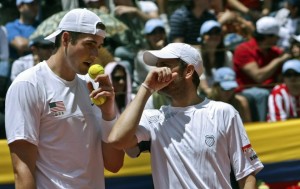
John Isner & Mardy Fish

After not playing an away match in South America in 13 years (since an away match against Brazil in 1997), the U.S. Davis Cup team will face their second-straight match in South America against the Chileans.

Chile is led by Fernando Gonzalez and Nicolas Massu, two legendary figures in tennis in their country based on their efforts at the 2004 and 2008 Olympic Games. Massu, who will turn 31 on October 10, won the gold medal in singles and in doubles with Gonzalez at the 2004 Games in Athens. Gonzalez won the Olympic bronze medal in singles in 2004 and the Olympic silver medal in singles in 2008. Gonzalez, 30, was ranked as high as No. 5 in the world and was a singles runner-up at the 2007 Australian Open.

However, both Gonzalez and Massu have struggled with their form and with injuries of late. Gonzalez has been hampered with a knee injury – even hinting that retirement might not be far off – with his ranking dropping to a current No. 44. Massu’s current ranking is at No. 128. The only other Chilean player ranked in the top 200 is Jorge Aguilar, who is ranked No. 198.

Gonzalez was forced to retire trailing 6-7, 6-1, 1-0 to Croatian qualifier Ivan Dodig in the first round of the 2010 US Open due to his nagging knee injury. “I’m worried and I’ll have to see what will happen,” said Gonzalez after the match. “I’m not thinking about retirement quite yet but I’ve had a really bad six months and, if this was to go on for longer, maybe two years, then I would have to see….It’s been 30 weeks out now and I will now take more time out to make the right decision for what I have to do. The prognosis isn’t that bad but that doesn’t solve the problem that it’s still really painful.”

The United States leads the head-to-head with Chile 4-0. Their last meeting came in the quarterfinals of the 2006 competition played on grass courts at Rancho Mirage, Calif., the U.S. winning 3-2. Their two previous matches played in Chile came in the 1978 quarterfinals – John McEnroe’s Davis Cup debut match – with the U.S. winning 3-2 in Santiago and in the 1972 Inter-zone Final, with the U.S. winning 5-0 again in Santiago.

Should the United States win against Chile, it would likely face a home tie against Spain, who hosts Belgium in the first round. The potential U.S. vs. Spain Davis Cup quarterfinal in the United States would be held July 8-10 – the week after Wimbledon and the same weekend as the International Tennis Hall of Fame induction ceremonies for Andre Agassi in Newport, R.I.

The first round match with Chile will be played at the end of the late winter South American clay court swing on the ATP World Tour, with clay-court events being played in Santiago, Chile (Feb. 1-7), Costa do Sauipe, Brazil (Feb. 8-14), Buenos Aires (Feb. 15-21) and Acapulco, Mexico (Feb. 22-29). The swing will provide both teams with ample South American clay-court tournament opportunities leading into the series. The BNP Paribas Open in Indian Wells will be played the week after the 2011 Davis Cup first round.

For the full 2011 Davis Cup draw, go to www.DavisCup.com

Next Page »

Primary Sidebar

Search the site

Randy Walker

Michael Zheng Caps Historic Sports Weekend For Columbia With NCAA Singles Title (Played In The Fall This Year)

November 24, 2024 By Admin

The Winding Final Year of Rafael Nadal’s Career Meets Its End In The Davis Cup Finals

November 19, 2024 By Admin

Ukraine Wins BJK Cup Match In Texas On Same Day When Russia Slams Their Nation With Over 200 Missiles

November 18, 2024 By Admin

Daniel Nestor Snubbed For Tennis Hall of Fame One Year After Slightly Less-Accomplished Leander Paes Gets Inducted

October 24, 2024 By Admin

More Posts from this Category

Sell your home fast in New York

Recent Posts

  • Neale Fraser Achieved (And Experienced) Things At The U.S. Championships That May Never Be Repeated
  • Common Racquet Mistakes
  • Juan Martin del Potro Bids Goodbye To Competitive Tennis In Exhibition Against Novak Djokovic

Popular Links

  • ATP World Tour
  • Tennis Grandstand
  • USTA
  • WTA Tour

Footer

Contact Us

c/o Randy Walker

Owner

1175 York Ave

Suite #3s

New York, NY 10065

Recent

  • Neale Fraser Achieved (And Experienced) Things At The U.S. Championships That May Never Be Repeated
  • Common Racquet Mistakes
  • Juan Martin del Potro Bids Goodbye To Competitive Tennis In Exhibition Against Novak Djokovic
  • Patrick Mouratouglou Talks About New Zephyrhills, Florida Tennis Academy
  • Juan Martin del Potro “Farewell Match” Against Novak Djokovic Sponsored By Aleph

Search

Copyright © World Tennis Magazine 2021 and beyond