• Skip to main content
  • Skip to secondary menu
  • Skip to primary sidebar
  • Skip to footer
World Tennis Magazine

World Tennis Magazine

Unique Tennis Perspectives

  • Home
  • World Tennis with Harry Cicma
  • Staff
  • About
  • Contact Us
  • Forum

Rene Stauffer

When Federer was the “Savior of Shanghai”

October 12, 2010 by WTM

Is Roger Federer “The Savior of Shanghai?”

Rene Stauffer, the author of the Federer book ROGER FEDERER: QUEST FOR PERFECTION ($19.95, New Chapter Press, www.RogerFedererBook.com) labeled him that from his appearance at the 2005 Tennis Masters Cup, held at the same venue – Qi Zhong Stadium – where this week’s Shanghai Rolex Masters is taking place.

The chapter of Stauffer’s book, called “The Savior of Shanghai” is excerpted below.

With the Grand Slam season of 2005 behind him, Roger Federer now focused on achieving his goals for the remainder of the calendar year. He wanted to play Davis Cup for Switzerland and help his homeland stay in the elite 16-team Davis Cup World Group and also protect his No. 1 ranking. He also wanted to defend his title in Bangkok, finally win the title in his hometown of Basel and, for the third year in a row, end the year with a victory at the Tennis Masters Cup. While he was at it, why not win titles in Madrid or in Paris at the Bercy tournament for the first time?

Federer’s plan got off to a good start, beginning with the Davis Cup. He rejoined the Swiss team for its Play-off Round match against Great Britain in Geneva. Federer easily defeated Alan Mackin in the opening singles match, and after he and Yves Allegro defeated Andy Murray and Greg Rusedski in four sets in the doubles, Switzerland clinched the victory that allowed the nation to remain in the Davis Cup World Group for a 12th straight year.
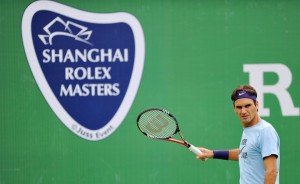
Roger Federer

Federer encountered Murray, the talented Scottish teenager, one week later in the singles final in Bangkok, when he won his 24th straight match in a singles final. The win in Bangkok clinched the year-end No. 1 for Federer, giving him the distinction of being ranked No. 1 in the world for every week of the 2005 season—a feat only achieved by four other players (Jimmy Connors, Ivan Lendl, Pete Sampras and Lleyton Hewitt.) As a reward, he and girlfriend Mirka Vavrinec treated themselves to a few days of vacation in Bangkok where they toured temples and Buddha statues and enjoyed the Thai cuisine. If not for Federer, Rafael Nadal was the clear cut No. 1 player for the 2005 season. The Spanish teenager won an astounding 11 tournaments, including the French Open and the Tennis Masters Series events in Monte Carlo, Rome, Montreal and Madrid. Nadal’s point total for the season ranked higher than four of the last five year-end No. 1 ranked players—Gustavo Kuerten (2000), Lleyton Hewitt (2001, 2002) and Andy Roddick (2003). In the era of Federer, this was only good enough for second place.

In October 11, Federer was in Allschwil, Switzerland training with countryman Michael Lammer, when he was once again struck by the “Curse of Basel.” At the same facility where he suffered a muscle tear the previous year, Federer injured his right ankle. He felt a searing pain and fell to the court and could not get back up. “At first I thought I had broken something,” he explained. The diagnosis was not that bad, but it was bad enough. Federer tore ligaments in his ankle and while surgery was not required, it forced him to withdraw from the events in Madrid, Basel and Paris. It was debatable if there was enough time for him to recover to play in the year-end Tennis Masters Cup in Shanghai in a month’s time.

Federer’s foot was in a cast and he was on crutches for two weeks. He did everything he could to accelerate the therapy to enable him to play in Shanghai. He underwent ultrasound, lymph drainage, massages, elevated the legs, special exercises—everything. To his benefit, he was not the only top player who was injured as the top 10 rankings at the time read more like a list of casualties. Three former Grand Slam tournament champions withdrew from Shanghai—Marat Safin was out with a bad left knee and Andy Roddick withdrew with a bad back. Lleyton Hewitt chose not to compete in Shanghai so he could spend time with his new wife, Bec Cartwright, who was expecting the couple’s first child.

A fourth former Grand Slam tournament winner, Andre Agassi, arrived in China still gimpy after injuring ligaments in his left ankle around the same time as Federer’s injury. After losing in his first round-robin match to Nikolay Davydenko 6-4, 6-2, Agassi also withdrew from the event. Since he won the tournament in Madrid in October, Nadal was troubled with a left-foot injury that caused him to withdraw from the events in Basel and Paris. Although he was in China with the expectation of competing, he also withdrew from the tournament just before his first scheduled match. Within a matter of hours, the tournament lost two of its most popular draws—Agassi and Nadal—and Federer’s start was still doubtful as well. The two-time defending champion arrived in Shanghai early to prepare, but he still didn’t know until two days before the event began whether he would compete at all.

The typhoon-proof stadium in Shanghai was nearly sold out—but for the ambitious Chinese organizers—the situation was far worse than a typhoon. After a highly successful staging of the 2002 Tennis Masters Cup in Shanghai, Chinese officials were able to lure the event back to their country for three years starting in 2005. During the two-year stint of the tournament in Houston, the Chinese built the magnificent Qi Zhong Stadium that seats 15,000 spectators in the Minhang district in southwestern Shanghai. The facility features a retractable roof that is shaped like a blooming magnolia—the city’s emblem. It is an eight-ton structure with eight retractable pieces that open and close. Since eight is Federer’s favorite number—because his birthday is on the eighth day of the eighth month—it made for a special connection between him and the tournament. Shanghai was also special for Federer since it was the site of his Tennis Masters Cup debut in 2002—and the memories were still fond. He even made an extra trip to take part of the official opening in the stadium in early October.

Federer’s injury was definitely the most serious of his career to date. While he was healthy enough to play in the tournament, his expectations were low. He did not properly prepare for the event and did not rule out the possibility of losing all three of his round-robin matches. In his opening match, Federer surprised himself when he was able to defeat David Nalbandian 6-3, 2-6, 6-4. He described the victory as one of the finest wins of his career, which gave some indication how ill-prepared for the tournament he actually felt.

Federer’s next match with Ivan Ljubicic became a high-point of the tournament. Ljubicic was regarded as a threat to win the title after posting the best indoor record of any player during the year. After Federer gave fans—and organizers—a scare when he called for a trainer to treat him on court before the third set, he saved three match points before prevailing in a 7-4 final-set tie-break. The win clinched Federer’s spot in the semifinals as the winner of his group.

In the semifinals, Federer registered an incredible 6-0, 6-0 thrashing of Gaston Gaudio of Argentina that not only moved him into the Tennis Masters Cup final for a third straight year, but gave him an 81-3 record for the year. He was within one match victory of tying John McEnroe’s record for the best won-loss record in the history of men’s tennis. In 1984, McEnroe won both the US Open and Wimbledon and achieved a record of 82-3. Nalbandian, whom Federer defeated in his opening round-robin match, was the only barrier that stood in his way of tying this important record. However, unlike round-robin play, the final was a best-of-five set affair, making the achievement that much more difficult for the out-of-match-practice Federer. Tie-breaks decided the first two sets, with Federer winning a first-set tie-break 7-4 and a second-set tie-break 13-11. With two hours of arduous tennis needed to take the two sets-to-love lead, Federer began to look weary in the early stages of the third set. Nalbandian took advantage and crawled back into the match. During a stretch in the fourth and fifth sets, Federer lost 10 straight games to trail 0-4 in the fifth set. At 0-30 in the fifth game of the final set, Federer, perhaps motivated by chants of “Roger! Roger!” as well as by his own will and pride, began to rally back into the match. Forty-five minutes later, he was just two points from victory serving for the match at 6-5, 30-0. Nalbandian, however, turned the tide again. Federer would later say, “I wasn’t playing to win any longer but just to make it as hard as possible for him.”

After breaking Federer back to force the final-set tie-break, Nalbandian rallied to win the match 6-7 (4), 6-7(11), 6-2, 6-1, 7-6 (3). Federer watched Nalbandian sink to the ground after the greatest victory of his career and as the first Argentinean Masters champion in 31 years. “I came closer to winning the tournament than I had thought,” said Federer. “Under these circumstances, this was one of the best performances of my career. This tournament was probably the most emotional one for me this year.”

Whether satisfied with his effort or not, the loss, nonetheless, meant the end of several of Federer’s streaks. It was his first defeat since the semifinals of the French Open in early June—a streak of 35 matches and the fifth-longest match winning streak in ATP history. (Nalbandian’s countryman Guillermo Vilas is the record-holder with 46 straight victories). The loss also marked his first defeat in a tournament final since July of 2003—a streak of 24 straight final-round matches. Although he only lost four matches, he ranked his 2005 season worse than 2004, since two of his four defeats happened at Grand Slam tournaments. “But this season was unbelievable as well,” he said. “At some stages, I felt invincible.”

Thanks to the star power of Federer, the Tennis Masters Cup was not a complete disaster for the Chinese promoters. The fledgling tennis movement in Asia continued. A few months later, the ATP renewed its contract for Shanghai to assume organization for the Masters through 2008. “If the tournament had been damaged by the many forfeits, then it was compensated for by one of the most exciting matches of the year,” the Shanghai Daily wrote the day after the epic Federer-Nalbandian final. John McEnroe was also satisfied. “It was nice to see how hard Federer fought to break my record,” McEnroe said. “Perhaps people will now realize that it’s not so easy to achieve a record of 82-3.”

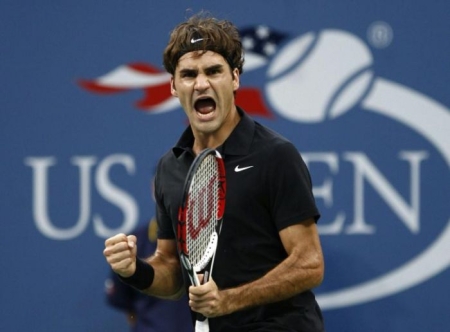
Roger Federer As A 16 Year Old

September 22, 2009 by WTM

It was on September 22, 1997 that 16-year-old Roger Federer debuted on the ATP computer. As documented in the book ON THIS DAY IN TENNIS HISTORY, Federer was less than two months after turning 16 years old when he debuted on the ATP computer with a world ranking of No. 803. Nearly six and half years later, the man from Basel, Switzerland moved into the No. 1 ranking on the computer, and kept the top spot for more consecutive weeks than any player in the history of the sport.

Roger Federer
Roger Federer

Rene Stauffer, the Swiss reporter who wrote the Federer biography THE ROGER FEDERER STORY: QUEST FOR PERFECTION ($24.95, New Chapter Press, www.RogerFedererBook.com), documents the future six-time Wimbledon champion during this time period in his global selling book, excerpted below.

His rush towards the top continued unimpeded in 1997 when he won both the indoor and outdoor Swiss national junior championships in the 18-and-under division. These titles marked his last national titles as Roger became more focused on the challenges of international tennis. Allegro, who fell victim to Federer during his final national junior triumphs, said he began to notice the enormous potential that lay dormant within the player. “When Roger was returning to Ecublens from a major international junior tourna­ment in Prato, Italy, I asked him how it went and how did he play,” Allegro said. “Roger said, ‘Well. Thank you. I won.’ I said, right, sure, but he had re­ally won and, not only that, but without losing a set. I thought to myself if he can win at tournament like this at 16, he’s really going to be a great player.”

Allegro recalled another story during this time period that also impressed him and gave him the indication of where Federer was headed. “We had to fill out a form stating our goals. Everybody wrote: To someday be among the top 100 in the world, but Roger was the only one to write: To first be in the top 10 in the world and then become No. 1,” he said. “From that point on, we viewed him in a different light.”

Swiss Tennis made a big move in 1997. Ecublens served its purpose and the “House of Tennis”—the new Swiss National Tennis Center opened in Biel along the German-French language border within Switzerland. The National Tennis Center, the “Tennis Etudes” program as well as the association admin­istration was united under one roof at this facility. There were courts with a variety of surfaces, a modern restaurant and a real players’ lounge—a vast improvement over Ecublens.

At the same time, Swiss Tennis also expanded its training staff. Among the new members of the coaching staff was Peter Carter, Federer’s coach from Basel. “He was brought in under the ulterior motive that he could be paired with Roger,” Annemarie Rüegg admitted. “We saw the potential he had and wanted to provide him with individualized training.” Federer also sometimes worked with another coach, Peter Lundgren, a former professional player from Sweden.

In the summer of 1997, at the age of 16, Roger Federer completed the man­datory nine years at school and decided to become a professional tennis player. With the exception of a few English and French lessons, he concentrated com­pletely on the sport from this point forward. His parents were aware that this step was unpredictable and risky. “We had immense respect for the entire process,” Robert Federer recalled. “Everybody was telling us how talented Roger was,” his mother added. “But we wanted to see results. We made it very clear to Roger that we could not financially support him for ten years so that he could dangle around 400 in the world rankings.” Although the parents’ finan­cial commitment to Roger’s career was sustainable—due to the Swiss Tennis Federation’s assistance with Roger—Lynette Federer increased her workload from 50 to 80 percent in order to ensure the family’s financial security. Money, it would soon prove, would not become an issue for very long.

Now training in Biel, Roger no longer lived with a guest family and moved into an apartment with his good friend Allegro. “Roger’s parents approached me and said that he would like to share an apartment with an older player and they asked me if I would be willing to do this,” said Allegro. “This sound­ed financially interesting to me so Roger’s and my parents went out looking for apartments together.”

The 16-year-old and the 19-year-old teenagers moved into a two-bedroom apartment with a kitchen, a bathroom and a small terrace above a soccer field. “We often watched matches and gave live commentary,” Allegro said. “It was a lot of fun. I usually did the cooking because I had more experience. Roger didn’t have much initiative but he always helped if I asked him to. His room was usually somewhat messy and when he cleaned it up, it was just as chaotic two days later.”

The young professionals, however, were completely focused on the sport. They otherwise passed the time watching television or playing electronic video games. “Roger was never a party guy,” Allegro said. “I once read that he drank alcohol but that only happened very rarely.” He played computer games sometimes until two in the morning but he never went out or went to parties.

Marco Chiudinelli, meanwhile, moved to Biel to further his tennis abilities and also became part of Federer’s circle. “We were cyber world guys,” said Chiudinelli. “We never felt attracted to parties and smoking or drinking didn’t interest us. We preferred to hang out on the courts or at the Playstation.”

Roger was still the same playful, fancy-free hot head whose temper some­times exploded. “You often heard a yodeling, a liberating primal scream from the dressing room or the players’ lounge,” Annemarie Rüegg recalled. “You knew it was Roger. He needed to do this as a release. He was pretty loud but it wasn’t unpleasant.”

Federer Serves Bagels To Hewitt

September 5, 2009 by WTM

Roger Federer is looking for his sixth straight US Open men’s singles title at the 2009. The first of his five straight titles in New York came in 2004 when he defeated Lleyton Hewitt, his third-round opponent in 2009, in the final. Rene Stauffer, the author of the Federer biography THE ROGER FEDERER STORY: QUEST FOR PERFECTION ($24.95, New Chapter Press, www.RogerFedererBook.com) details the 2004 US Open final between Federer and Hewitt in his celebrated tome. The brief book excerpt is seen below…

Awaiting him in the final was another of his past nemeses, Lleyton Hewitt, the 2001 US Open champion. The Australian skipped the Olympic Games, but won the two ATP tournaments played concurrently to the Olympics in Washington, D.C. and in Long Island. Entering his match with Federer, he won his last 16 matches and did not surrender a set in his six-match run to the final.

It only took 17 minutes for Federer to hand Hewitt his first lost set of the tournament, losing only five points in a near perfect execution of tennis. When Hewitt won his first game of the match after Federer led 6-0, 2-0, the crowd at Arthur Ashe Stadium gave him a standing ovation. Federer contin­ued to be the much stronger player, until a lapse of concentration and a run of errors and missed serves allowed Hewitt to win four straight games after trailing 2-5 in the second set.

“If he had managed to win the second set, it would have turned out to be an entirely different match,” Federer said. “I forced myself to keep positive. I said to myself that I only got this break because I was playing against the wind and I was serving with old balls. When I changed sides, everything actually did go easier.”

Federer held serve at 5-6 to force the tiebreak and won that 7-3. The two-set lead broke Hewitt’s resistance and Federer plowed through the final set 6-0 to win his first US Open championship.

“First I was surprised that Lleyton was no longer getting to the ball,” Federer said of his moment of victory. “Then I was suddenly lying on my back, look­ing into the sky at the lights of the stadium. I thought, ‘That’s unbelievable.’ Once again I was close to tears.”

Federer and Hewitt rewind

September 4, 2009 by WTM

Roger Federer and Lleyton Hewitt will meet in an epic third round match up at the 2009 US Open in a battle of former champions. Rene Stauffer, the author of book THE ROGER FEDERER STORY: QUEST FOR PERFECTION ($24.95, New Chapter Press, www.RogerFedererBook.com) describes a memorable match-up between the two future Hall of Famers from the 2002 Tennis Masters Cup in Shanghai, China. The excerpt is below.

In the semifinals, Federer faced Hewitt, who already clinched the year-end No. 1 ranking for a second year in a row. The Australian barely qualified for the semifinals and benefited from Carlos Moya winning a three-hour mean­ingless match over fellow Spaniard Costa, where a Costa victory would have him reach the semifinals rather than Hewitt. Although Federer lost five of the last seven matches with Hewitt, he reasoned his chances of beating him and winning the first big championship of his career were very attainable.

Federer started his semifinal with Hewitt in furious fashion, taking a 3-0 and a 5-2 first-set lead, but Hewitt ran and fought as if his life were at stake. Hewitt fought off five set points and rallied for a 6-5 lead. Serving for the set, Hewitt staved off another five break points, before capturing the first set 7-5. Federer, however, was not ready to surrender. The second set turned into a wild back-and-forth struggle. Hewitt served for the match at 5-4 and held match point, but Federer broke back for 5-5. After holding serve for 6-5, Federer evened the match by breaking Hewitt’s serve, connecting on his fourth set point of the game.

The Chinese fans went wild—out of their seats, screaming and cheering. In the commentary booth high above the stadium, Heinz Günthardt and Stefan Bürer, the Swiss TV commentary team, described the tension and fast-paced action to the audience back in Switzerland, where it was Saturday morning and many people postponed their weekend shopping to watch the dramatic match with their new sports hero.

As the match extended into a third hour, the breaks seemed to fall in favor of Federer. Leading 4-3 in the final set, Federer held two break points to put him in the position to serve for the match. Both opportunities, however, were lost and Hewitt held for 4-4. Hewitt then subsequently broke Federer’s serve the next game to serve for the match at 5-4. The Australian reached his second match point—and shockingly double-faulted. Federer then broke Hewitt’s serve to square the match at 5-5. Serving with new balls in the next game, Federer committed two consecutive double-faults to allow Hewitt to break him back and gained another opportunity to serve for the match. It took Hewitt another four match points before he finally corralled Federer and advanced to the final with an epic 7-5, 5-7, 7-5 victory. Following the match, Hall of Fame journalist Bud Collins walked into the press room and asked his fellow scribes, “Have you ever seen a better match?”

In the craziest match of his career to date, Federer was aware that he let victory escape from his grasp. “I have no one to blame but myself,” he said to a small group of Swiss journalists who traveled to China. “Luck wasn’t on my side. I blew a big opportunity. That hurts.” A vacation in Phuket, Thailand helped heal the wounds.

FEDERER’S FIRST OF FIVE US OPEN TITLES

August 28, 2009 by admin

Roger Federer is no doubt the King of the US Open. He will be seeking his sixth straight men’s singles title in 2009, equaling the effort by Bill Tilden, who won six straight titles from 1920-1925. The all-time tournament record for consecutive men’s singles titles came when Richard Sears won the first seven U.S. titles, but Sears only had to win one match – the challenge round – to win the last six of his titles.

Roger’s reign in Flushing began in 2004, highlighted by an incredible five-set win over Andre Agassi in the quarterfinals and a decisive “double bagel” over Lleyton Hewitt in the final. Swiss journalist and author Rene Stauffer summarizes Roger’s first US Open title in his book THE ROGER FEDERER STORY: QUEST FOR PERFECTION ($24.95, New Chapter Press, www.RogerFedererBook.com), excerpted below.

Federer had little trouble advancing into the quarterfinals, where he faced Agassi, now age 34. After a European summer highlighted by physical problems and unexpected defeats, Agassi found his groove on the American hard courts, defeating both Roddick and Hewitt to win the title in Cincinnati—his first title in over a year. Agassi’s confidence was high.

In one of the US Open’s celebrated night matches, Federer and Agassi battled on Wednesday evening, September 8, and Federer immediately found his rhythm. He was leading 6-3, 2-6, 7-5 when it began raining and play was postponed. The match resumed the following afternoon and the players were greeted with gale force winds—as part of the weather front that swept through New York as a leftover from Hurricane Frances that battered Florida earlier in the week. Federer described the wind swirls as being the worst conditions that he ever played under. “Just five years ago I would have gone nuts playing in such a wind,” he said.

The wind forced Federer to change tactics. He no longer tried to go for winners and display his usual aggressive style, but concentrated on getting the ball and his serves over the net and simply into play—which in the windy conditions was itself a challenge. “I played just like at practice and that was the right recipe,” he said. A 6-3, 2-6, 7-5, 3-6, 6-3 win over Agassi put him into the semifinals of the US Open for the first time, where he would face an old acquaintance, Tim Henman. The 30-year-old Brit won six of his eight career matches with his Swiss rival, but Federer was a different player than many of the previous matches, with more self-confidence and stamina. As in March in Indian Wells, Federer encountered little resistance with Henman, winning 6-3, 6-3, 6-4 to advance into the championship match at the US Open for the first time.

Awaiting him in the final was another of his past nemeses, Lleyton Hewitt, the 2001 US Open champion. The Australian skipped the Olympic Games, but won the two ATP tournaments played concurrently to the Olympics in Washington, D.C. and in Long Island. Entering his match with Federer, he won his last 16 matches and did not surrender a set in his six-match run to the final.

It only took 17 minutes for Federer to hand Hewitt his first lost set of the tournament, losing only five points in a near perfect execution of tennis. When Hewitt won his first game of the match after Federer led 6-0, 2-0, the crowd at Arthur Ashe Stadium gave him a standing ovation. Federer contin–ued to be the much stronger player, until a lapse of concentration and a run of errors and missed serves allowed Hewitt to win four straight games after trailing 2-5 in the second set.

“If he had managed to win the second set, it would have turned out to be an entirely different match,” Federer said. “I forced myself to keep positive. I said to myself that I only got this break because I was playing against the wind and I was serving with old balls. When I changed sides, everything actually did go easier.”

Federer held serve at 5-6 to force the tiebreak and won that 7-3. The two-set lead broke Hewitt’s resistance and Federer plowed through the final set 6-0 to win his first US Open championship.

“First I was surprised that Lleyton was no longer getting to the ball,” Federer said of his moment of victory. “Then I was suddenly lying on my back, look–ing into the sky at the lights of the stadium. I thought, ‘That’s unbelievable.’ Once again I was close to tears.”

Roger Federer’s victory at the 2004 US Open provided new content for the record books of tennis. Statisticians and historians of the game quickly discovered that he was only the second man in the “Open Era” of profes–sional tennis (since 1968) to win a Grand Slam final with two 6-0 sets. The other was the Argentinean Guillermo Vilas, who dominated American Brian Gottfried 6-0, 6-3, 6-0 at Roland Garros in 1977. The last time a player won a final at the U.S. Championships with two 6-0 sets came back in 1884 in only the fourth edition of the U.S. national championship and in the days of tennis infancy.

In the United States, 6-0 sets are referred to as “bagels” with a “double bagel” being considered the bitterest variety when a match is lost 6-0, 6-0. In German-speaking countries, these whitewashes are called a “bicycle.” Although, Lleyton Hewitt was able to force a second-set tie-break against Federer in the US Open final, he was not spared the shame of the “double bagel” or “the bicycle.” The Australian Associated Press (AAP) exaggerated that Hewitt’s loss was “the greatest humiliation in the history of Grand Slam finals.” One reporter in the post-match press conference even had the audac–ity to ask Hewitt if it was difficult to swallow a “double bagel.”

More importantly in historical significance was that Federer, with his vic–tories at the Australian Open, Wimbledon and the US Open, became only the fourth man in the Open Era of tennis to win at least three of the four Grand Slam titles in a calendar year. Mats Wilander from Sweden was the last man to manage such a feat in 1988, as did Rod Laver, who won all four Grand Slams in 1969, and Jimmy Connors, who won the Australian, Wimbledon and the US Open in 1974. Don Budge was the first player to win all four major titles in the same year—the Grand Slam—in 1938. The term “Grand Slam” was first coined when American tennis writer Allison Danzig suggested in 1938 that Budge scored a Grand Slam of victories—like a winning bridge player—at the four most prestigious championships of the year.

Laver, a left-hander given the nickname the “Rockhampton Rocket,” even managed to win the Grand Slam twice—once in 1962 as an amateur and again in 1969 as a professional. In Laver’s time, however, this accomplish–ment had a different value and was less significant than today as three of the four Grand Slam events were played on grass courts, unlike the four different surfaces of today’s game.

In women’s tennis, three players have won the Grand Slam—the American Maureen Connolly (1953), the Australian Margaret Smith Court (1970), as well as Steffi Graf (1988). The German, who married Andre Agassi after her tennis career, also won at the Olympic Games in Seoul in 1988 giving her the distinction of winning what is called the “Golden Slam.” Martina Hingis, like Federer, won the Australian Open, Wimbledon and the US Open in 1997, narrowly missing the Grand Slam, with her surprising loss to Iva Majoli in the French final preventing her from joining this elite club.

In New York, Federer once again proved his ability to amplify his perfor–mance in the final stages of the tournament. He became the first professional player to win all of his first four Grand Slam tournament finals. It was almost equally amazing that in this feat, he lost only one set in his eight matches in the semifinals and finals. In the meantime, Federer’s US Open final marked the 11th straight victory in a tournament final. For Federer, a tournament final proved to be his greatest motivation. His attitude was simple—what’s the use of all the effort and match victories if you ultimately lose in the final? Winners stay, losers go.

The coup at Flushing Meadows transformed him into a sports star on Broadway. The American media celebrated him lavishly and some journalists even asked the question at such a pre-mature stage if he would be the man who would break Pete Sampras’ record of 14 Grand Slam titles.

Federer remained grounded and modest in the hour of his greatest achievement in the United States. “I honestly never expected to win the US Open,” he said. “Until a year ago, I always had problems in the United States. The Americans always play with more confidence in their home tour–naments than anywhere else. Conditions are difficult with the high heat and humidity.”

But he admitted something else; “I had a strange feeling before the final because everybody was talking about how long it had been since anybody had won his first four Grand Slam finals. I knew that I only had this one chance to do this.” Some were already talking that Federer was in a position to achieve the Grand Slam, but he didn’t allow these musings of grandeur to mislead him. “I would be really happy if I were to win one of the four Grand Slams next year,” he said the day after his US Open triumph during an extended interview session with a select group of journalists. “I know that I have to work hard for each match and for each title. It’s crazy what’s happening to me now. It’s out of this world.”

Federer’s US Open title generously extended his points lead on the No. 1 ranking. His margin between him at No. 1 and Roddick, his next challenger at No. 2, was extended from 1390 points to 2990 points—the equivalent of three Grand Slam titles. It would be impossible for any player to overtake him before the end of the year, even if Federer lost every match for the rest of the year. In the last four years, the year-end Tennis Masters Cup was the final determining tournament to decide the year-end No. 1 player. However, 2004 was not a normal year and thanks to the US Open, the year-end No. 1 was already in the books.

The Monday after the US Open brought Federer to the realization that the clocks tick differently in the American media world. He was chauffeured in a stretch limousine from one television station to another—7:45 am at ESPN’s show “Cold Pizza,” then at 8:30 am to the “CBS Early Show” and then at 9:30 am at “Live with Regis and Kelly,” followed by a photo shoot in Times Square, and a meeting with a select group of print journalists at the Hard Rock Café. At 2:30 pm, he was a guest on John McEnroe’s television talk show, and finally he appeared on the “Charlie Rose Show.” He had to prove his dexterity at ping-pong at two of his television appearances. Many things are possible in the United States, but setting up a tennis court in a television studio is not one of them.

Roger Federer’s First of Five US Open Titles

August 28, 2009 by WTM

Roger Federer is no doubt the King of the US Open. He will be seeking his sixth straight men’s singles title in 2009, equaling the effort by Bill Tilden, who won six straight titles from 1920-1925. The all-time tournament record for consecutive men’s singles titles came when Richard Sears won the first seven U.S. titles, but Sears only had to win one match – the challenge round – to win the last six of his titles.

Roger Federers First of Five US Open Titles
Roger Federer's First of Five US Open Titles

Roger’s reign in Flushing began in 2004, highlighted by an incredible five-set win over Andre Agassi in the quarterfinals and a decisive “double bagel” over Lleyton Hewitt in the final. Swiss journalist and author Rene Stauffer summarizes Roger’s first US Open title in his book THE ROGER FEDERER STORY: QUEST FOR PERFECTION ($24.95, New Chapter Press, www.RogerFederer Book.com), excerpted below.

Federer had little trouble advancing into the quarterfinals, where he faced Agassi, now age 34. After a European summer highlighted by physical problems and unexpected defeats, Agassi found his groove on the American hard courts, defeating both Roddick and Hewitt to win the title in Cincinnati—his first title in over a year. Agassi’s confidence was high.

In one of the US Open’s celebrated night matches, Federer and Agassi battled on Wednesday evening, September 8, and Federer immediately found his rhythm. He was leading 6-3, 2-6, 7-5 when it began raining and play was postponed. The match resumed the following afternoon and the players were greeted with gale force winds—as part of the weather front that swept through New York as a leftover from Hurricane Frances that battered Florida earlier in the week. Federer described the wind swirls as being the worst conditions that he ever played under. “Just five years ago I would have gone nuts playing in such a wind,” he said.

The wind forced Federer to change tactics. He no longer tried to go for winners and display his usual aggressive style, but concentrated on getting the ball and his serves over the net and simply into play—which in the windy conditions was itself a challenge. “I played just like at practice and that was the right recipe,” he said. A 6-3, 2-6, 7-5, 3-6, 6-3 win over Agassi put him into the semifinals of the US Open for the first time, where he would face an old acquaintance, Tim Henman. The 30-year-old Brit won six of his eight career matches with his Swiss rival, but Federer was a different player than many of the previous matches, with more self-confidence and stamina. As in March in Indian Wells, Federer encountered little resistance with Henman, winning 6-3, 6-3, 6-4 to advance into the championship match at the US Open for the first time.

Awaiting him in the final was another of his past nemeses, Lleyton Hewitt, the 2001 US Open champion. The Australian skipped the Olympic Games, but won the two ATP tournaments played concurrently to the Olympics in Washington, D.C. and in Long Island. Entering his match with Federer, he won his last 16 matches and did not surrender a set in his six-match run to the final.

[amazon-product align=”left”]0942257391[/amazon-product]It only took 17 minutes for Federer to hand Hewitt his first lost set of the tournament, losing only five points in a near perfect execution of tennis. When Hewitt won his first game of the match after Federer led 6-0, 2-0, the crowd at Arthur Ashe Stadium gave him a standing ovation. Federer contin­ued to be the much stronger player, until a lapse of concentration and a run of errors and missed serves allowed Hewitt to win four straight games after trailing 2-5 in the second set.

“If he had managed to win the second set, it would have turned out to be an entirely different match,” Federer said. “I forced myself to keep positive. I said to myself that I only got this break because I was playing against the wind and I was serving with old balls. When I changed sides, everything actually did go easier.”

Federer held serve at 5-6 to force the tiebreak and won that 7-3. The two-set lead broke Hewitt’s resistance and Federer plowed through the final set 6-0 to win his first US Open championship.

“First I was surprised that Lleyton was no longer getting to the ball,” Federer said of his moment of victory. “Then I was suddenly lying on my back, look­ing into the sky at the lights of the stadium. I thought, ‘That’s unbelievable.’ Once again I was close to tears.”

Roger Federer’s victory at the 2004 US Open provided new content for the record books of tennis. Statisticians and historians of the game quickly discovered that he was only the second man in the “Open Era” of profes­sional tennis (since 1968) to win a Grand Slam final with two 6-0 sets. The other was the Argentinean Guillermo Vilas, who dominated American Brian Gottfried 6-0, 6-3, 6-0 at Roland Garros in 1977. The last time a player won a final at the U.S. Championships with two 6-0 sets came back in 1884 in only the fourth edition of the U.S. national championship and in the days of tennis infancy.

In the United States, 6-0 sets are referred to as “bagels” with a “double bagel” being considered the bitterest variety when a match is lost 6-0, 6-0. In German-speaking countries, these whitewashes are called a “bicycle.” Although, Lleyton Hewitt was able to force a second-set tie-break against Federer in the US Open final, he was not spared the shame of the “double bagel” or “the bicycle.” The Australian Associated Press (AAP) exaggerated that Hewitt’s loss was “the greatest humiliation in the history of Grand Slam finals.” One reporter in the post-match press conference even had the audac­ity to ask Hewitt if it was difficult to swallow a “double bagel.”

More importantly in historical significance was that Federer, with his vic­tories at the Australian Open, Wimbledon and the US Open, became only the fourth man in the Open Era of tennis to win at least three of the four Grand Slam titles in a calendar year. Mats Wilander from Sweden was the last man to manage such a feat in 1988, as did Rod Laver, who won all four Grand Slams in 1969, and Jimmy Connors, who won the Australian, Wimbledon and the US Open in 1974. Don Budge was the first player to win all four major titles in the same year—the Grand Slam—in 1938. The term “Grand Slam” was first coined when American tennis writer Allison Danzig suggested in 1938 that Budge scored a Grand Slam of victories—like a winning bridge player—at the four most prestigious championships of the year.

Laver, a left-hander given the nickname the “Rockhampton Rocket,” even managed to win the Grand Slam twice—once in 1962 as an amateur and again in 1969 as a professional. In Laver’s time, however, this accomplish­ment had a different value and was less significant than today as three of the four Grand Slam events were played on grass courts, unlike the four different surfaces of today’s game.

In women’s tennis, three players have won the Grand Slam—the American Maureen Connolly (1953), the Australian Margaret Smith Court (1970), as well as Steffi Graf (1988). The German, who married Andre Agassi after her tennis career, also won at the Olympic Games in Seoul in 1988 giving her the distinction of winning what is called the “Golden Slam.” Martina Hingis, like Federer, won the Australian Open, Wimbledon and the US Open in 1997, narrowly missing the Grand Slam, with her surprising loss to Iva Majoli in the French final preventing her from joining this elite club.

In New York, Federer once again proved his ability to amplify his perfor­mance in the final stages of the tournament. He became the first professional player to win all of his first four Grand Slam tournament finals. It was almost equally amazing that in this feat, he lost only one set in his eight matches in the semifinals and finals. In the meantime, Federer’s US Open final marked the 11th straight victory in a tournament final. For Federer, a tournament final proved to be his greatest motivation. His attitude was simple—what’s the use of all the effort and match victories if you ultimately lose in the final? Winners stay, losers go.

The coup at Flushing Meadows transformed him into a sports star on Broadway. The American media celebrated him lavishly and some journalists even asked the question at such a pre-mature stage if he would be the man who would break Pete Sampras’ record of 14 Grand Slam titles.

Federer remained grounded and modest in the hour of his greatest achievement in the United States. “I honestly never expected to win the US Open,” he said. “Until a year ago, I always had problems in the United States. The Americans always play with more confidence in their home tour­naments than anywhere else. Conditions are difficult with the high heat and humidity.”

But he admitted something else; “I had a strange feeling before the final because everybody was talking about how long it had been since anybody had won his first four Grand Slam finals. I knew that I only had this one chance to do this.” Some were already talking that Federer was in a position to achieve the Grand Slam, but he didn’t allow these musings of grandeur to mislead him. “I would be really happy if I were to win one of the four Grand Slams next year,” he said the day after his US Open triumph during an extended interview session with a select group of journalists. “I know that I have to work hard for each match and for each title. It’s crazy what’s happening to me now. It’s out of this world.”

Federer’s US Open title generously extended his points lead on the No. 1 ranking. His margin between him at No. 1 and Roddick, his next challenger at No. 2, was extended from 1390 points to 2990 points—the equivalent of three Grand Slam titles. It would be impossible for any player to overtake him before the end of the year, even if Federer lost every match for the rest of the year. In the last four years, the year-end Tennis Masters Cup was the final determining tournament to decide the year-end No. 1 player. However, 2004 was not a normal year and thanks to the US Open, the year-end No. 1 was already in the books.

The Monday after the US Open brought Federer to the realization that the clocks tick differently in the American media world. He was chauffeured in a stretch limousine from one television station to another—7:45 am at ESPN’s show “Cold Pizza,” then at 8:30 am to the “CBS Early Show” and then at 9:30 am at “Live with Regis and Kelly,” followed by a photo shoot in Times Square, and a meeting with a select group of print journalists at the Hard Rock Café. At 2:30 pm, he was a guest on John McEnroe’s television talk show, and finally he appeared on the “Charlie Rose Show.” He had to prove his dexterity at ping-pong at two of his television appearances. Many things are possible in the United States, but setting up a tennis court in a television studio is not one of them.

Federer Fined For Violating “Best Effort” Rule

August 25, 2009 by admin

Yes. Roger Federer was fined for violating the “Best Effort” rule…..back in 1998. The six-time Wimbledon champion was fined for breaking this rule. In the book, THE ROGER FEDERER STORY, QUEST FOR PERFECTION (www.rogerfedererbook.com) the author, Rene Stauffer documents when Federer was hit with a fine for violating the rule in the Kublis, Switzerland satellite event in 1998. The book excerpt is below.

After appearances in big events in Toulouse and Basel, Federer next competed on the much lower level Swiss satellite circuit—and felt as if he were in a bad movie. He just played before 9,000 spectators against Agassi, one of the all-time greats, in front of a major television audience with all the newspapers writing articles about him. Meanwhile, he just signed with the world’s largest sports agency, International Management Group, and was be–ing supplied, like Pete Sampras, by brands such as Nike and Wilson. But now he suddenly found himself in the eastern Swiss town of Küblis, in a gloomy tennis stadium in a valley wedged in the Bündner Mountains. There were no spectators, no line judges and no ball boys. He was not facing Andre Agassi, but Armando Brunold, the No. 11 player in Switzerland, whom Federer by now outclassed as the No. 6 player in the country.

The first-round match at the circuit’s first tournament proved to be a cul–ture shock for Federer and he reacted apathetically. His listlessness didn’t escape tournament referee Claudio Grether. “He simply stood unmotivated and non-chalantly on the court and double-faulted twice each game,” Grether explained. After Federer lost to Brunold 7-6, 6-2, Grether imposed a $100 fine against Federer because he violated the “best effort” rule stipulating that professional players must put forth their best efforts in every competition. “I could have disqualified him as well but then he would no longer have been able to compete in the rest of the circuit,” Grether said. Federer silently re–ceived the verdict. With prize money earnings of only $87, Federer left Küblis with a $13.00 deficit. It would be the only professional tournament he played where he actually lost money.

But Federer learned his lesson. “The fine was justified,” he admitted and he reacted in a way that showed his class. A week later, he won the second tournament on the circuit and went on to win the circuit’s overall points title. His effort paid off and despite his initial setback, he moved passed 100 opponents in the world rankings, landing at No. 303. Not bad for somebody who just turned 17

Primary Sidebar

Search the site

Randy Walker

Michael Zheng Caps Historic Sports Weekend For Columbia With NCAA Singles Title (Played In The Fall This Year)

November 24, 2024 By Admin

The Winding Final Year of Rafael Nadal’s Career Meets Its End In The Davis Cup Finals

November 19, 2024 By Admin

Ukraine Wins BJK Cup Match In Texas On Same Day When Russia Slams Their Nation With Over 200 Missiles

November 18, 2024 By Admin

Daniel Nestor Snubbed For Tennis Hall of Fame One Year After Slightly Less-Accomplished Leander Paes Gets Inducted

October 24, 2024 By Admin

More Posts from this Category

Sell your home fast in New York

Recent Posts

  • Neale Fraser Achieved (And Experienced) Things At The U.S. Championships That May Never Be Repeated
  • Common Racquet Mistakes
  • Juan Martin del Potro Bids Goodbye To Competitive Tennis In Exhibition Against Novak Djokovic

Popular Links

  • ATP World Tour
  • Tennis Grandstand
  • USTA
  • WTA Tour

Footer

Contact Us

c/o Randy Walker

Owner

1175 York Ave

Suite #3s

New York, NY 10065

Recent

  • Neale Fraser Achieved (And Experienced) Things At The U.S. Championships That May Never Be Repeated
  • Common Racquet Mistakes
  • Juan Martin del Potro Bids Goodbye To Competitive Tennis In Exhibition Against Novak Djokovic
  • Patrick Mouratouglou Talks About New Zephyrhills, Florida Tennis Academy
  • Juan Martin del Potro “Farewell Match” Against Novak Djokovic Sponsored By Aleph

Search

Copyright © World Tennis Magazine 2021 and beyond