• Skip to main content
  • Skip to secondary menu
  • Skip to primary sidebar
  • Skip to footer
World Tennis Magazine

World Tennis Magazine

Unique Tennis Perspectives

  • Home
  • World Tennis with Harry Cicma
  • Staff
  • About
  • Contact Us
  • Forum

PODCASTS

Emma Raducanu Trivia: Who Was The First Player She Beat In Her Historic 10-Match U.S. Open Run?

August 18, 2022 by Admin

By Randy Walker

@TennisPublisher

Emma Raducanu made history at the 2021 U.S. Open when she became the first player to emerge via qualifying rounds to win a major singles title.

Who was the first player that Raducanu beat in her historic run? It’s an excellent trivia question, sure to stump even the most astute followers of the game.

The answer to the question is Bibi Schoofs of The Netherlands who lost 6-1, 6-2 to Raducanu in the first round of qualifying at the Billie Jean King USTA National Tennis Center.

I decided to reach out to Schoofs and do a short interview about the match, her status as Trivial Pursuit answer and about her thoughts on Raducanu’s run to her historic title. She also revealed some fascinating perspectives on playing in qualifying events at Grand Slams and on the ITF World Tennis Tour, the “minor leagues” of professional tennis. She also talked about experiences and moments in tennis – not necessarily where she was victorious on the court – that she holds dear and is the reason why she continues to pursue her dreams in tennis.

Watch the interview here:  https://www.youtube.com/watch?v=C9EpJhG8-Ac

Schoofs, who is currently recovering from a serious foot injury, reached a career high of No. 142 in singles and No. 83 in doubles on the WTA Tour. While she won one WTA Tour doubles title (Auckland, New Zealand in 2018 with Sara Errani. which she hilariously discusses in her interview), she excelled on the ITF World Tennis Tour. She won eight singles titles in 19 finals in singles and won 21 doubles titles in 37 finals.

She also represented The Netherlands in Fed Cup (now Billie Jean King Cup).

Todd Martin Was The “Fifth Beatle” Of American Tennis, But Who Was Paul, John, George And Ringo?

July 18, 2018 by Admin

By Randy Walker

@TennisPublisher


Todd Martin was part of what many describe as the greatest era of American tennis. After playing two years at Northwestern University, Martin turned pro at the 1990 U.S. Open and embarked on a 14-year professional career that saw him win eight ATP singles titles, five ATP doubles titles, a career-high ranking of No. 4 and runner-up showings at the 1990 US Open and the 1994 Australian Open. To boot, Martin was a long-time and loyal member of the U.S. Davis Cup team, helping the team win the 1995 title.

Martin, however, had the unfortunate luck to be playing in the same era as 14-time major champion Pete Sampras, eight-time major champion Andre Agassi, four-time major champion Jim Courier and 1989 French Open champion Michael Chang. Only Chang did not reach the No. 1 ranking, but he did make it to No. 2.

Martin has described himself as “the Fifth Beatle” of this general of American tennis legends. In an interview with myself and Meredith Bach with 1490 WGCH Radio as part of the “Anything Goes” Radio program, Martin discusses himself as “The Pete Best” of American tennis and labels who among Pete, Andre, Jim and Michael was the corresponding Paul, John, George and Ringo of American tennis. Watch the video here: https://www.youtube.com/watch?v=DKTOc8ZGJPw

For the rest of this interview with Martin, watch here: https://www.youtube.com/watch?v=syfvIyc75kA


Paul McCartney and Pete Sampras

Andrea Leand Podcast: The Greatest Upset In WTA Rankings History

July 26, 2016 by Admin

By Randy Walker

@TennisPublisher


Andrea Leand is more recently known as the former tennis writer for USA Today and in other volunteer and administrative roles in the world of tennis, but as a player, she made tennis history – a few times.

As an unranked amateur at the 1981 US Open, she performed the greatest upset in the history of women’s tennis by ranking by upsetting No. 2 seed Andrea Jaeger in the second round. After her fourth-round US Open finish, she soon made history again making the highest rankings debut ever in the WTA rankings at No. 18.

She was a member of the 1984 U.S. Olympic tennis team that competed in the demonstration event in Los Angeles and is the only player in history of tennis to represent the United States in the Olympics, Fed Cup, Wightman Cup and the Bonne Bell Cup.

What is Wightman Cup and the Bonne Bell Cup? Find out when in my conversation with her in the PrimeSportsNetwork tennis podcast here: http://primesportsnetwork.com/prime-sports-tennis-july-25-podcast/

Leand relives her historic win over Jaeger in the podcast and also discusses the breakthrough Olympic tennis competition in Los Angeles in 1984 and about representing the United States in international tennis competitions.

Andrea Leand
Andrea Leand

Podcast: French Open Tales And Tennis History With Cliff, Nancy Richey

May 27, 2016 by Admin

Randy Walker talks with the greatest brother-sister combination in American tennis history – Cliff and Nancy Richey – about the French Open and some amazing stories from the history of tennis on the PrimeSportsNetwork.com / World Tennis Magazine podcast here: http://primesportsnetwork.com/prime-sports-tennis-cliff-nancy-richey-podcast/

Highlights from the podcast include….


–       The chaos in Paris at the first ever major tournament open to pros at the 1968 French Open

–       The story on the only amateur to win a major singles title in Open Era

–       What 16-year-old Bjorn Borg and 16-year-old Martina Navratilova were like in their first major tournaments – from their opponents!

–       The story of the founding of the WTA Tour

–       The dynamics of a brother and sister being top-ranked professional players


Nancy Richey won two major singles titles in her career – the Australian singles title in 1967 and the French Open in 1968 – and won a total of 73 singles titles spanning the amateur and pro eras. She was one of the “Original 9” founders of the WTA Tour, a member of the winning US Fed Cup team in 1969 and was inducted into the International Tennis Hall of Fame in 2003.

Cliff Richey was a semifinalist at Roland Garros in 1970 and a semifinalist at the US Open in 1970 and 1972. He won the first ever Grand Prix points title in pro tennis in 1970 and was a member of the 1969 and 1970 winning U.S. Davis Cup teams. He won 45 singles title in his career spanning the amateur and pro eras. He is also the author of the book “Acing Depression: A Tennis Champion’s Toughest Match” for sale here: http://www.amazon.com/dp/0942257669/ref=cm_sw_r_tw_dp_tKfsxb12PF601

Cliff and Nancy Richey

George Barth: Playing Tennis In Rwanda, Pakistan In Search Of ATP Ranking Points

May 26, 2016 by Admin

Host Randy Walker is joined by part-time journeyman tennis pro George Barth who tells tales of playing professional events in countries like Rwanda and Pakistan and the best route on how to earn your first ATP points. Barth also offers advice for up and coming players as they strike out across the globe to stake their claim in the sport. Listen here: http://primesportsnetwork.com/tag/george-barth/

George Barth
George Barth


Never too late: Alex Bogomolov evolves from teen tabloid headliner to solid tennis pro

July 28, 2013 by wonok

By Christopher Lancette

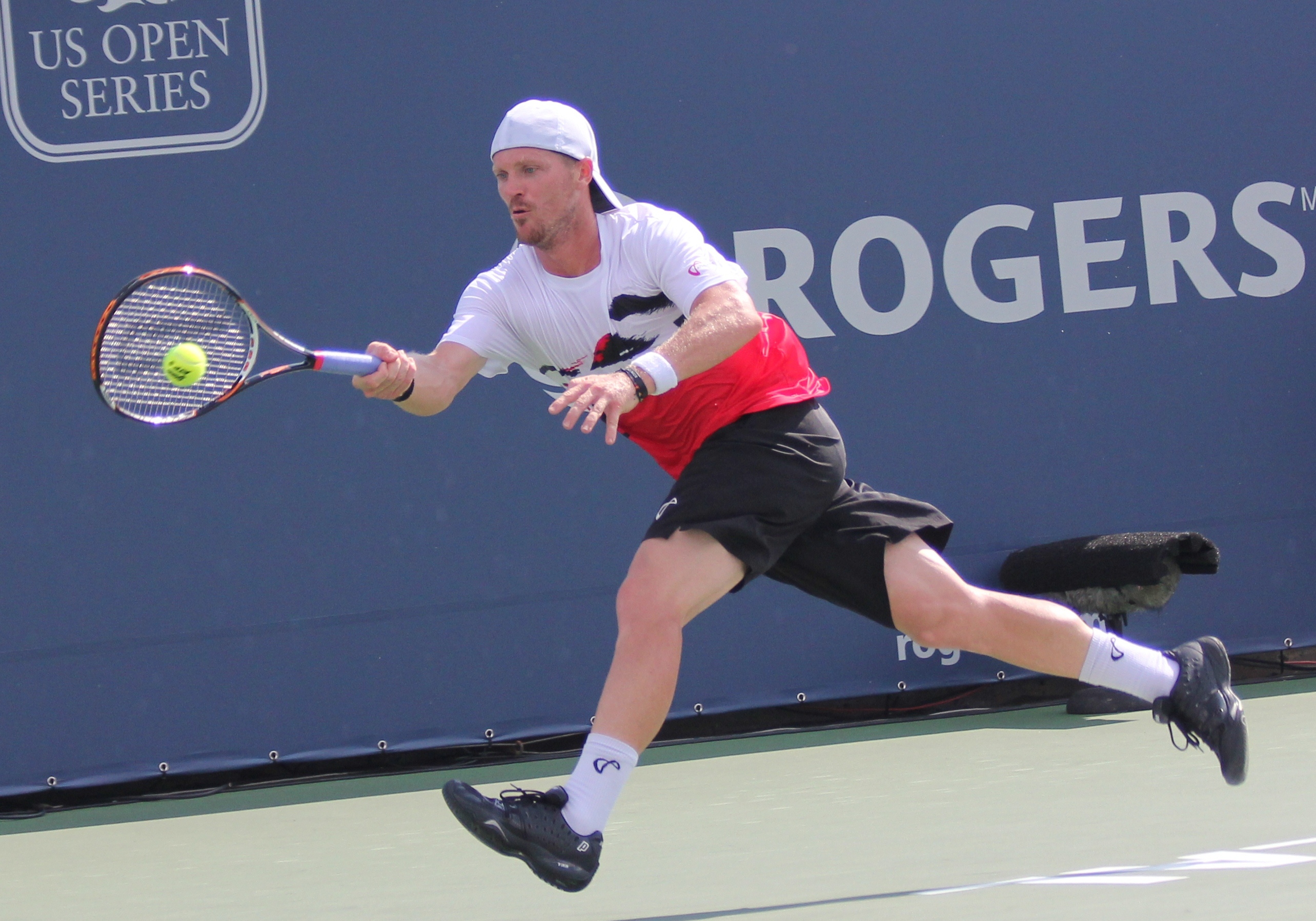
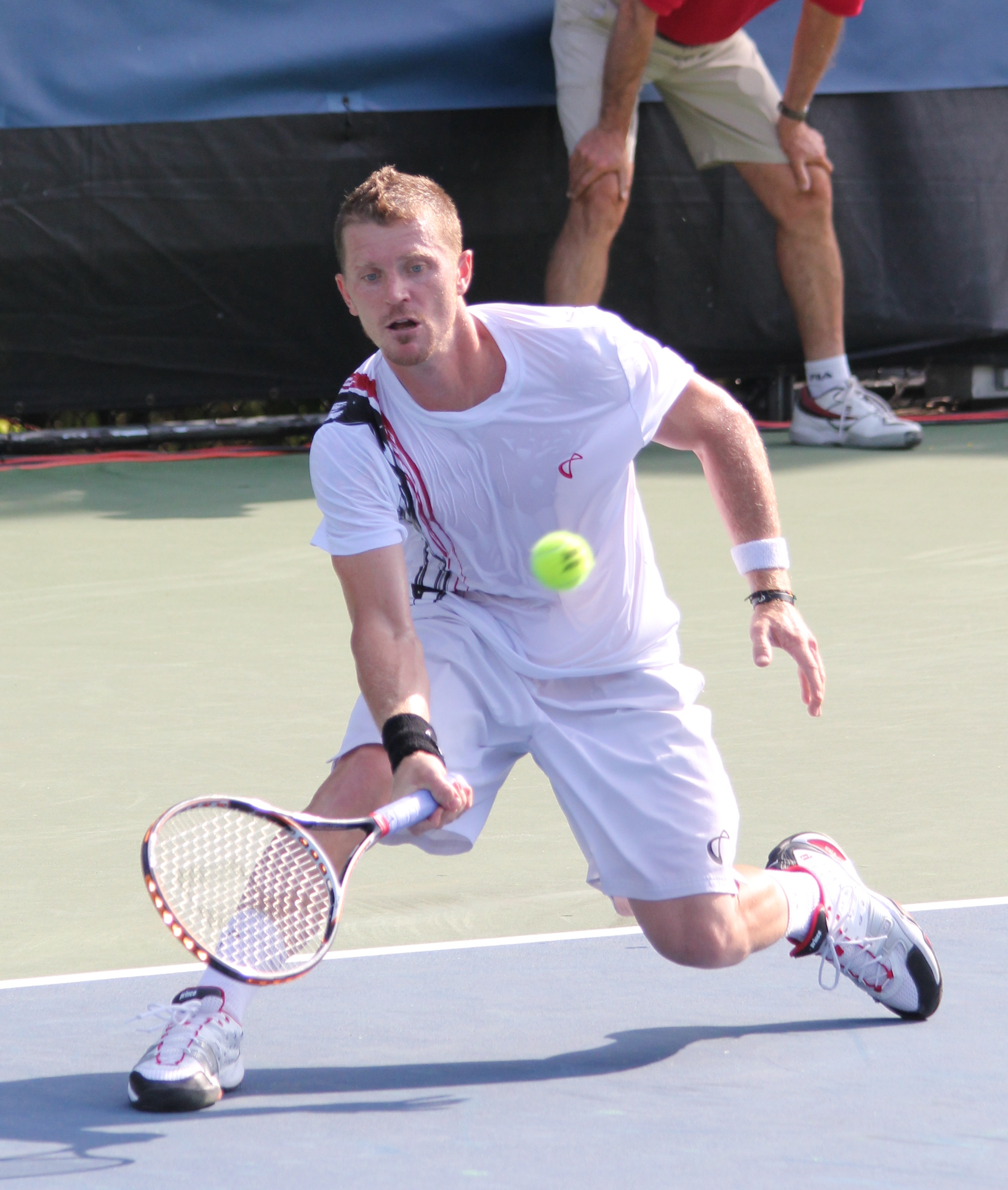
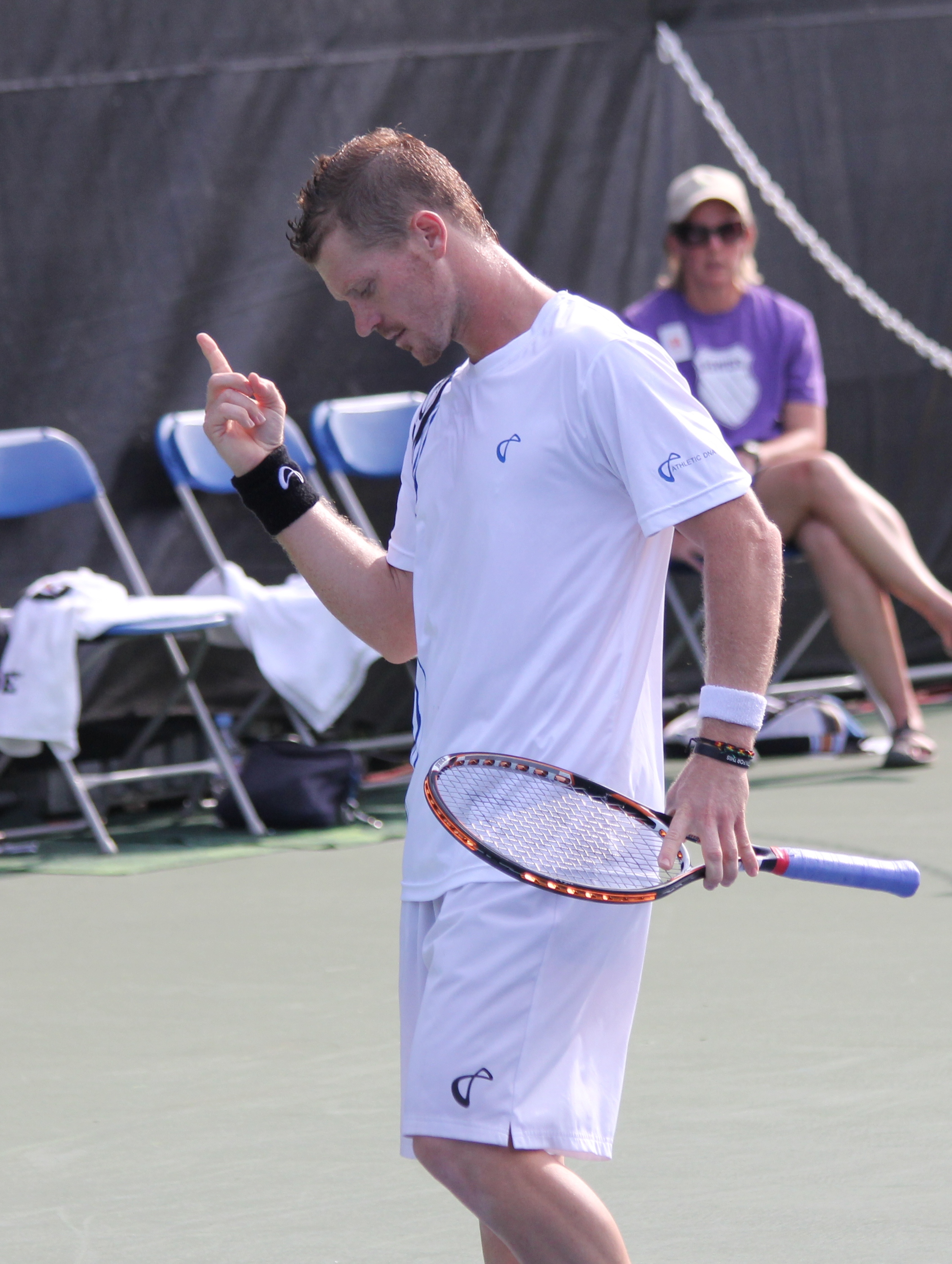
Five years may have passed since current world No. 81 Alex Bogomolov Jr., got the worst news of his pro career but the memory still burns inside him even at age 30 as he returns to the Citi Open in Washington D.C. this week.

With a cast on his left wrist due to recent ligament damage suffered at a tournament in Korea, the Russian-born American headed to Texas in 2008. He thought that all he needed was time to rest and recover so that he could resume a career filled with equal parts great promise and personal distraction. That’s when a doctor called him with a shot he didn’t see coming.

Alex Bogomolov, Jr.

“He called me and told me I might be done,” Bogomolov recalls, his speech slowing as he relives the moment. “I remember sitting in a parking lot bawling.”

The then 25-year-old was in shock. A decade had passed since he burst onto the tennis scene by winning the USTA National Boys 16’ championships – beating Andy Roddick in the final – He won the Boys’ 18s and then began to learn how to win at the pro level, reaching the 130s in the rankings.

At the lowest point in his career, though, serendipity stepped in. It took the form of two people.

The first was Dr. A. Lee Osterman, a gifted hand surgeon that “Bogie” calls “the magician.” Osterman found a way to repair the pro’s wrist and give him a chance to fight his way back on to the court, even as his patient’s ranking fell from No. 167 to 313.

Bogomolov grows even more elated when he talks about the second person who entered his life that year. Back in his hometown of Miami, he couldn’t do much of anything but count the days until his wrist came free.

“I had the cast on and I was just hanging out with friends,” he recalls. “We went to a car show. That’s where I met my wife Luana. She was working as a Mazda sales rep. She didn’t know anything about tennis and had no idea who I was.”

Bogomolov found something in Luana that he had not found in his personal life before: Genuine happiness. The new couple soon had a son Maddox, a child that the proud papa calls the light of his life.

The settled-down stability was a far cry from his bachelor days – a time in his life that led to his first marriage to WTA player and Playboy model Ashley Harkleroad that ended quickly in 2006. He also made headlines through his friendship with hitting partner Anna Kournikova. Tennis, he admits, wasn’t always his top priority as a teenager or young adult. Bogomolov also makes no claim that he was a Boy Scout.

Alex Bogomolov, Jr.

“I grew up in Miami, and parts of it are rough,” he says. “I started running with some wrong crowds.”

Tennis played a role even in his mischief: At age 15, he would get his first taste of the U.S. Open … but not through a first-round invitation or qualifying win.

“I used to go to New York a lot as a kid,” he says. “Me and about five friends used to sneak into the U.S. Open, getting into the locker room without passes. We stationed ourselves at different posts and waited for players to make their way to an entrance. We’d ask them if we could carry their bags and then scoot right in with them.”

He became the No. 1-ranked USTA 18’s player by the year 2000. The same year, he earned a wild card into the Major he had only snuck into before. He lost to David Nalbandian in the first round at the U.S. Open but found that his appearance had suddenly made the tennis world aware of his talent.

“All of these agents starting coming to me and talking to me,” he says.

Out went plans to play for Texas Christian University; in came the decision to turn pro.

“As far as making a living playing tennis, I hadn’t thought that much about it until then,” he says.

Bogomolov fought his way through the challenger circuit and paid his dues at ATP stops in the years ahead. Misfortune slammed him again in 2005 when he was suspended for 1.5 months for failing a doping test. The punishment came despite the fact that a tribunal determined he had no intention of trying to enhance his performance by using salbutamol – which Bogomolov admitted ingesting through an inhaler he used to treat exercise-induced asthma. The decision robbed the player of prize money and rankings points earned by reaching the main draw of the Australian Open in 2004.

He met with greater success down under the following year, winning his first Grand Slam tournament match in 2006 – beating ninth seed Fernando Gonzalez of Chile in five sets.

Every time Bogomolov appeared to be poised for another major ascent in his career, adversity found its way to him. The 2008 wrist injury, though, would not knock him out of the game. While many players at that age are beginning to accept the notion they’ve risen as far in the rankings as they’ll ever go, Bogomolov refused to surrender to Father Time. With a beautiful new bride and baby boy in the stands cheering him on, he qualified for one ATP main draw and reached the quarterfinals or better in seven challengers in 2010.

His climb back up the rankings accelerated in 2011 – catapulting him to a career-best No. 33. Along the way, he notched the biggest win of his career by beating then No. 5 Andy Murray in Miami and No. 10 Jo-Wilfried Tsonga in Cincinnati. The success and 27 wins that year earned him the ATP’s “Most Improved Player” award.

Bogomolov hit another bump in the road in 2012 when he made the unusual decision to play for his birth country rather than the U.S. in the Davis Cup. Though chided by some of his American friends on the tour, Bogomolov says that it felt right to make the switch. His dad, after all, had been a Soviet national coach and the current Russian team had lost players to other nations. Russia lost to Austria in their February contest, Bogomolov dropping both of his matches.

Alex Bogomolov, Jr.

If history holds true for the now 30-year-old, the setback will be followed by another leap forward. He often says that he believes success visits some players at a later age and that everything in life happens for a reason.

Bogomolov makes it clear that tennis means more to him now that it did as a can’t-miss prospect. He’s no longer playing just for himself but for his family. There is also another group of kids that he doesn’t forget – the kids that gather outside the U.S. Open dreaming of meeting or perhaps becoming a pro … just like he and his friends used to do.

“It’s a very special time for me now,” he says. “Now these kids are living vicariously through me. They see that I can do this, that I can achieve my dream.”

Photos By Won-ok Kim

Bobby Reynolds Still Chasing Dreams, Giving Back To The Game He Loves

July 18, 2013 by wonok

By Christopher Lancette

Bobby Reynolds

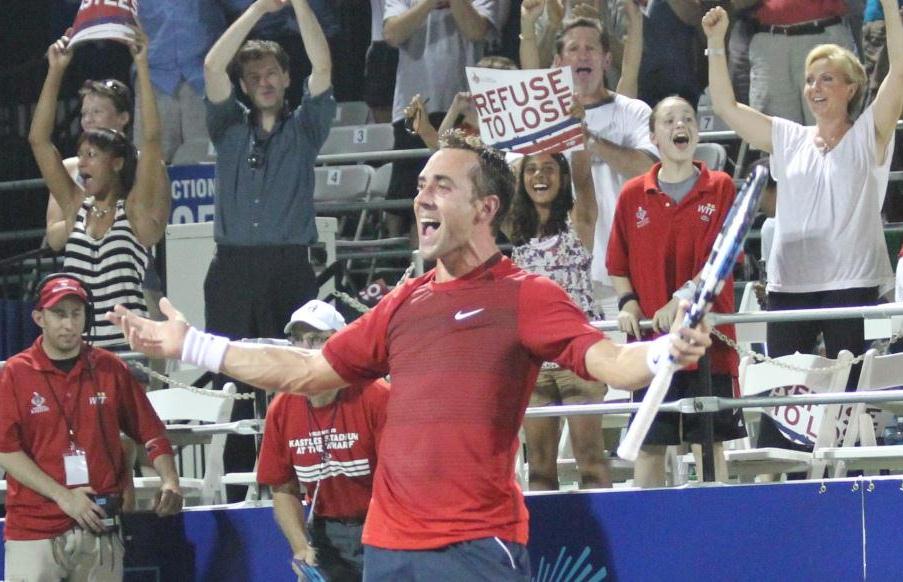
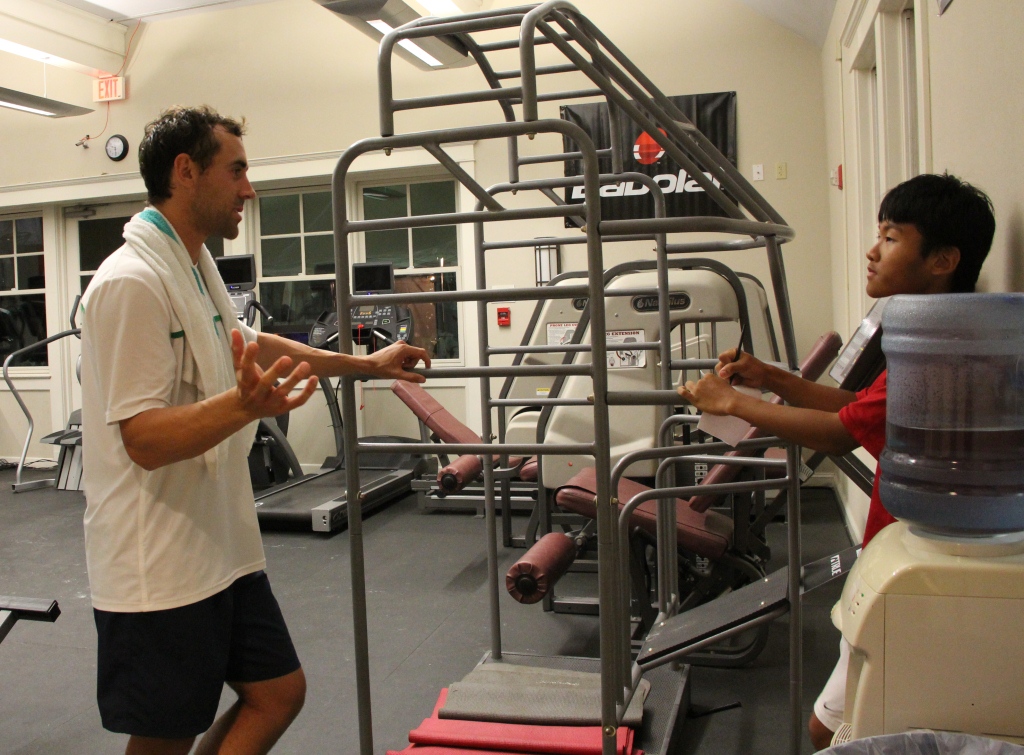
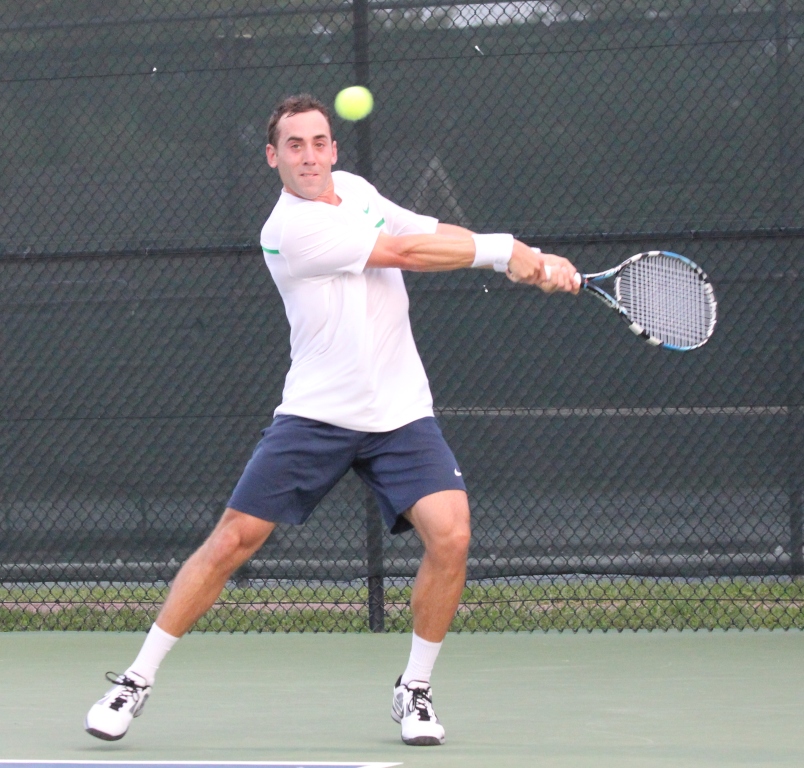
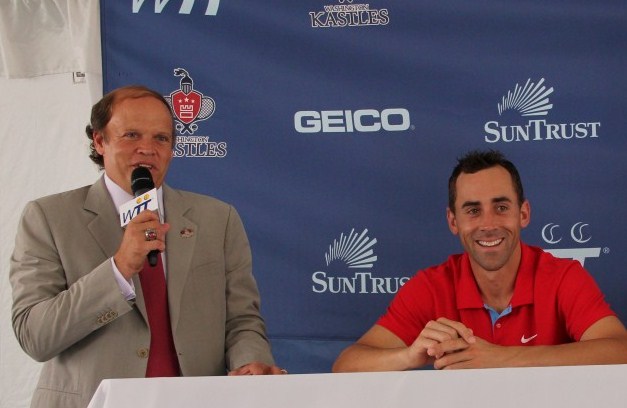
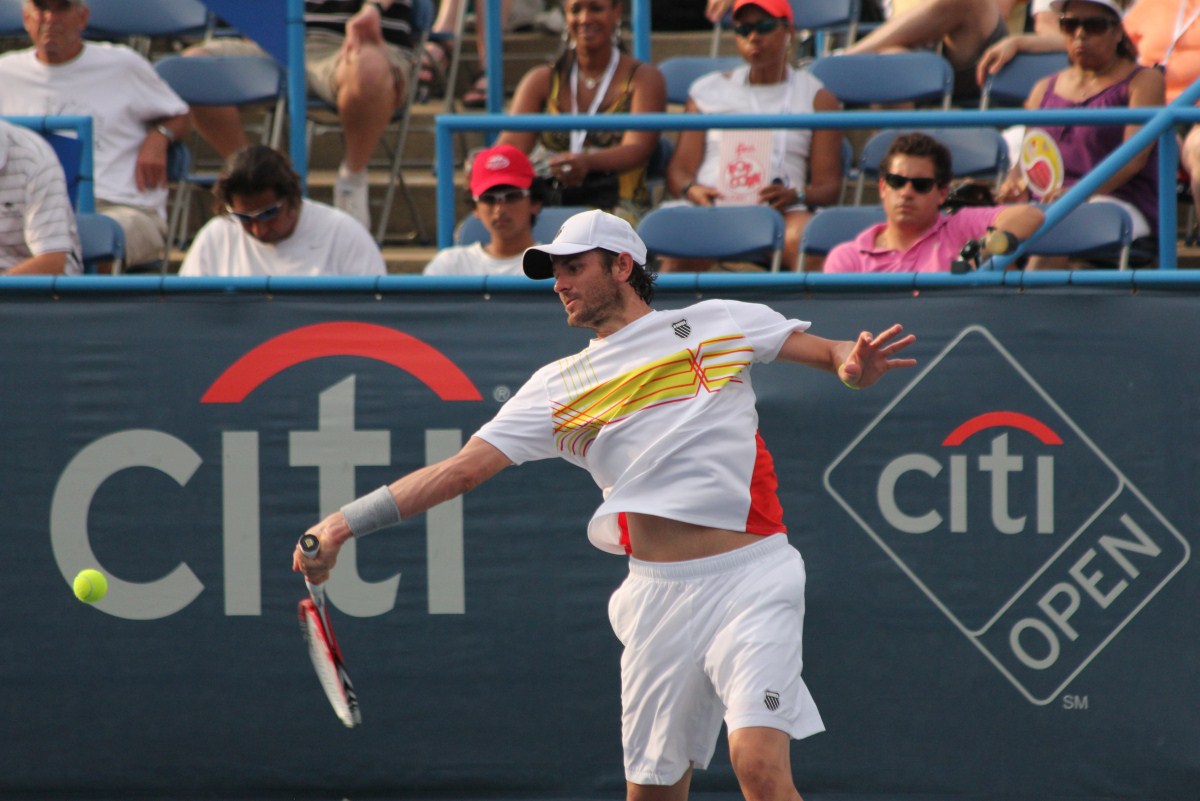
It is a scorching hot summer day in College Park, Maryland and Bobby Reynolds has gone from the raucous crowds supporting his Washington Kastles World Team Tennis matches to the obscurity of pumping iron in a stuffy, pint-sized gym at the site of a 2011 U.S. Open qualifying tournament. He doesn’t know it at the moment but the former world No. 63 is a few days away from earning a return to New York – and a few years away claiming a chance to play Novak Djokovic on center court at Wimbledon.

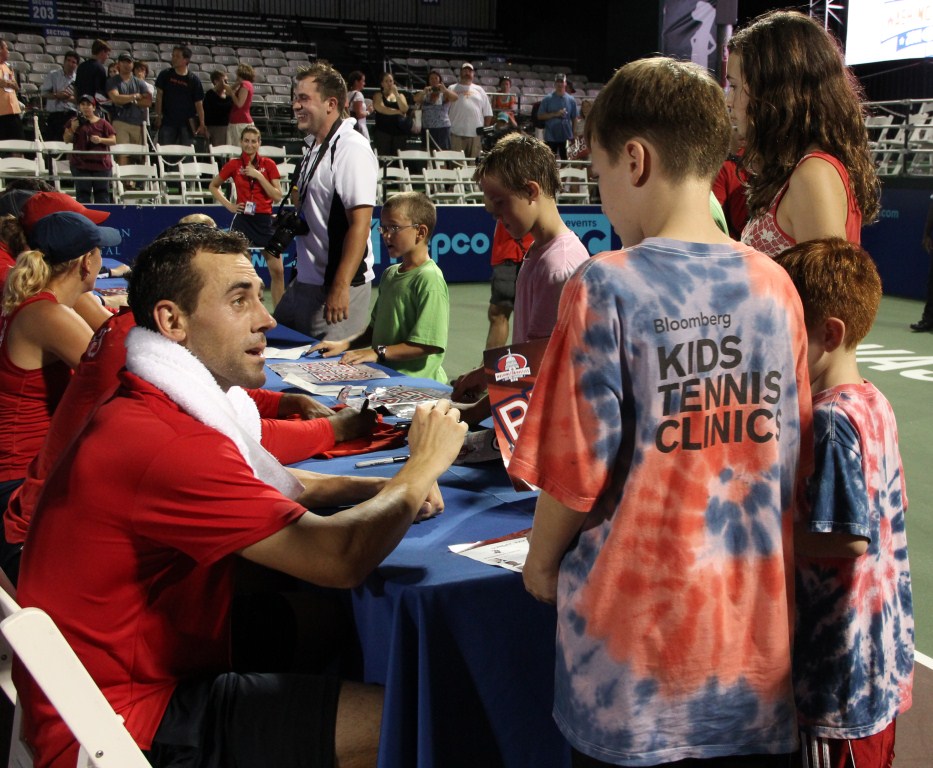
All Reynolds is thinking about is the next match … and the group of kids who seem to cling to him wherever he goes. He doesn’t pull a W.C. Fields even though he’s working out hard at the end of a long day. The six-foot-tall but down-to-earth professional tennis player answers all kinds of questions from aspiring teenage writers and athletes – treating them all as if they were top-notch pros themselves.

“He really took the time to talk to me,” says high school student Ethan Park. “It’s great to meet someone who plays at that level. He’s one of the best 150 players in the world. He has played in Grand Slams. He’s a nice person, really talks to you. It’s humbling to me that he would take that much time for me and an article I’m writing for a school paper. He loves tennis and he’s not in it for the money.”

Park’s analysis couldn’t be more accurate. Big bucks don’t come easily to most players ranked outside the top 50. Reynolds, though, has managed his income wisely and lived a frugal life on the ATP tour.

Bobby Reynolds (Left) and Ethan Park

Observing and interviewing Reynolds over the past few years, it’s easy to see all the factors that  motivate Reynolds even as he turns 31 this summer but lacks the fame and resume of another man his age who possesses 17 “Grand Slam” titles and enough cash to take care of his family for generations.

Start with his love of the game.

“I love to be out here competing,” Reynolds says. “I love playing tennis for a job. We do get paid but I don’t think the money is what makes us do this work. Ultimately, we play to be in the Grand Slams!”

Reynolds has appeared in the main draw of 17 Grand Slam events but had not won a Major match since 2008. That changed last month when he beat No. 97 Steve Johnson in the first round at Wimbledon – earing the opportunity to play the No. 1-ranked Djokovic. Reynolds fought valiantly but lost in three sets. The win in the previous round, though, continued a 2013 resurgence in which he knocked out five top 100 players in about a three-week span starting in late February.

Bobby Reynolds

“I would say it’s never too late to go after your dreams,” the aging (by tennis standards) veteran says of his goals to keep reaching Grand Slam events and winning matches there. “I never said to myself, ‘Oh, you’re too old.’” (His latest dream came true when his wife Josie gave birth to their first child, Parker Thomas Reynolds.)

Reynolds does recognize his own human limitations: He knows he is not the most skilled player on the ATP tour or in the World Team Tennis league.

“Ninety percent of my game is just staying out there on my feet just battling,” he says. “I don’t have the most talent. I rely on my heart. I know in the back of my mind, I can get to one extra ball.”

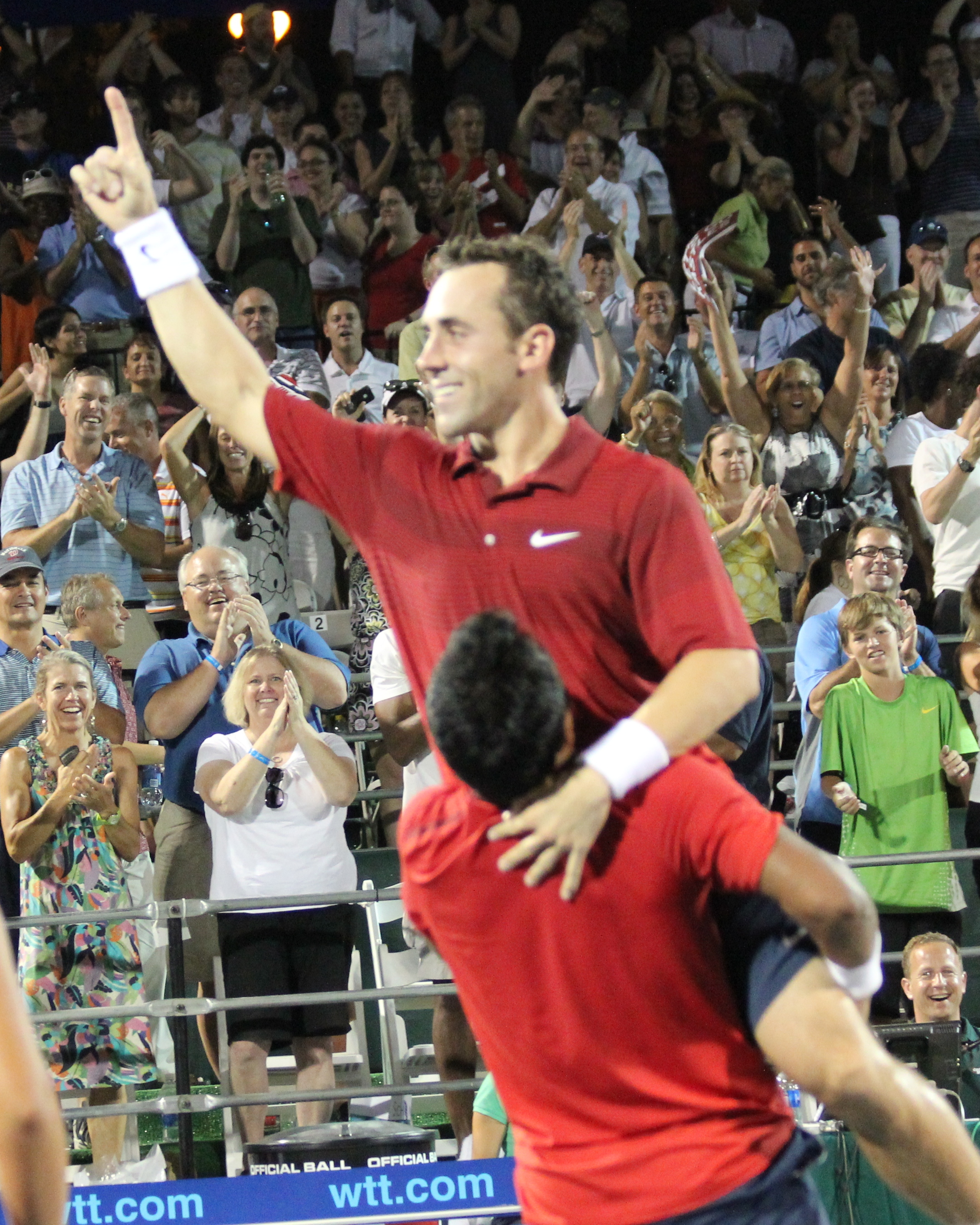
He has tracked down a ton of those “extra balls” while playing for the Washington Kastles, winners of two consecutive championship titles. By the end of the 2012 season, Reynolds had closed 19 of the team’s 32 consecutive wins. His numbers will almost certainly go up during the 2013 season that began on July 8.

Coach Murphy Jensen is counting on it.

“His character is the reason we have him as a closer,” Jensen says. “We can count on him. We rely on him going into the final set. We know that he’s going to leave everything on the court and he’s playing for everyone else – not for himself.”

Former Kastles teammate Arina Rodionova is quick to laud Reynolds’ unselfishness, too. She credits much of her success in Washington to the time Reynolds set aside to help her train and improve her strokes.

“Bobby will do everything for anybody on the team,” she says. “He has been like a brother to me. It has been unbelievable the way he has helped me.”

Reynolds readily admits that he is crazy about World Team Tennis and the camaraderie of the Kastles – perhaps even to the detriment of his own potential rise up the rankings. He is at press time ranked No. 137 and has earned 409 points. One of his goals is to return to the top 100, a spot currently held by Lukas Lacko, who has a scant 146 more points.

I love to do this, playing World Team Tennis,” Reynolds says. “If I miss three or four tournaments a year, so what. I love playing for the Kastles. I look forward to these three weeks every year.”

The Massachusetts-born but Georgia-reared journeyman knows it’s important to do what he loves while he still can: Tennis was nearly taken away from him four years ago in perhaps one of the most unexplainable injury in tennis – one he never even felt. It came after lunch at the 2009 French Open.

“I practiced in the morning to get ready for French,” he remembers. “I went to lunch, came back and went to hit a ball. I couldn’t do it. I don’t know what happened. All of a sudden I couldn’t hit the ball. It was a freak accident. A tendon in my left wrist just stopped working. I was at a career-high 63. It was depressing, frustrating.”

The injury sidelined him for the rest of the year and altered the upward trajectory of his career. The injury also gave Reynolds time to reflect – lessons that are still with him today.

“I think everything happens for a reason, good or bad,” he says. “Maybe I won’t make it back to 63 but playing is better than sitting at home on the couch. I understand and appreciate the game. I owe everything to the sport of tennis. It was a lifetime dream to play tennis. It started off just going to college and it has kind of built from there. I never felt like I could be a professional tennis player but I went out there and good things happened. I’ve seen places that I would have never been able to see and that a lot of people can only imagine. I’ve met a lot of people from all over the world, people who make an impact on me and who I have a chance to influence. I owe everything to the game.”

The “influence” part is high atop Reynolds’ motivations. He would like to play for several more years but he knows time is catching up to him.

“It’s going to be hard for me to step away from the game,” he says. “I want to stick with tennis, give back to kids.”

At a Kastles celebration at the end of the 2012 regular season – a scorching hot day in Washington D.C. — Reynolds leaves before the party is over … but not so he can take at least half a day off. Some of the ball kids for the Kastles had asked him to hit with them before the season was over. Off to The Wharf he went.

Kastles’ owner Mark Ein wasn’t surprised by the move.

Mark Ein (left) & Bobby Reynolds

“He’s so selfless, so giving,” Ein says. “Today he’s going to go hit with the ball kids because they asked to hit with him. He hasn’t had a day off in weeks. He’s working so hard and the schedule is so grueling and he’s going to take time to go hit with the ball kids. That’s how much it means to him. The guy has the absolute highest work ethic, the finest character and the most sincere and genuine personality. It’s an incredibly rare package.”


Photos By Won-ok Kim

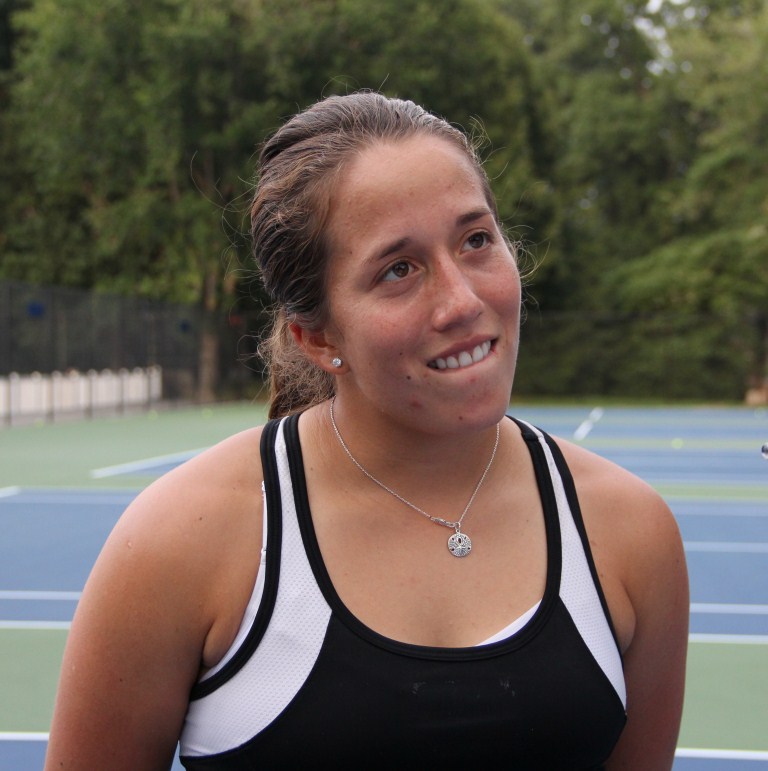
Irina Falconi swings hard, laughs hard

August 23, 2012 by wonok

[youtube=http://www.youtube.com/watch?v=nJWa9JY-mBY&w=560&h=343]

– Video produced by Wonok Kim –


By Christopher Lancette

WASHINGTON — Third-year pro Irina Falconi and I sit down at a bar. It’s open mic night for comedians and Falconi is ready to take the stage.

Actually, that’s a lie.

We’ve never been to a bar together. The sum total of our relationship is the time I spent watching her compete in the last two Citi Open tournaments and the interview we did earlier this month. The reason I wanted to chat with the Ecuador-born New Yorker currently ranked No. 111 in singles is because I had to see if she was as hilarious and honest in person as she is in the blog posts she writes for the WTA and World Team Tennis.

Turns out that the 22-year-old really is that funny. She made me laugh so hard on and off camera that I’d be afraid to have dinner with her for fear I’d spit my beverage all over her.

Ask Falconi about her next goal in life and she doesn’t even mention tennis.

“My goal is to reach Lady Gaga status of 25 million Twitter followers,” she deadpans during our “The Changeover” video interview. She’s at about 2,100 now. Follow her immediately @irinafalconi. If you help her reach 2,500, she’ll be off and running. No doubt she’ll appreciate it. Maybe she’ll even come up with a name for her fans. I’m sure it would be better than “Little Monsters.”

How did she make the agonizing decision to play college tennis instead of turning pro? She didn’t agonize.

“I had a tournament that went 0-6, 6-0, 0-6,” she remembers. “I lost. I said, ‘Mom, I’m going to college.’”

Oblivious to how college recruiting works, Falconi reached out to Georgia Tech women’s coach Bryan Shelton. She had met him briefly but hadn’t communicated with him in nine months. There’s nothing college coaches love more than thinking they’ve been given up for dead.

“I asked if he had a spot,” she says. “He said, ‘Yeah, but we’ve got to hurry.’ A month later I was in school. It was ridiculous. He had only seen me play once so I just kind of showed up. I hadn’t seen the campus and didn’t know what I wanted to study.”

She quickly ruled out Georgia Tech’s traditional engineering route. She chose history.

“There was no English major at Georgia Tech so that’s the reason why I did it,” she says. “I wasn’t into the whole math and science thing. I was pretty sure I’d live without having AP physics in my degree — pretty sure I’d be OK.”

Besides, Falconi can do things the nerds can’t — like crush a ball with various spins and speeds. And when is the last time a math club member beat a No. 14 seed in the second round of the U.S. Open? Falconi did that in 2011, taking out Dominika Cibulkova in a dramatic, come-from-behind victory. She has reached a career-high of No. 73 and looks to best that ASAP. She also won four ITF titles from 2007 to 2010 and broke all kinds of school records in the two years she spent with the Yellow Jackets.

Has there been a part of WTA life that was harder than she expected?

“Losing sucks,” she says. “Last year, I was in Asia and I lost four first rounds in a row, and I was alone. For four weeks, I was alone. I came back to visit a friend in L.A. for 12 hours. The next week, I won the gold at the Pan Am Games. You just never know, but losing definitely is not fun.”

Blogging is, and she excels at that, too.

Falconi blogs from all over the place – planes, trains, automobiles, tournaments, World Team Tennis matches, and hotels. She shares her new life as a pro the way the rest of us would if we suddenly made the tour and began having all kinds of amazing experiences: She writes with excitement and joy. She also plays loose with grammar, not because she’s incapable of producing perfect prose but because she’s in touch with her inner Snoop Dogg.

Take the time she first met John Isner.

“So, I went up to him,” she wrote, “stopped him in his tracks, and asked him ‘Hey man, look I gotta ask you, how tall are you?’ And he answers “Eh, about 6’9, 6’10.’ So me, being the unfiltered little teenager that I was, looks at him in astonishment and says ‘Dang, you’re a TREE!’ And I walked off.”

She pulls no punches on babies screaming on airplanes, self-absorbed folks that won’t put their cell phones on mute even when stuck in claustrophobic quarters, or a Boston Lobsters’ teammate drawing on her arm while she was busy signing autographs after a World Team Tennis match. “REEEEEEEL mature,” she wrote, sending Vanna White into a frenzy.

Falconi also likes to invent words.

My favorite Falcon-ism is “anywhoozer.” That’s the transition she uses to start a new paragraph that loops back to her previous point – but only after she has gone for a long stroll down tangent lane. (Maybe that’s a name for her fans: the “Anywhoozers.” I want royalties if she puts it on t-shirts!)

Blogging helps Falconi relax. It also happens to be an excellent way to interact with fans. She even answers questions in the blog from the Anywhoozers. (That does have a ring to it, doesn’t it? I know Falconi will let me know if it doesn’t. She didn’t hesitate to crack on my penmanship when she saw me scribbling away during the interview. “Are you a doctor as well? You’ve got the handwriting down. That’s all you need.”)

Falconi hits the target when she adds that so many fans “are bored with the mundane. Oh, I hit cross-courts today and I hit down-the-lines today. I figured I’d spice it up a little bit. It’s fun to throw in a little joke here and there. People want to know what tennis players are about, not just on the court.”

She put a particularly interesting twist on a night of getting gussied after a match with her WTT Boston Lobster teammates.

“After that, we got to dress up and join our friends for a wonderful dinner at this fantastic venue,” she wrote.” Ya know, tennis players probably feel like Superman sometimes. Cuz Lois Lane would always just see him in his regular clothing — which to us is tennis clothing. And when he put his cape on, he would become Superman — yet we become normal when we put on regular nice girly clothing … bah, you know what I mean.”

I do, actually. I’ll spend a week covering a women’s tournament and interviewing a player multiple times – then struggle to recognize her when she walks right past me in street clothes two hours later.

When Falconi is in her normal-person disguise, she likes to read voraciously. She’s also into music. She tells me that her favorite artist right now is Usher. I decide to see if I can turn the table on Falconi and make her chuckle by telling her about my near encounter with the guy many years ago. I don’t know anything about music and had no idea why burger flippers at an Atlanta Wendy’s were going nuts about a man picking up a bite at a drive-through one night. They tell me that was “Usher”. I asked them what was so exciting about meeting a guy who shows you to your seat in a theater.

Falconi gives me a blank stare: I bombed.

“Sometimes I’m too proud to laugh,” she says, sympathetically. “That was really funny. Deep down inside, I’m laughing.”

Suuuure she is.

Our conversation turns serious for a moment, the video camera having stopped rolling long ago. I mention that I recognize that life on the pro tour is not necessarily as easy and glorious as fans might think. I see the brutally long days of intense physical work, career-determining stress that comes with each match and brutal travel schedules. I ask her if she’s having a good time – if she really enjoys her career on the courts.

“At the end of the day, I have one of the best lives you could possibly ask for,” she tells me. “I travel the world and get to play competitively and make money. How many people would love to do that?”

Great point.

I thank her for her time and wish her well in the tournaments to come. Falconi heads to the nearest phone booth for a quick change and a flight to Montreal.

Follow Christopher Lancette on Twitter @chrislancette.

Nuggets: Citi Open 2012 in review – singles, doubles and kid journalist at large

August 8, 2012 by wonok

By Christopher Lancette

Emptying out my reporter’s notebook of observations, facts, ruminations and other random thoughts from the Citi Open …

One of the great things about covering any tournament is seeing players up close that I have not seen play in person before. Interviewing them is even better. Every tournament gives me a bevy of new people whose games and whose lives I take an interest in. The Citi Open was no different.

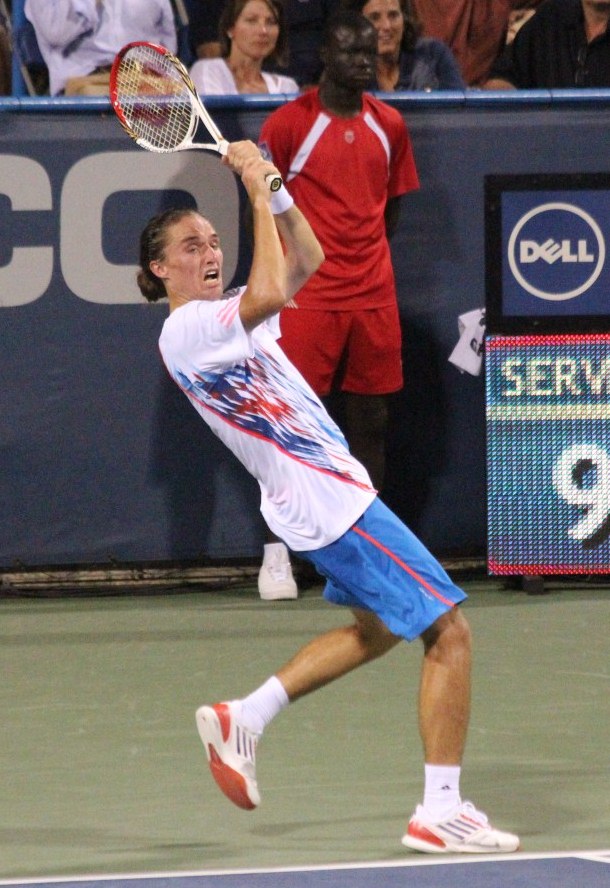
Alexandr Dolgopolov – Photo by Wonok Kim
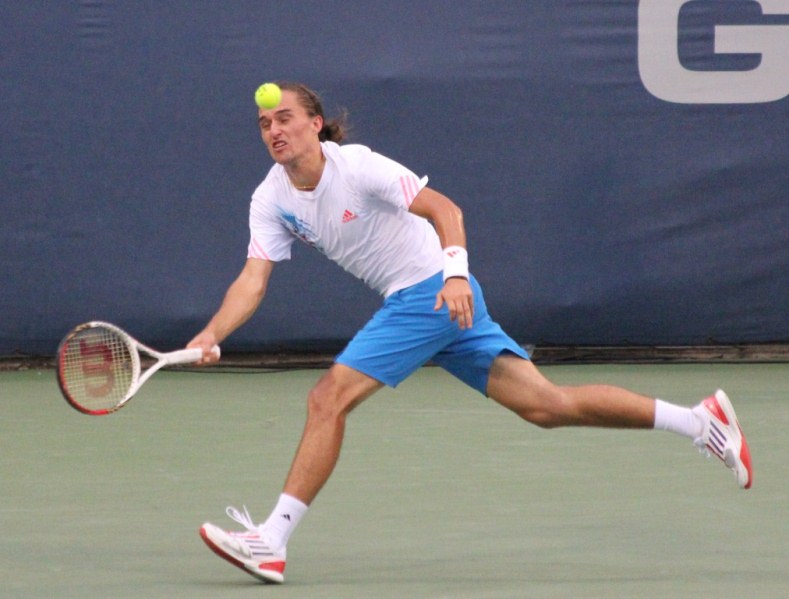
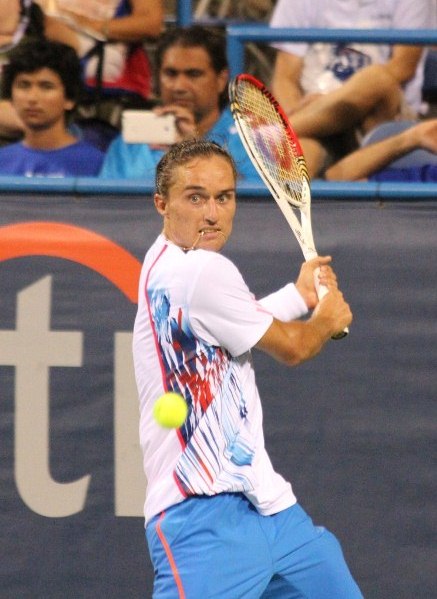
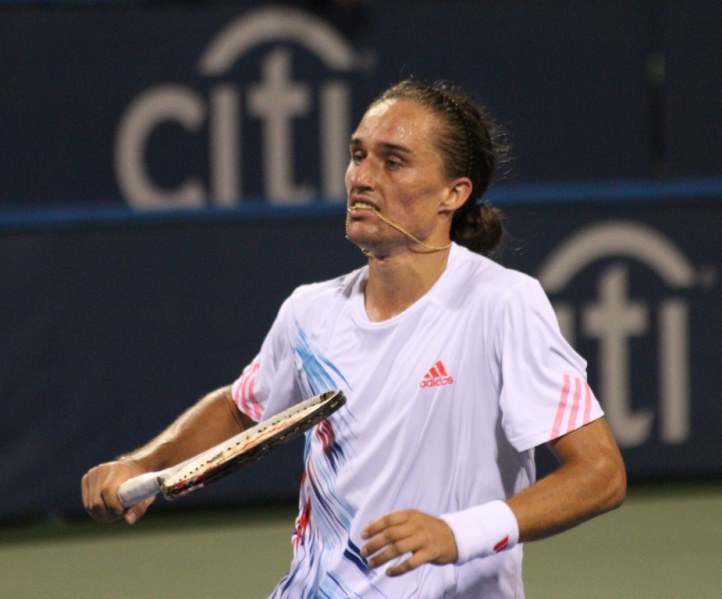
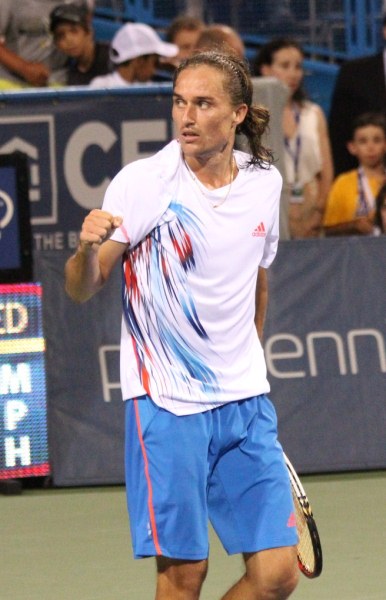
Start with tournament champion Alexandr Dolgopolov. I love this guy’s game. He plays tennis the way we would all be well-served to live – boldly. He made it clear that he loves to live life on the edge. Dolgopolov is quite sincere when he says he simply does not worry about making a lot of errors. If he makes one more winner than he does errors in a match, he believes he will win.

A reporter friend of mine pointed out to the Ukrainian that Sam Querrey said his shots were crazy and that Tommy Haas described them as kind of strange. What did Dolgopolov think?

“I’d say they described it right, pretty much,” he said. “They are a bit unique. They are a bit crazy. Sometimes it works and sometimes it doesn’t. I think that’s my way to play.”

Dolgopolov’s work here boosted him to No. 16 in the rankings. A long, hot week and rain-delayed final, though, may have spelled his doom at the Rogers Cup in Toronto. He lost in the first round to Radek Stepanek, last year’s Citi Open champion who also lost in the first round of the Rogers Cup a few days later.

Mica Gelb – Photo by Wonok Kim

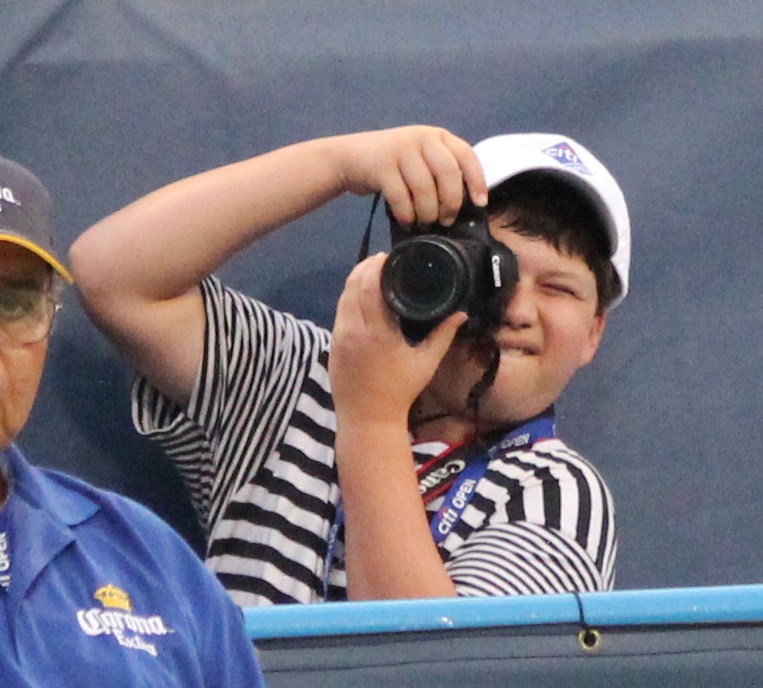
Journalists who covered the Citi Open should fear for their jobs because an 11-year-old kid might just send us all to the unemployment lines. Mica Gelb asked the best question of the week when he asked Mardy Fish how he approaches playing close friend Tommy Haas. Not only was the follow-up question a timely one, the young man showed no fear when he jumped in to ask it. Fish treated the youngster like a full-fledged member of the press corps, giving Gelb a thoughtful answer: Fish said he has to put friendship aside when someone is trying to take his lunch money.

Gelb was in the pressroom thanks to the Citi Open offering fans the chance to purchase an experience for their kids enabling them to get a taste of the varied professions involved in a tennis tournament. Naturally, World Tennis Magazine pulled aside Gelb and his father Amos Gelb – a journalism instructor at Northwestern University here in the District – for a “Changeover” video interview. Look for that in the weeks ahead.

Irina Falconi – Photo by Wonok Kim

Speaking of “The Changeover”, we have a nice little strong of them on YouTube, ranging from a light-hearted conversation with the Bryan Brothers at the Rogers Cup 2011 to a serious conversation with Shahar Peer. Next up is Irina Falconi. She is make-you-fall-down funny. I caught up with her after her doubles final here. Look for that video soon but get the jump on following the quick-witted and hard-hitting WTA newbie on Twitter @irinafalconi.

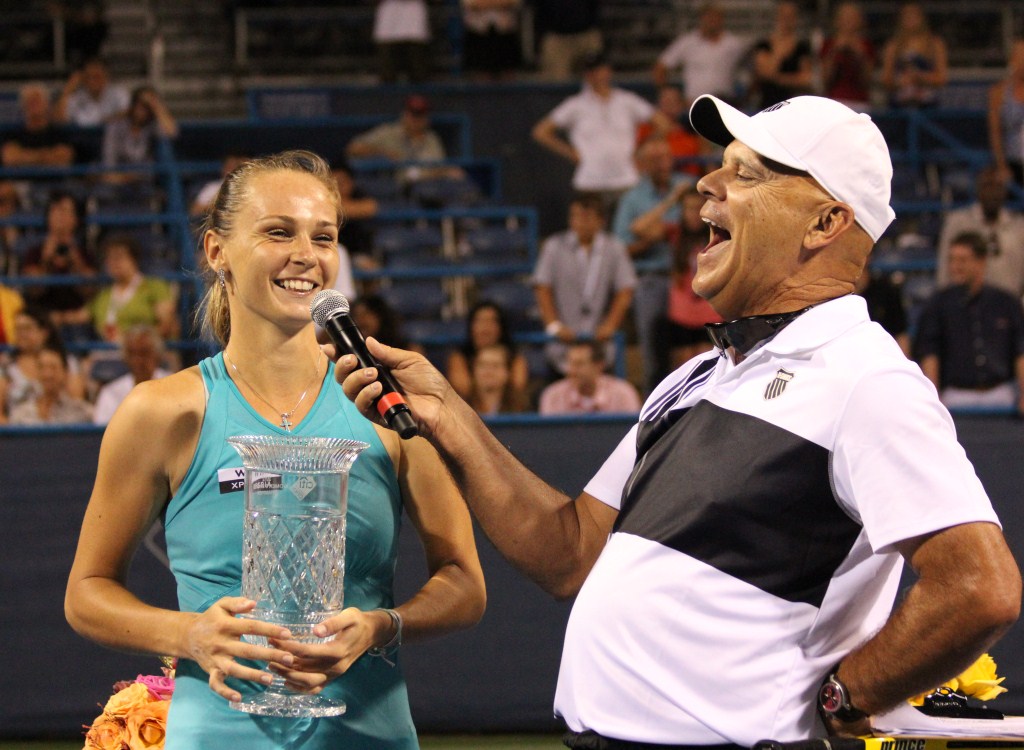
I enjoyed watching Magdalena Rybarikova win the women’s title. I had not seen her play before and it’s always refreshing to see a new face in the pressroom. The 5’11’’ right-hander from Slovakia jumped in the tournament at the last minute and played fearlessly all week long. She said she played like she had nothing to lose — even in the finals against top seed Anastasia Pavlyuchenkova, who didn’t seem to enjoy “defending” the position one bit.  To Pavlyuchenkova’s credit, though, she still fought to scrape out a few points even when all was clearly lost. Rybarikova’s win sent her flying up the rankings, jumping from No. 102 to No. 67.

Magdalena Rybarikova (L) and Wayne Bryan – Photo by Wonok Kim
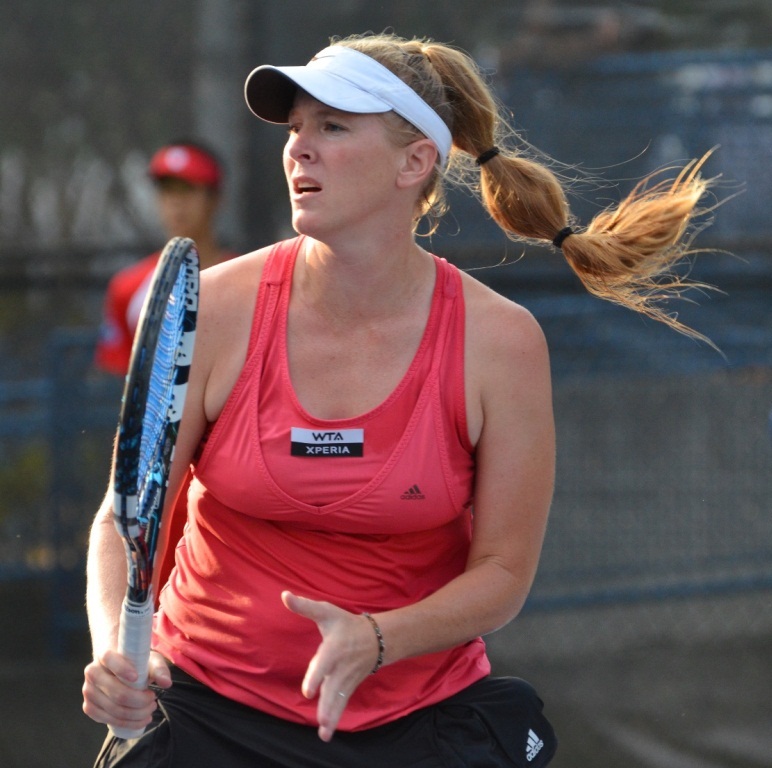
You’d think life would be kind to a young man for at least a few hours after he wins a doubles championship. (See the Tennis Grandstand report by Romi Cvitkovic on the match.) Not so for Treat Conrad Huey of University of Virginia and Washington Kastles fame. After he and partner Dominic Inglot knocked out Kevin Anderson and Sam Querrey, Huey dropped his sandwich on the ground. With our photographer Won-ok Kim’s camera clicking away, he instituted the five-second rule, picked it up and ate it.

Doubles part deux: I regret not having a chance to see more of, or interview, the Citi Open women’s doubles champions – Japan’s Shuko Aoyama and Kai-Chen Chang of Taiwan. I caught glimpses of Chang crushing some groundies in two matches and look forward to seeing if the 21-year-old can make a move inside the Top 100 in singles and doubles.

Lindsay Lee Waters – Photo by Romana Cvitkovic
One person I don’t need to see on the court again – at least not with me as the opponent – is women’s doubles specialist Lindsay Lee Waters. I renewed an acquaintance with her this week, reliving memories of the day 16 years ago that she gave me a beat-down. She was charming as ever in my interview with her, even if I didn’t give her enough competition for her to remember me. I thought I was done suffering from the humiliation until a college friend who witnessed the event dropped me an email after he read the story. He told me something I had forgotten: He brought his camera that day.

The horror.

Follow Christopher Lancette on Twitter @chrislancette.

Electric Alexandr Dolgopolov wins Citi Open championship

August 6, 2012 by wonok

By Christopher Lancette

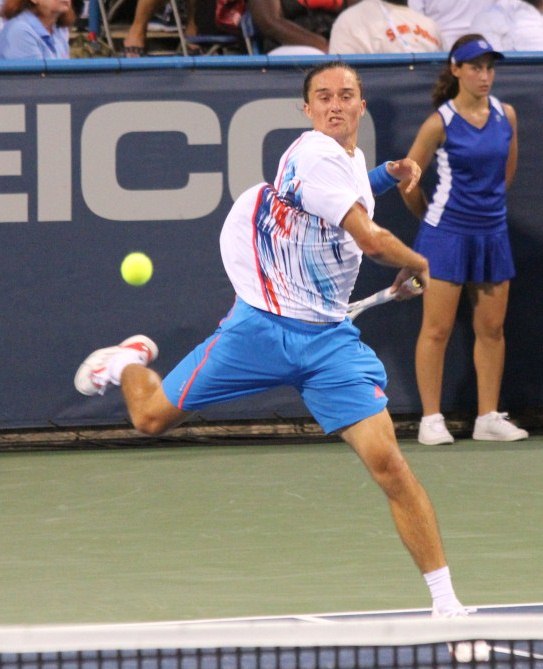
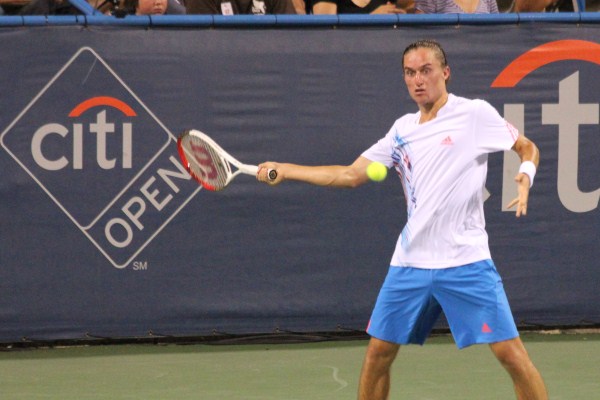
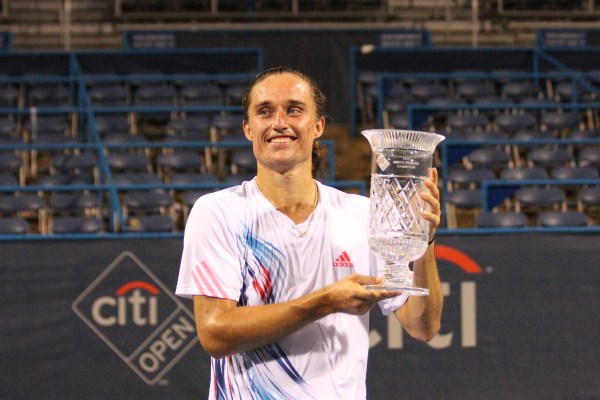
WASHINGTON – When Alexandr Dolgopolov spots a ball he can attack, he springs to life like a sleeping dog smelling a whiff of bacon. The 23-year-old almost levitates as shuffles his feet into position, draws the next shot or two in his mind, and pounces.

The 25th-ranked Dolgopolov feasted on a heavy diet of such points this week – enough to fuel his rain-delayed 6-7, 6-4, 6-1 victory over No. 36 Tommy Hass today at the Citi Open. One second he’s serving out wide and racing in for a put-away volley, the next he’s running wind sprints between the sidelines before cracking winners.

Alexandr Dolgopolov – Photo by Wonok Kim
Forget playing defensively and waiting for the opponent to make a mistake.

“I have so many shots that I like to risk,” Dolgopolov said after winning his first 500-level championship and second title overall. “It’s a part of me, like my personality. I like risking in life so I do that on the court. I just like to play tennis like that; I don’t think about the percentage. I like to do it my way and that’s how I win.”

Dolgopolov  is as confident driving winners through openings only he can see as he is racing cars at 200 miles per hour. That’s how he loves to spend his free time. Leave golf for the milk toast crowd.

His unconventional style was born when he was a kid. He was undersized and had health issues occasionally. Dolgopolov compensated for it by swinging for the fences – strikeouts be damned — like a Ukrainian version of Babe Ruth.

The power and prowess, along with the pitfalls they create, were on full display against Haas. Dolgopolov struggled a bit early in the first set, allowing it to go to a tiebreaker. At 7-all in the breaker, he came to the net and was in position to put away a volley. Instead, he chose to let Haas’s passing shot go by and drop in for a winner. Dolgopolov sent a forehand long on the next point, giving Haas the early momentum.

Dolgopolov began to find his rhythm through the course of the second set, constantly forcing Haas to work exceptionally hard to hold his serve. He held his own serve more easily, often filling Fitzgerald Stadium with the electricity of his strokes. At 1-all in the second set, Dolgopolov raced back toward the baseline to retrieve a would-be winner from Haas. He stopped, planted his feet and whipped a stunning forehand past a diving Haas. Up 5-4, he broke Haas’s serve – if not also his spirit – with a combination stab returns, lobs and vicious groundstrokes.

Haas admitted the match got away from him in the second set, too.

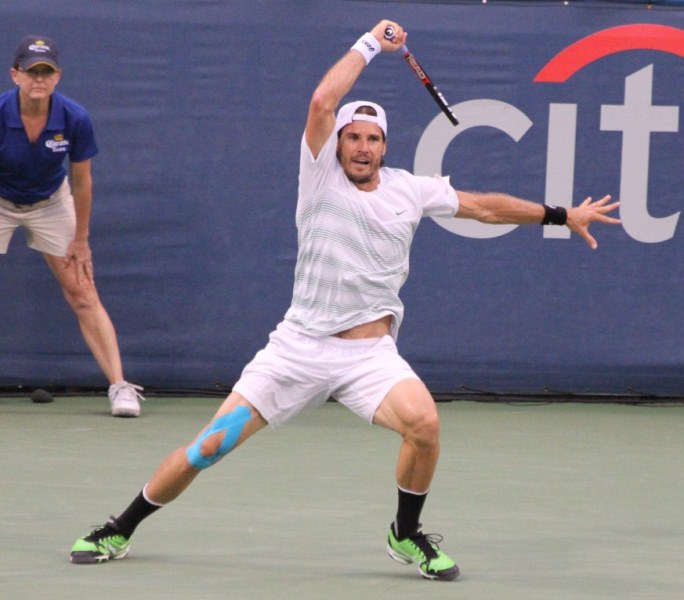
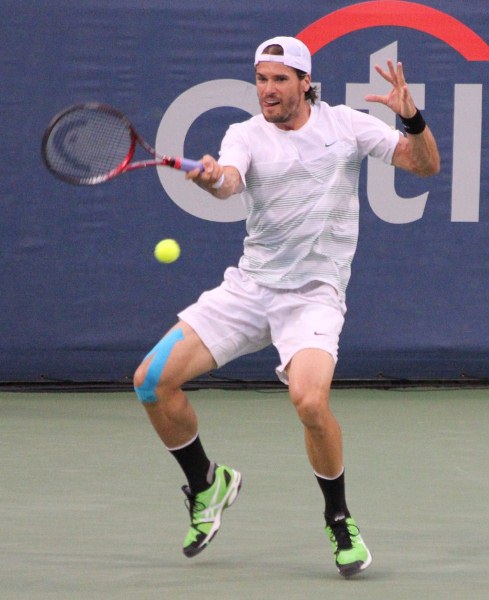
Tommy Haas – Photo by Wonok Kim
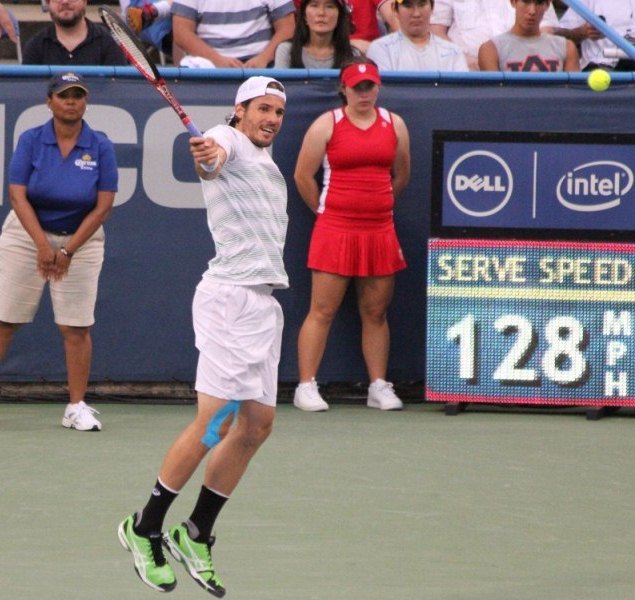
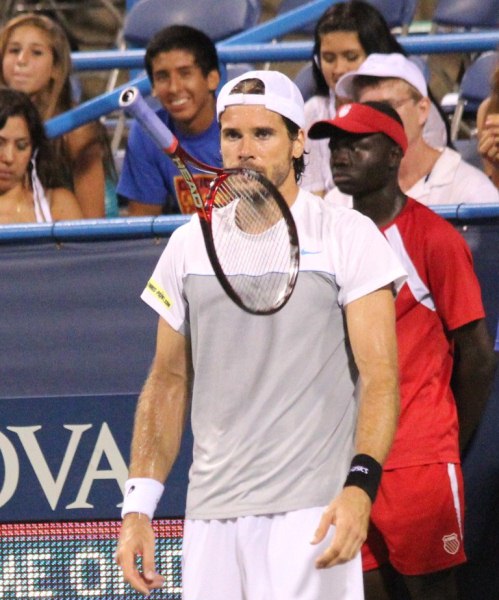
“In that second set, I think I cracked a little bit mentally,” Haas said. “I made a few bad decisions and was behind a break.”

The 34-year-old Haas turned in an excellent week of work himself and will see his ranking go up next week as well. His Citi Open accomplishments add to a great summer that has also included a title at Halle and a finals appearance at Hamburg.

“It has been unbelievable,” he said. “Obviously I’m a little frustrated now. I thought I had some chances to maybe win this title and I really wanted it. Overall, I’m obviously proud to get here to a final. I played really solid tennis. I just hope I can stay injury free and keep going and try to keep improving.”

Haas said he has no doubt that Dolgopolov get better, too.

“I know he’s got a pretty tricky serve, a pretty tricky game,” he said. “You have to be ready for all sorts of things. He’s got good firepower and he keeps the ball very flat. He’s a shot maker and he goes for his stuff. He’s tough and he has a good future ahead of him.”

Dolgopolov said he was going to celebrate the win in a way that a lot of people can appreciate.

“Drink some beer,” he said in answer to his evening plans. “I can’t really afford to celebrate too much. I play Tuesday already in Toronto. I have a flight in the morning. I have to have a practice tomorrow. It’s a bit of a tough schedule but still I’m happy to win here.”

Opponents at the Rogers Cup next week won’t see anything different from him than they’ve seen all year. Lest anyone think Dolgopolov is just a free spirit who plays with no rhyme or reason, there is a method to his madness.

“That’s my game, you know – to miss shots and to make winners,” Dolgopolov explained earlier in the week. “That’s what I understood this past half a year when I tried to play more solid. The (other) players get more comfortable and everyone is hitting so well these days that you can’t give them time. It’s more comfortable for me to make an error than let the player, the opponent, play really well. Then, you don’t have control of the match. For me, it’s better to make errors and make winners than let the guy beat you in a normal-paced game.”

Dolgopolov can certainly drink to that tonight.

Follow Christopher Lancette on Twitter @chrislancette. Get a look at the Citi Open men’s doubles finals later this week in World Tennis Magazine.

 All photos below by Wonok Kim

Rybarikova wins Citi Open title; Dolgopolov and Haas to play for men’s championship

August 4, 2012 by wonok

By Christopher Lancette

WASHINGTON – Unseeded Magdalena Rybarikova completed her remarkable romp through the 2012 Citi Open by upsetting top seed Anastasia Pavlyuchenkova (No. 28) 6-1, 6-1. The world No. 102 knocked out all three of the top-seeded players en route to winning a tournament she barely planned to attend.

“I didn’t expect this,” Rybarikova said. “I am absolutely happy. I don’t know what to say. It’s amazing.”

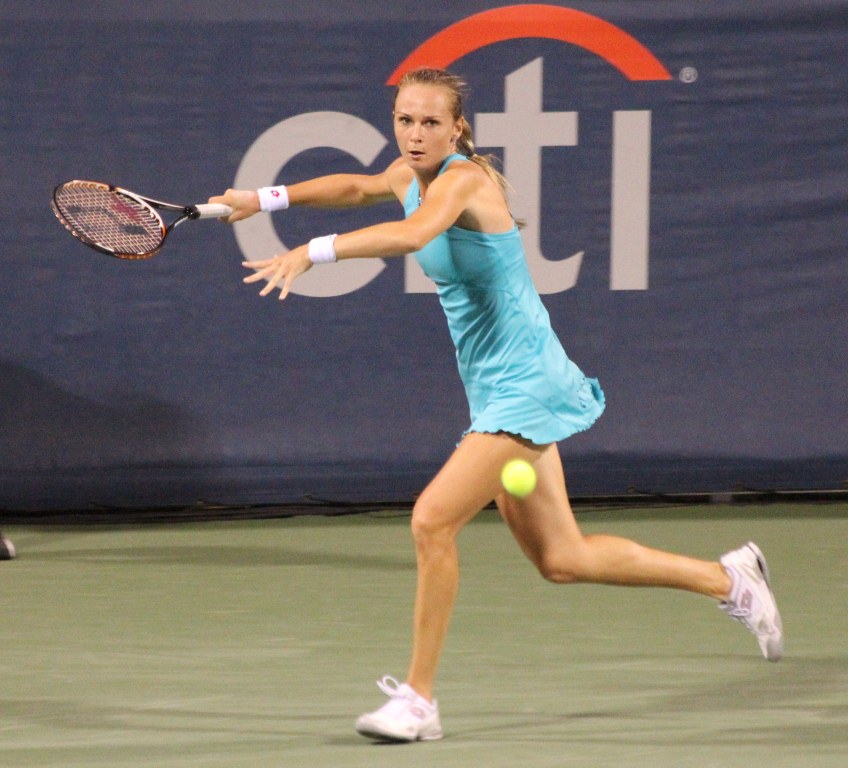
 Magdalena Rybarikova – Photo by Wonok Kim

Rybarikova dominated from the start, breaking Pavlyuchenkova in the opening game. She displayed calm nerves and a combination of power and placement throughout the match, never giving the more heralded player a chance. The win gives Rybarikova her third career title and a pending boost in the rankings.

“I didn’t have anything to lose,” she said. “I was very relaxed and able to play my game.”

Despite winning the championship, Rybarikova said what so many players say at the end of a tournament – even when they win: There will be no big celebration tonight.

“Maybe more tomorrow,” she said, “because tonight I’m very tired … I just want to sleep tonight and tomorrow celebrate for sure.”

The men’s side offered more competition today. Tommy Haas punched his ticket to Sunday’s championship match by upending top seed Mardy Fish 6-3, 7-5 and will square off against second seed Alexandr Dolgopolov, who overpowered Sam Querrey 6-4, 6-4.

Haas earned his first trip to the tournament’s finals by playing steadily and attacking Fish’s second serve.

Tommy Haas – Photo by Wonok Kim
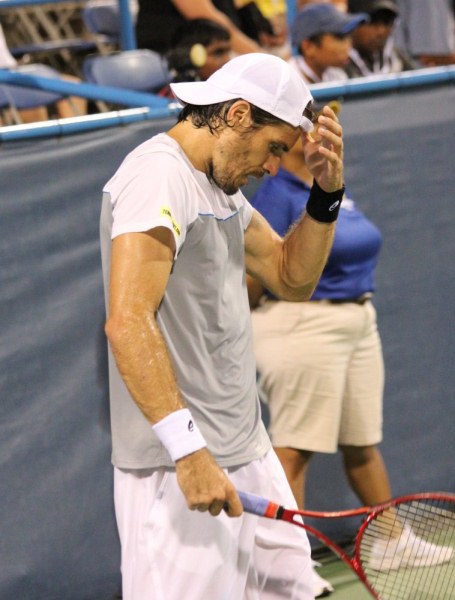
“Mardy probably has a slight edge on the first serve, I think,” Haas said. “His first serve is even better than mine, I would say. He has more speed, better placement at times, so I knew if I get some opportunity on the second serve, I’m going to have to take as many as I can and try to put some pressure on him, which I think I did really well throughout the whole match.”

Haas turned the match in his favor after fighting off a Fish charge in the second set. Down 4-5 and serving at 30-40, Haas came in behind a curious drop shot from Fish and won the point – causing Fish to slam his racket into the ground in disgust. (Fish said later that he was attempting to hit a deep slice instead of a drop and that he saw that play as a turning point.) Haas drew even two points later with a forehand winner. Haas went up 6-5 by breaking Fish in the next game, hitting winners off an inside-out backhand and crushing returns from the back side, too. The game ended on a poorly timed double fault by Fish.

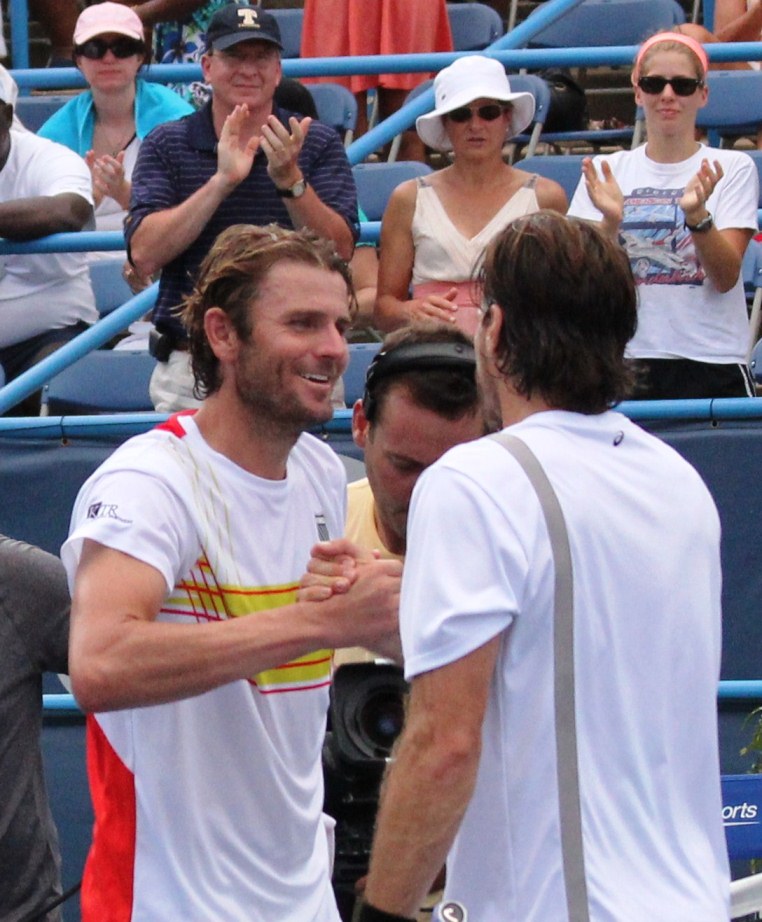
Mardy Fish (L) congratulates his close friend Tommy Haas after the match – Photo by Wonok Kim

While Fish contributed four double faults and 26 unforced errors on the day, Haas gave away but one point on his serve and made only seven unforced errors in the match – none of them occurring in the second set.

“I didn’t even register that,” Haas said of the perfect second set. “That’s obviously something that doesn’t happen often in my game since I play quite aggressively at times and mishit a few balls here and there. In order to beat people like Mardy Fish, you have to play at a very high level and I guess that speaks for itself – that stat.”

Haas has now won six of his last seven matches against Top 15 players and will see his ranking climb next week regardless of Sunday’s result.

On the other side of the bracket, Dolgopolov (No. 25), turned his first appearance at this event into a shot at the title – moving to 22-15 on the year.

The Ukrainian broke Querrey in the first game of the match, held on through a shaky first service game of his own, and denied Querrey of the advantage that often comes with his big serve.

“That was really important,” said Dolgopolov, who has spent 41 career weeks in the Top 20 and will return there next week. “It’s tough to break his serve. To start the game with that gave me confidence even though I almost lost my serve … That was a big moment in the match.”

How did Dolgopolov neutralize Querrey’s booming serve?

“The players know each other,” he said. “Most of them watch matches and try to see where a player is serving in the important moments. I analyzed a bit his service so that was the main thing – and just to step in the court and with a good reaction try to return as many serves as you can on the first serve, and be aggressive on the second serve. I do that anyway with the other players but with the servers that’s really big. They get a bit unconfident and try to go for bigger serves. I think at that point he hit a few double faults as well. That made him uncomfortable on the serve.”

Alexandr Dolgopolov – Photo by Wonok Kim

The critical moments of the second set came at 4-4 with Querrey serving at deuce. Dolgopolov ran Querrey around, cranked an approach shot, hit an aggressive volley and then finished the point on an overhead smash. Dolgopolov won the next point and then took the match onto his strings in the next game. He opened with a sizzling forehand slice volley winner and followed that with a forehand winner into the corner, another put-away at the net and an inside-out backhand winner.

For his part, Querrey said he was pleased with his work in the nation’s capital but knows there’s something he must do more often.

“I just need to play a little more fearless on those big points and I didn’t do a very good job of that today,” he said.

The men’s final takes place on stadium court at the Fitzgerald Tennis Center at 4 p.m. Sunday. The men’s doubles match is scheduled for 1 p.m., when the team of Sam Querrey and Kevin Anderson will face Treat Conrad Huey and Dominic Inglot.

Follow Christopher Lancette on Twitter @chrislancette


Dolgopolov rallies, men’s semifinals and women’s finals set at Citi Open

August 3, 2012 by wonok

By Christopher Lancette

WASHINGTON — Second seed Alexandr Dolgopolov came within one point of going down 0-4 in the first set but rallied for a 7-6, 6-4 win over fan favorite James Blake on Friday. He will play Sam Querrey at 7 p.m. Saturday in one semifinal while top seed Mardy Fish will take on Tommy Haas at 3 p.m. in the other. The women’s final, meanwhile, features top seed Anastasia Pavlyuchenkova against surprise title contender Magdalena Rybarikova. In women’s doubles, the team of Shuko Aoyama (Japan) and Kai-Chen Chang of Taiwan won the championship today by defeating Irina Falconi (U.S.) and Chanelle Scheepers (Russia.)

“I was pleased with how I got back in that game,” No. 25 Dolgopolov said of the critical point in the most compelling match of the day. “I got back in the game and got some momentum going.”

Alexandr Dolgopolov – Photo by Wonok Kim

Dolgopolov said he did not make any drastic changes in his game when he faced that double-break point in the fourth game.

“I was playing the same game,” he said. “I got lucky on one point but I was pretty much playing the same but making less unforced errors.”

Fish (world No. 15) dispatched Belgian Xavier Malisse (No. 67) 6-3, 6-4, taking command early in the first set and never looking back. In the second set, he pounded serves reaching the mid-130s and buried a bushel of backhand winners up the line – depositing a number of cross-court forehands in the same location.

Mardy Fish – Photo by Wonok Kim

The highlight point of the night came in the second set with Fish up 2-1 and serving for the game. The American ran Malisse from sideline to sideline with a series of groundies and hit a drop shot to lure his opponent to the net. Malisse hit a backhand overhead into the corner that Fish tracked down before blasting a backhand passing shot up the line for the winner.

Despite the quick start, Fish said that he does not consciously try to finish matches quickly and conserve energy for later in the week.

“That doesn’t enter my mind at all,” he said. “Federer is the only guy who’s able to do that.”

Fish’s win increased his season series lead over Malisse to 3-1 and proved to be another step forward in his return to good health. Fish continues to rebound after missing two and a half months between April and June recovering from surgery to fix an irregular heartbeat in May. Injuries also prevented Fish from competing here last year.

Next up for Fish is Haas of Germany. He opened the men’s quarterfinals today by steamrolling German countryman Tobias Kamke 6-1, 6-2. The easy win improved Haas’s 2012 quarterfinal record this season to 4-0.

“I expect a tough match,” Fish said, “a really tough match. I expect him to play well. He has played well in the past few weeks. He’s a great player, as high as No. 2 in the world a while ago. He has had a ton of injuries but he seems to be pretty close to back to one hundred percent with his health and he’s hitting the ball as well as I’ve seen him hit it in a long time.”

Sam Querrey – Photo by Wonok Kim

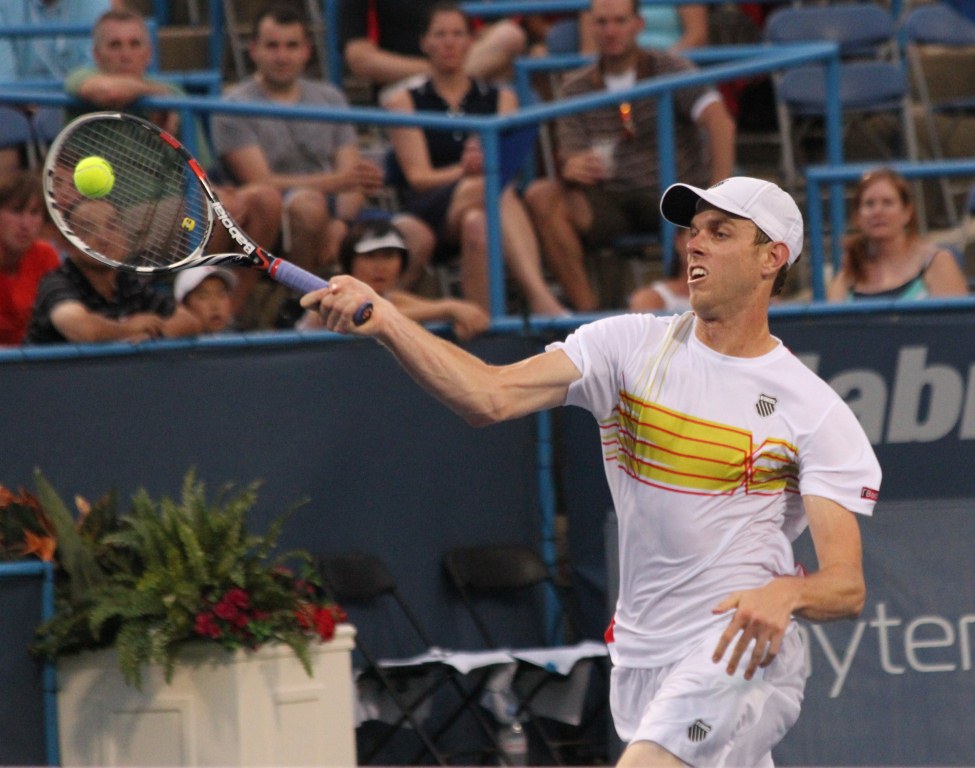
Querrey, the No. 8 seed, knocked out Kevin Anderson, 6-4, 6-4.  Querrey took control of the match at four-all in the second set when he pulled the score to 30-all with a backhand cross-court winner.  After Anderson hit an inside-out forehand wide right on the next point, Querrey responded to a high-bouncing tape job by hitting a dropshot that caught Anderson on his heels. Querrey polished off the match with a bevy of booming serves that Anderson returned long.

Querrey’s advance to the semis in Washington continues the roll he has been on, too. After falling outside the Top 100, he has fought his way back inside the Top 40 thanks to a 2012 season that has included a championship title in Los Angeles and a semifinal appearance at Queen’s Club.

Anastasia Pavlyuchenkova – Photo by Wonok Kim

On the women’s side of the tournament, top seed Pavlyuchenkova of Russia turned in a come-back win, dropping the first set 4-6 to No. 4 seed Vania King of the U.S. She righted the ship in the second, 7-5, and closed out the match 6-4 in the third. World No. 28 Pavlyuchenkova has been on a hot streak since the French Open this year, reaching the third round or quarterfinals at four of her last five tournaments.

Rybarikova (Slovakia) reached her first WTA final by upsetting No. 3-seed Sloane Stephens 6-3, 6-3.

“I’m very happy,” she said, “because I didn’t expect this. I came here Saturday and thought, ‘OK, let’s prepare maybe for some other tournament because it was going to be very tough to play here. It’s amazing hot here. The first match, I was playing very relaxed because I had nothing to lose and I was playing very good. Then it continued.”

The No. 102-ranked Slovak broke the American midway through the first set and applied consistent pressure throughout the second, causing Stephens to begin committing a barrage of unforced errors throughout the first set. Stephens became visibly upset with herself and could not pull out of her tailspin.

Magdalena Rybarikova – Photo by Wonok Kim

Once Rybarikova observed the impact of the pressure she was applying, did she choose to get more aggressive or simply play conservative balls to Stephens and let the younger player make more mistakes?

“I have to play every match different,” Rybarikova said. “One match, I’m more aggressive. One match I’m making her play. That’s why I was playing sometimes more aggressive and sometimes I was just making her play because I saw that she was struggling.”

The women’s final between Rybarikova and Pavlyuchenkova is scheduled on stadium court at no earlier than 9 p.m.

Next Page »

Primary Sidebar

Search the site

Randy Walker

Michael Zheng Caps Historic Sports Weekend For Columbia With NCAA Singles Title (Played In The Fall This Year)

November 24, 2024 By Admin

The Winding Final Year of Rafael Nadal’s Career Meets Its End In The Davis Cup Finals

November 19, 2024 By Admin

Ukraine Wins BJK Cup Match In Texas On Same Day When Russia Slams Their Nation With Over 200 Missiles

November 18, 2024 By Admin

Daniel Nestor Snubbed For Tennis Hall of Fame One Year After Slightly Less-Accomplished Leander Paes Gets Inducted

October 24, 2024 By Admin

More Posts from this Category

Sell your home fast in New York

Recent Posts

  • Neale Fraser Achieved (And Experienced) Things At The U.S. Championships That May Never Be Repeated
  • Common Racquet Mistakes
  • Juan Martin del Potro Bids Goodbye To Competitive Tennis In Exhibition Against Novak Djokovic

Popular Links

  • ATP World Tour
  • Tennis Grandstand
  • USTA
  • WTA Tour

Footer

Contact Us

c/o Randy Walker

Owner

1175 York Ave

Suite #3s

New York, NY 10065

Recent

  • Neale Fraser Achieved (And Experienced) Things At The U.S. Championships That May Never Be Repeated
  • Common Racquet Mistakes
  • Juan Martin del Potro Bids Goodbye To Competitive Tennis In Exhibition Against Novak Djokovic
  • Patrick Mouratouglou Talks About New Zephyrhills, Florida Tennis Academy
  • Juan Martin del Potro “Farewell Match” Against Novak Djokovic Sponsored By Aleph

Search

Copyright © World Tennis Magazine 2021 and beyond