• Skip to main content
  • Skip to secondary menu
  • Skip to primary sidebar
  • Skip to footer
World Tennis Magazine

World Tennis Magazine

Unique Tennis Perspectives

  • Home
  • World Tennis with Harry Cicma
  • Staff
  • About
  • Contact Us
  • Forum

Bud Collins

Bud Collins On The Historic John Isner Wimbledon Match Win

August 30, 2023 by Admin

When Bud Collins was going through the updates and edits to his famed “Bud Collins History of Tennis” encyclopedia, he was confronted with the major updates that came with the infamous John Isner vs. Nicolas Mahut match at Wimbledon in 2010. The match is undoubtedly what people will most remember Isner for as he ends his professional playing career at the 2023 U.S. Open. Collins decided that in the “Records” section of the book that the match needed to have its own mini-section in the record book, which we present below.

John Isner’s 6-4, 3-6, 6-7(9-7), 7-6(7-3), 70-68 victory over Nicolas Mahut in the first round of Wimbledon in 2010 set the record for the longest ever tennis match in history in terms of number of games and duration. The match stretched over three days, beginning at 6:08 pm on Tuesday, June 22 and was suspended due to darkness overnight at 9:03 pm at two-sets all. The match was resumed at 2:07 pm with the start of the fifth set on Wednesday, June 23 and was suspended again due to darkness 9:10 pm with the score at 6-4, 3-6, 6-7 (9-7), 7-6 (7-3), 59-59. The match again resumed at 3:42 pm on Thursday, June 24 and was completed at 4:48 pm.

The match lasted 11 hours, 5 minutes and totaled 183 games. The final set alone lasted 8 hours, 11 minutes. In comparison, the fewest games played through seven rounds to win a major singles title in the Open era (since 1968) in men’s singles title was 147, set by Guillermo Vilas at the 1977 US Open.

On Wednesday, Isner missed four match points in the fifth set, one at 10-9, two at 33-32, and one at 59-58. There were 168 consecutive service holds until the final game. The last previous break of serve had been in the second game of the second set when Isner was broken at 0-1. Mohamed Lahyani of Sweden was the chair umpire for the entire duration of the match and did not take a bathroom break during play.

Records broken during the epic include the following;

Longest match in time: 11 hours, 5 minutes

Previous record: 6 hours, 33 minutes, Fabrice Santoro def. Arnaud Clement, 6-4, 6-3,

6-7 (5), 3-6, 16-14, 2004 French Open first round

Longest match by games: 183

Previous record in singles: 126 games, Roger Taylor def. Wieslaw Gasiorek 27-29,

31-29, 6-4, King’s Cup, Warsaw, 1966

Previous record in doubles: 147 games, Dick Leach and Dick Dell def. Len Schloss

and Tom Mozur, 3-6, 49-47, 22-20, Newport Invitational second round, 1967

Longest set in time: 8:11

Longest set by games: 138

Previous record: 96 games, Dick Leach and Dick Dell def. Len Schloss and Tom Mozur,

3-6, 49-47, 22-20, Newport Invitational second round, 1967

Most aces by player in a match: Isner: 113

Previous record: 78 aces, Ivo Karlovic, 2009 Davis Cup semifinal match vs. Radek

Stepanek

Most aces overall in a match: 216 (Isner 113, Mahut 103)

Previous record: 96 aces, Ivo Karlovic (78 aces) and Radek Stepanek (18 aces) Davis

Cup semifinal, 2009

John Isner

Pancho Segura – A Look Back At A Hall of Fame Career

February 26, 2023 by Admin

Pancho Segura was one of the most charismatic and interesting people in the history of tennis. While he never won a Grand Slam tournament title, Segura’s success and longevity on the little-discussed pre-Open Era professional tour added to his legend. After his playing days, he was best known as the mentor and coach to Jimmy Connors.

The following is the biography of Segura, as it was written by the legendary Bud Collins in his encyclopedia of tennis “The Bud Collins History of Tennis.”

A curious sight was Francisco Olegario “Pancho” Segura when he appeared on the North American scene in 1941, a mite who began to make a big impression with jarring strokes and jovial personality despite seeming physical limitations. He had won his native Ecuadorian title at 17 in 1938 along with various other Latin American titles, and presently was on his way to big-time tennis in the U.S., riding a tennis scholarship at the University of Miami where his coach was Gardnar Mulloy, his Hall of Fame colleague-to-be. “Mulloy saved me. I didn’t have any money, and spoke no English, but he helped me with everything,” Segura recalls.

A big smile and a yen for the battle offset what appeared, at first appraisal, to be disadvantages: An unorthodox two-fisted forehand, flimsy-looking bowed legs and a 5-foot-8 frame. Yet his footwork was admirable. He was quick, nimble, extremely effective. By 1942, he had a No. 4 U.S. ranking, and would be the ever-welcome centerpiece at depleted home-front tournaments during World War II, his status as an alien keeping him out of uniform. Over the 1943-45 period, he was the big winner, grabbing 15 of 30 tournaments (7 of 10 in 1943) and 107 of 122 matches. He could never realize his dream of conquering the U.S. at Forest Hills, coming as close as the semis, 1942-45, and the quarters in 1946-47.

Segura was born June 20, 1921, in Guayaquil, Ecuador and was raised there. A childhood attack of rickets deformed his legs but his will was strong, and he drove himself to play tennis well, even though he was so weak at first that he had to grip the racket with both hands. A right-hander, he was likely the first to utilize a two-fisted forehand. At Miami, he won the National Intercollegiate singles in 1943-44-45, the only man since Malcolm Chace to take three straight—for Brown in 1893, and Yale in 1894-95. Pancho won the U.S. Indoor title of 1946 and the U.S. Clay Court of 1944 and was a member of the U.S. Top 10 six times, No. 3 in 1943-44-45.

But his best days were ahead of him, as a professional. After settling in the U.S., he left the amateurs in 1947, signing on to play mostly the secondary matches on the strung-out world-wide tour of one-nighters. Unfortunately for Segura, he was out of the limelight once he became a professional. While he lost to Aussie Dinny Pails, 41-31 at their end of his first tour (Jack Kramer and Pancho Gonzalez the headliners), he would overcome Frank Parker and Ken McGregor in their series. Sharpening his strokes and tactics and becoming one of the great players, he received little recognition. Kramer and Gonzalez were the stars, but Segura was making his mark in a small circle as a shrewd strategist, a cunning lobber and a killer with that (then) strange forehand.

And Pancho was becoming dangerous for anybody. He prizes a 6-4, 8-10, 1-6, 6-4, 6-3 victory over world-best Kramer in the semis of the U.S. Pro of 1950, a tourney he won over Frank Kovacs, forcing Kovacs to surrender with cramps. That earned Segura a tour against Kramer the following year, but Jack was still too strong, 64-28. Nevertheless, short Pancho was long on endurance. Again he won the U.S. Pro in 1951-52, both times over Gonzalez, seven years his junior—6-3, 6-4, 6-2; and 3-6, 6-4, 3-6, 6-4, 6-0. He then lost the finals to Gonzalez, 1955-56-57, as well as the final of the pros’ biggie, Wembley at London, to Gonzalez in 1951, 6-2, 6-2, 2-6, 6-4. There he made the final three more times, 1957, 1959-60, losing to 25-year-old Ken Rosewall in 1960. Segura was 39, and seven years later, he beat Rosewall during a tournament at Binghamton, N.Y. At 41, he lost his last U.S. Pro final, to Butch Buchholz, 6-4, 6-3, 6-4, in 1962. Pancho also won the U.S. Pro doubles with Kramer in 1948 and 1955, and Gonzalez in 1958.

He toured for more than two decades and stands as one of the prominent figures in the history of the pros’ days in the wilderness, prior to Open tennis. Hardy and good-natured, Segura was a favorite with crowds. He could always smile and crack a joke, yet was thoroughly professional and a constant competitor. He never made big money. Open tennis arrived too late for him, but he entered the doubles of the first open Wimbledon in 1968 with Alex Olmedo, and in the second round, they won the third longest doubles match of Wimbledon’s Open era, 94 games, over Abe Segal and Gordon Forbes, 32-30, 5-7, 6-4, 6-4. The 62-game set was the longest ever at Wimbledon.

When his playing career ended, he became one of the best teaching pros, settling in Southern California, and making his mark as one of the sharpest minds in the game. He was instrumental in Jimmy Connors’ development, and was elected to the Hall of Fame in 1984.

U.S. TITLES (14)—Intercollegiate singles, 1943, 1994, 1945; Indoor singles, 1946; Clay Court singles, 1944; Pro singles, 1950, 1951, 1952: Clay Court doubles, 1944, 1945 with Bill Talbert; Pro doubles, 1948, 1955 with Jack Kramer; 1954, 1958 with Pancho Gonzalez. SINGLES RECORD IN THE MAJORS—French (2-1), Wimbledon (2-2), U.S. (21-7).

Pancho Segura

Remembering Arthur Ashe 30 Years After His Death

February 3, 2023 by Admin

February 6, 2023 marks the 30-year anniversary of the death of Arthur Ashe.

In his “Bud Collins History of Tennis” volume, Collins summarizes the career of Ashe which can read in this book excerpt below.

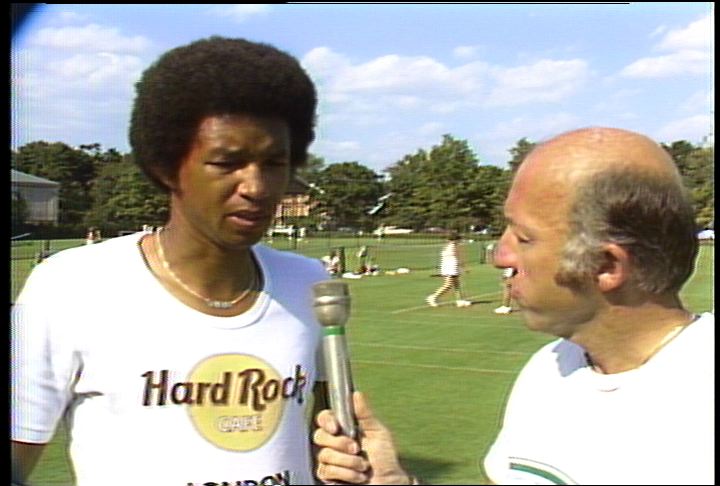
Arthur Ashe

United States (1943–1993)

Hall of Fame—1985

A singular figure in the game’s history as the first black male to win a major singles titles—the first three in fact—Arthur Robert Ashe, Jr., also set a record in 1968 that is most unlikely to be equaled: he won both the U.S. Amateur and Open championships, the first time such a double was possible. No one has come remotely close since.

That first season of the Open era was a whirlwind year for him, then 1st Lieutenant Ashe of the U.S. Army. In order to maintain Davis Cup eligibility and gain time away from duty for important tournaments, Ashe was required to maintain his amateur status. Determining that the traditional (and previously amateur) U.S. Singles Championships at Forest Hills would become the inaugural U.S. Open in 1968, the USTA designated Longwood Cricket Club grass in Boston as the site for a U.S. Amateur tournament. Seeded No. 1 in Boston, Ashe came through to the title by surging past teammate Bob Lutz in the exciting final, 4-6, 6-3, 8-10, 6-0, 6-4.

However, with pros introduced to Forest Hills, Ashe was a lightly regarded No. 5 seed. Nevertheless, at 25, he came of age as an internationalist. Unflappable over the New York fortnight, he served-and-volleyed splendidly. In the final, he clocked 26 aces, returned with precision, and held his cool in a five-set championship victory over pro Tom Okker, 14-12, 5-7, 6-3, 3-6, 6-3.An amateur would never do so well again. As the last remaining pro, Okker got the $14,000 first prize while Ashe was happy to settle for $20 daily expenses for his historic triumph, the first major for a black since Althea Gibson’s Forest Hills triumph a decade before. Ashe’s victory also boosted American morale by ending the U.S. male championship drought that dated back 13 years to Tony Trabert’s 1955 title.

That year Ashe was also a Davis Cup drought-buster, spearheading the U.S. drive to the sterling tub last won five years before. He won 11 straight singles (the most in one campaign for an American) in the drive to retrieve the Cup from Australia in Adelaide. In the finale, he started slowly but beat lefty Ray Ruffels on opening day, 6-8, 7-5, 6-3, 6-3, for a 2-0 lead. After the Cup was clinched by Lutz and Stan Smith in doubles, he finally gave way, losing to Bill Bowrey in a meaningless third-day match. The season closed with Ashe the winner of 10 of 22 tournaments on a 72-10 match record.

He would win both his singles in 1969 as the U.S. successfully defended the Cup, 5-0, against Romania. He beat Ilie Nastase on the first day, 6-2, 15-13, 7-5. Next came West Germany, 5-0, also at Cleveland in 1970, and his first-day win over Willy Bungert, 6-2, 10-8, 6-2. His third-day defeat of Christian Kuhnke, 6-8, 10-12, 9-7, 13-11, 6-4, was the longest match (86 games) in a Cup-deciding round. Eight years later, he reappeared for a vital cameo that led to another Cup for the U.S. His singles victory over Kjell Johansson, 6-2, 6-0, 7-5, was the clincher over Sweden, 3-2, in the semifinal at Goteborg.

Ashe put in 10 years of Davis Cup, topped for the U.S. only by John McEnroe’s 12 and Bill Tilden and Stan Smith’s 11 each, and won 27 singles matches. He returned in 1981 as captain for five years, piloting the victors of 1981 and 1982. He was born July 10, 1943 in Richmond, Va., and grew up there. He was 6’1, 160 lbs and right-handed. Since racial segregation was the law at that time, he could not play in the usual junior tournaments. With the aid of the concerned Lynchburg, Va., physician, Dr. Walter Johnson (who had also befriended and helped Althea Gibson), Ashe finished high school in St. Louis where he could get the necessary tennis competition.

In 1961, after Dr. Johnson’s lobbying got him into the previously segregated U.S. Interscholastic tourney, Ashe won it for Sumner High. Four years later, leading man of his alma mater’s varsity (University of California at Los Angeles), he won the 1965 U.S. Intercollegiate singles over Mike Belkin of the Univ. of Miami, 6-4, 6-1,6-1, and took the doubles with Ian Crookenden. Although Ashe was a man of strong character, poised and able to overcome racial blocks, it took him a while to harness his power, groove his groundstrokes and become a thoughtful player, comfortable on all surfaces. He won 35 amateur singles tournaments, including the U.S. Hard Court in 1963 over Allen Fox, 6-3, 12-10, and the U.S. Clay Court in 1967 over Marty Riessen, 4-6, 6-3, 6-1, 7-5. As one whose career overflowed the amateur and Open eras, he followed the 1968 breakthrough with 11 sterling years as a professional that netted 33 singles titles including the 1970 Australian over Aussie Dick Crealy, 6-4, 9-7, 6-2, and the gloriously unexpected Wimbledon title in 1975.

Days before his 32nd birthday, seeded No. 6, he was a longer shot than he had been seven years earlier at Forest Hills. Defending champ Jimmy Connors, seemingly inviolable, was a 10-to-1 favorite in the final, but Ashe was too slick and cerebral in one of the momentous upsets, 6-1, 6-1, 5-7, 6-4. Changing pace and spin cleverly, startling Connors with a sliced serve wide to the two-fisted backhand, Arthur out-foxed the man a decade his junior.

This was the centerpiece of Ashe’s preeminent year, a heavy duty season when he won nine of 29 tourneys on a 108-23 match record and wound up No. 1 in the U.S., No. 4 in the world. He reached No. 2 in the world in 1976. Improving with age, he unfortunately was grounded prematurely, and permanently, by a heart attack in July, 1979. In 1992, he revealed that he’d contracted AIDS through a 1988 blood transfusion.

Besides 1975, he spent nine other years in the world’s Top 10: No. 10 in 1965 and 1978; No. 7 in 1966; No. 9 in 1967, 1970 and 1973; No. 2 in 1968; No. 8 in 1969; No. 6 in 1971; No. 5 in 1972. In the U.S. rankings, he was No. 1 in 1968 and 1975 and in the Top 10 10 other years: No. 6 in 1963; No. 3 in 1964 and 1976; No. 2 in 1965-66-67, 69, 71, 73; No. 4 in 1970; No. 5 in 1974. He was one of the founders of the ATP in 1972, served as president and had been a reasoned, intelligent spokesman for the game, serving on numerous corporate boards and received several honorary degrees.

A long-time protester of apartheid in South Africa, he was, after several refusals, granted a visa to visit that country in 1973, and became the first black to win a title there, the doubles (with Okker) in the South African Open, over Lew Hoad and Rob Maud, 6-2, 4-6, 6-2, 6-4, after losing singles final to Connors, 6-4, 7-6, 6-3. “You have shown our black youth that they can compete with whites and win,” poet Don Mattera lauded him.

He was gratified to return again after the dismantling of apartheid and meet with president Nelson Mandela (who identified himself as “an Ashe fan”). Ashe lent himself, his name and his money to various enlightened causes. He was arrested not long before his death in a protest against what he regarded as cruel U.S. policies toward Haitian refugees. His principal cause was fostering, furthering education for needy kids, and he was the guiding light in the Safe Passage Foundation for that purpose. He was also a warrior in the fight against AIDS. A tennis player who went well beyond the game, Arthur upheld the qualities that distinguished him as a champion: he showed that it was possible to compete ferociously while maintaining personal honor and sportsmanship. Having entered the Hall of Fame in 1985, he died Feb. 6, 1993, leaving his wife, Jeanne, and six-year-old daughter, Camera. He was posthumously awarded the Presidential Medal of Freedom by President Clinton.

During his career, he won 35 amateur singles, 33 pro singles (634-202 in matches), 18 pro doubles titles (323-176) and $1,584,909 in prize money.

MAJOR TITLES (5)—U.S. singles, 1968; Australian singles, 1970; Wimbledon singles, 1975; Australian doubles, 1977; French doubles, 1971. OTHER U.S. TITLES (8)—Amateur singles, 1968; Clay Court singles, 1967; Hard Court singles, 1963. Intercollegiate singles. 1965; Indoor doubles, 1967 with Charles Pasarell; 1970 with Stan Smith; Clay Court doubles, 1970. with Clark Graebner; Intercollegiate doubles, 1965, with Ian Crookenden. DAVIS CUP (As player)—1963, 1965-66-67-68-69-70, 75, 77, 78, 27-5 singles, 1-1 doubles. As captain—1981-82-83-84-85, record 13-3, won 1981-82 Cups.

Arthur Ashe with Bud Collins

Roger Federer, “The Lord of the Swings,” Retires; What Bud Collins Wrote About Him

September 15, 2022 by Admin

By Randy Walker

@TennisPublisher

“Lord of the Swings”

This was the nick-name that the one and only tennis historian and Hall of Fame tennis journalist Bud Collins bestowed on the great Roger Federer, who announced his retirement from the pro tennis tour on Thursday.

The following is how Collins, in his unique prose, wrote of Federer in his famous tome “The Bud Collins History of Tennis” book.

Roger Federer

Switzerland (1981—)

As Lord of the Swings, Federer was top of the list in men’s tennis as the all-time leader in major singles titles—winning his record-breaking 15th major singles title in dramatic fashion with a 5-7, 7-6 (6), 7-6 (5), 3-6, 16-14 final-round victory over Andy Roddick at Wimbledon in 2009 in the longest Wimbledon final in games and the longest final set in the history of major championship finals. The Wimbledon title moved him past Pete Sampras, a spectator from the Royal Box who held the previous record with 14 majors. The previous month, Federer completed the “Career Grand Slam”—winning the French Open title, defeating Sweden’s Robin Soderling in the final 6-1, 7-6 (1), 6-4—joining Fred Perry, Don Budge, Rod Laver, Roy Emerson and Andre Agassi as only men in tennis history to win all four majors in their career. He won a 16th major at the 2010 Australian Open, defeating Andy Murray 6-3, 6-4, 7-6 (13-11).

Federer took over No. 1 in 2004, from Andy Roddick, and held the top spot for a record 237 consecutive weeks. Performing in a smooth, seemingly effortless, style, a right-hander using one-handed backhand, he occupies his status as arguably the greatest player ever in men’s tennis with rare grace and competitive verve, always in the right place to deliver the right shot from his peerless all-court arsenal of angles, spins, volleys, pinpoint serves. Is there a weakness, a flaw? Doubtful. Perhaps only one man has found it: that would be Rafael Nadal of Spain, whose high-rolling topspin and speed afoot has stymied Federer on Parisian clay four straight years—semifinals in 2005, 6-3, 4-6, 6-4, 6-3; finals in 2006, 1-6, 6-1, 6-4, 7-6 (7-4), finals in 2007, 6-3, 4-6, 6-3, 6-4, and finals in 2008 6-1, 6-3, 6-0. Rafa would then end Roger’s five-year reign at Wimbledon, beating Federer 6-4, 6-4, 6-7 (5), 6-7 (8), 9-7 in the epic 2008 final. Rafa would also snare Roger in an epic Australian Open final in 2009, winning 7–5, 3–6, 7–6(3), 3–6, 6–2.

Other than Nadal, Roger has been mistreating his colleagues regularly at the major occasions. He has three major triples (Australian, Wimbledon, U.S.), 2004, 06, 07. Merely eight men in history have previously tripled:Rod Laver (AUS) twice with Grand Slams in 1962 and 1969; Don Budge (USA) with the original Grand Slam, 1938; Jack Crawford (AUS), 1933; Fred Perry (GBR), 1934, Tony Trabert (USA), 1955; Lew Hoad (AUS), 1956; Ashley Cooper (AUS), 1958; Roy Emerson (AUS), 1964; Mats Wilander (SWE), 1988. But nobody but Roger thrice. After a 2005 French semifinal loss to Nadal, he made itto 10 successive major finals, winning eight. Colossal. Big Bill Tilden (USA) reached 11 straight major finals, winning eight between 1918 and 1927, but there were gaps in his appearances. Federer’s triple triples amount to nine of his 16 singles majors as of July of 2010. By reaching the final of Wimbledon in 2009, he reached his 20th major final, breaking Ivan Lendl’s record of 19.

Roger, who turned pro in 1998, showed an aptitude for Wimbledon’s Centre Court greensward as a 19-year-old in 2001, severing Sampras’s streak of 31 Wimbledon match wins, 7-6 (9-7), 5-7, 6-4, 6-7 (2-7), 7-5, in the fourth round. He then lost the quarterfinal to Tim Henman (GBR), 7-5, 7-6 (8-6), 2-6, 7-6 (8-6), and, seeded No. 7, was stunned in the 2002 opening round by No. 154 Mario Ancic (CRO), 6-3, 7-6 (7-2), 6-3. A two-match losing streak at the Big W—but he wouldn’t lose there again. Near the end of 2007, he lost consecutively to David Nalbandian (ARG) in Paris and Fernando Gonzalez (CHI) in the round robin of the Masters at Shanghai, his longest losing streak four-and-a-half years. Federer says his 2003 first-round loss at the French to No. 88 Luis Horna (PER), 7-6 (8-6), 6-2, 7-6 (7-3), shook him up, made him question his motivation. Bearing down, he was a changed man, won his first major title, Wimbledon seeded No. 4, 7-6 (7-5), 6-2, 7-6 (7-3), over No. 48 Mark Philippoussis (AUS).

Nadal was the first to push him to five sets in the majors since Roger’s defeat of Sampras in 2001. Theirs was a magnificent battle in the 2007 Wimbledon title bout, Roger denying Rafa four break points in the fifth set (two each at 1-2 and 2-3) which could have cost him the championship. His grit showed as he won, 7-6(9-7), 4-6, 7-6(7-3), 2-6, 6-2, and again two months later at the U.S. There Djokovic held five set points on serve (6-5, 40-0, 2 ads) in the first set, and two more set points in the second (5-6, 15-40), but Roger wouldn’t budge, 7-6 (7-4), 7-6 (7-2), 6-4. Federer fought back from two-sets down to nearly hold on and win a record sixth straight Wimbledon crown in 2008, falling to Nadal 9-7 in the fifth set.

Born Aug. 8, 1981, Basel, Switzerland, where he grew up. Turned pro, 1998, 6 ft. 1, 177 lbs. At the end of 2007, he suffered a case of mononucleosis which hampered his 2008 start. He has a charitable foundation, and is a UNICEF Good Will Ambassador. From 2004 Wimbledon to 2010 Australian Open, reached 23 straight semifinals at major events, snapped by Robin Soderling in the quarterfinals of the 2010 French Open. Played Davis Cup, 1999–2009, he has played 18 ties; 27-6 singles, 10-5 doubles. Fulfilled lifelong dream of winning Olympic gold in Beijing in 2008, pairing with Stan Wawrinka to win doubles gold, defeating Simon Aspelin and Tom Johansson (SWE) 6-3, 6-4, 6-7 (4), 6-3 in the gold medal match. Lost to James Blake of the U.S. in the singles quarterfinals, 6-4, 7-6 (2).

Before Carlos Alcaraz, Rafa Nadal Was The Last Teenager To Win A Men’s Major Title

September 12, 2022 by Admin

Before Carlos Alcaraz, the last teenager to win a men’s major title was Rafael Nadal, also from Spain, when he won the French singles title in 2005. No one could document tennis history, and make you smile at the same time, quite like the late, great Bud Collins. The following is an excerpt from “The Bud Collins History of Tennis” book where Bud describes Nadal’s debut on the scene and his first major singles title just after his 19th birthday in Paris.

     “Vamos, Rafa!”

     That was the cry heard increasingly throughout the world as the big, fast and vivacious 19-year-old Spaniard Rafael Nadal came into view.  Not just “promising,” which would be enough for most at that age – but as a major champion.

     It’s thrilling as tennis evolves to watch a kid burst onto the scene and make an historic mark.  Think of Billie Jean King at the 1961 Wimbledon doubles, Chris Evert at the 1971 U.S. Open, Evonne Goolagong at 1971 Wimbledon, Jimmy Connors at the 1973 U.S. Pro, Bjorn Borg at the 1974 French, Tracy Austin at the 1977 U.S. Open, Martina Navratilova at 1978 Wimbledon, Boris Becker at 1985 Wimbledon, Steffi Graf at the 1986 U.S. Open, Arantxa Sanchez Vicario and Michael Chang at the 1989 French, the Sisters Williams at the U.S. Open – Venus in 1997, Serena in 1999 – Martina Hingis at the 1997 Australian.

      And Mats Wilander, 17, at the 1982 French, winning it on the first visit. It was Nadal who made such a move in 2005, champion as a novitiate. Only he and the Swede, Mats won at Roland Garros in their first attempt. In fact, Rafa, as 2008 dawned, remained undefeated in Paris, overpowering Argentine Puerta in 2005, then none other than Roger Federer in 2006-07.

     After a round of 16 showing at the Australian Open, losing to eventual finalist Lleyton Hewitt in a titantic struggle 7-5, 3-6, 1-6, 7-6 (7-3), 6-2, Nadal took clay titles at Costa Do Sauipe, Brazil, 6-0, 6-7 (2-7), 6-1, over Spain’s Alberto Martin, and Acapulco, Mexico, 6-1, 6-0, over another Spaniard Albert Montanes, and made an impressive hard-court gallop to the final of Key Biscayne, simmering down against Federer in the final, 2-6, 6-7 (4-7), 7-6 (7-5), 6-3, 6-1.

     Back to the comfort of clay, Rafa hiccupped in a quarterfinal loss to Russia’s Igor Andreev in Valencia, 7-5, 6-2, but would not lose another match on the dirt for another 25 months. He won Monte Carlo, beating Guillermo Coria, 6-3, 6-1, 0-6, 7-5, then Barcelona, taking out Juan Carlos Ferrero 6-1, 7-6 (7-4), 6-3 and then in Rome in an epic Italian final over Coria, 6-4, 3-6, 6-3, 4-6, 7-6 (8-6). The excellently fought five hour and 14 minute job was the longest ever final at Il Foro Italico, and the match of the year, as Nadal rose from 0-3 in the fifth, watched Coria blunt three match points in the tie-breaker before missing a backhand. Called “El Mago” (magician) by his admirers, Coria made himself disappear with the concluding error.

     At the French, Nadal surrendered sets to Sebastien Grosjean (6-4, 3-6, 6-0, 6-3 in the round of 16), and to Federer (6-3, 4-6, 6-4, 6-3 in the semifinals) before hanging on to take out the difficult unseeded upstart, No. 37 Puerta, 6-7 (6-8), 6-3, 6-1, 7-5, in the rare all-lefty final. Nadal was the seventh Spaniard to win the men’s prize at Roland Garros and one of five teen-age champs. In December, it was announced that Puerta failed a drug test after the French final – testing positive for the stimulant etilefrine. Puerta was forced to return his prize money, was stripped of his points and suspended eight months (later shortened to two years on appeal).

Had drugs helped his endurance?  Some thought so, considering his long battles in the quarters and semis: over Argentine Willy Canas, 6-2, 3-6, 1-6, 6-3, 6-4, and over Russian Nikolay Davydenko, 6-3, 5-7, 2-6, 6-4, 6-4, but a three-person panel concluded that Puerta mistakenly ingested the drug will drinking out of his wife’s wine glass.

Gaston Gaudio labored hard to keep his French title, but another Spaniard, David Ferrer, unseated him in the fourth round, 2-6, 6-4, 7-6 (7-5), 5-7, 6-4.

     Nadal finished the year with 11 titles – tied with Federer for tops for the year – a 70-15 won-loss record, but was a solid No. 2 behind Federer, who won Wimbledon for a third straight year and the U.S. Open for a second time.

Rafael Nadal at the 2005 French Open

50 Years Ago In Tennis – Rod Laver Clinches His First “Grand Slam”

September 8, 2012 by Admin

The year 1962 witnessed many “firsts” and historic moments in pop culture and society. It marked the first year the iconic band The Rolling Stones started making music. It was the first time the character James Bond first appeared on a movie screen. It marked the last year that movie star Marilyn Monroe graced the Earth and the first year that the New York Mets, the neighbor of the US Open tennis championships, first played as a baseball team.

It also marked an epic year in the world of tennis, climaxed by Australian legend Rod Laver winning his first of two Grand Slam sweeps of all four major singles titles. Bud Collins, the legendary tennis writer and historian, reviews the year 1962 in tennis in his famous book THE BUD COLLINS HISTORY OF TENNIS (available here on amazon.com: http://www.amazon.com/The-Collins-History-Tennis-Authoritative/dp/0942257707/ref=sr_1_1?ie=UTF8&qid=1347105221&sr=8-1&keywords=bud+collins+history+of+tennis) in this exclusive book excerpt.


The Australian grip—both hands firmly around the throat of players of any other nationality— was in vogue in 1962, the season of Rod Laver’s first Grand Slam and Margaret Smith’s near-Slam.

Laver duplicated Don Budge’s supreme feat of 1938, sweeping the singles titles of Australia, France, Great Britain (Wimbledon) and the United States. He also won the Italian and German titles, not to mention the less prestigious Norwegian, Irish and Swiss, and led Australia to a 5-0 blitz of upstart Mexico in the Davis Cup Challenge Round. In all, Laver won 19 of 34 tournaments and 134 of 149 singles matches during his long and incomparably successful year.

Smith (to become better known as Margaret Court after marriage to Barry Court) was staggered in the first round of Wimbledon by the pudgy chatterbox who would grow up to be her archrival, Billie Jean Moffitt (later Billie Jean King),  but otherwise won just about everything in sight. Smith’s only other loss was to another young American, Carole Caldwell, but “Mighty Maggie” won 13 of 15 tournaments, including the Australian, French and U.S., and 67 of 69 singles matches.

Laver, the “Rockhampton Rocket” from that Queensland town, started his Slam at White City Stadium in Sydney, beating Roy Emerson, 8-6, 0-6, 6-4, 6-4, not that he’d had an easy time making it that far. Laver was particularly harried by Geoff Pares in the third round before prevailing, 10-8, 18-16, 7-9, 7-5. Emerson and Neale Fraser  took the doubles, 4-6, 4-6, 6-1, 6-4, 11-9, over mates Fred Stolle and Bob Hewitt.

Laver lived precariously at the French in Paris, the only leg of the Slam on slow clay, going the maximum sets down the stretch. He saved a match point in beating countryman Marty Mulligan in the quarterfinals, 6-4, 3-6, 2-6, 10-8, 6-2. He also went five with Fraser in the semifinals, 3-6, 6-3, 6-2, 3-6, 7-5, and with Emerson again in the final, 3-6, 2-6, 6-3, 9-7, 6-2. Emerson and Fraser racked up another doubles title, 6-3, 6-4, 7-5, over Germans Christian Kuhnke and Wilhelm Bungert.

At Wimbledon, Laver lost only one set to Manolo Santana in a 14-16, 9-7, 6-2, 6-2, quarterfinal victory. There were no Americans in the quarters for the first time since 1922, and hardly room for anyone but Australians— six of them—as Yank Frank Froehling fell to Santana, 12-10, 6-3, 8-10, 6-3, in the fourth round. The semis were an all-Aussie show: Laver, Mulligan, Neale Fraser and his brother John Fraser, a physician by profession, who got an uncommonly lucky draw. Laver beat Neale Fraser, 10-8, 6-1, 7-5, and trampled Mulligan in the final, 6-2, 6-2, 6-1. With Emerson sidelined by the painful toe, defaulting to Mulligan in the quarterfinals, Aussies Bob Hewitt and Fred Stolle won the doubles over two new faces, Yugoslavs Boro Jovanovic and Nikki Pilic, 6-2, 5-7, 6-2, 6-4.

At Forest Hills, Laver lost only one set again en route to the U.S. final—to gangly Froehling in a 6-3, 13-11, 4-6, 6-3 quarterfinal victory. The athletic Emerson was back, but Laver repelled him as he had in Sydney, Rome (6-2, 1-6, 3-6, 6-3, 6-1 in the Italian final) and Paris. Laver hit four fearsome backhand returns to break serve in the first game and dominated the first two sets with his varied backhand, either bashed or chipped, a topspin forehand, and ruthless serving and net play. Emerson, always barreling forward and battling, aroused a crowd of 9,000 by winning the third set, but Laver closed out the match and the Slam, 6-2, 6-4, 5-7, 6-4, and was greeted by original Slammer Budge afterward. They had the male precinct of the ultra-exclusive club to themselves, sharing with only Maureen Connolly.

Rod Laver
Rod Laver

Astonishingly, there were again no Aussies in the final of the U.S. Doubles Championships at Longwood, where the “Mexican Thumping Beans,” collegians Rafe Osuna and Tony Palafox, out-hustled temperamental Americans Chuck McKinley and Dennis Ralston, reversing the previous year’s final result, 6-4, 10-12, 1-6, 9-7, 6-3.

Osuna and Palafox had scored a victory of much greater import over Ralston-McKinley earlier in the year, in the pivotal match of Mexico’s 3-2 upset of the U.S. in the Davis Cup. Palafox beat Jack Douglas in the rarefied atmosphere of Mexico City, 6-3, 6-1, 3-6, 7-5 after McKinley had disposed of Osuna, 6-2, 7-5, 6-3, in the opener. The doubles point provided the impetus, 8-6, 10-12, 3-6, 6-3, 6-2. The next day Osuna was carried off on the shoulders of jubilant countrymen when he out-nerved Douglas, 9-7, 6-3, 6-8, 3-6, 6-1, for the clinching 3-1 point. This was the first time Mexico had defeated the U.S. in 15 tries and won the American Zone. Osuna and Palafox lugged their adoring nation all the way to the Challenge Round – defeating Yugoslavia, 4-1, Sweden, 3-2 (Osuna taking the tingling fifth match in Mexico City over Jan-Erik Lundquist, 3-6, 6-4, 6-3, 1-6, 6-3) and India, 4-1 at Madras.

Osuna had gone 5-1 in singles, Palafox 3-2 and they were 4-0 in doubles, all on clay. However, the left-handers Laver and Fraser on the swift grass of Brisbane were too steep a proposition, 5-0: Laver slamming Osuna, 6-2, 6-1, 7-5, and Fraser taking Palafox, 7-9, 6-3, 6-4, 11-9. Queensland mates Emerson and Laver settled it over the game Mexicans, 7-5, 6-2, 6-4.

For the third straight year, Margaret Smith, 19, drubbed Jan Lehane, 20, in the final of the Australian, 6-0, 6-2, where Jan, with her then-rare double-handed backhand, removed second-seeded Darlene Hard 7-5, 6-4 in the quarterfinals.

But Margaret had a much closer French final against another countrywoman, Lesley Turner. In a meeting of two future Hall of Famers, Smith had shown she could play on clay too, winning the Italian title, defeating Maria Bueno 8-6, 5-7, 6-4 in the final. In Paris, Smith prevailed over Turner 6-3, 3-6, 7-5, rescuing a match point at 3-5 in the third.

By that time, she must have been entertaining thoughts of duplicating the Grand Slam, joining Connolly, who had emulated Budge in 1953. But 18-year-old Billie Jean Moffitt, who had a premonition weeks earlier that she would draw Smith in her opening match at Wimbledon, rudely wrecked the dream, 1-6, 6-3, 7-5. It was the first time that the top-seeded female failed to survive one round. (Steffi Graf would lose to Lori McNeil in 1994, Martina Hingis to Jelena Dokic in 1999, and to Virginia Ruano Pascal in 2001.) Her victory established “Little Miss Moffitt” as a force to be reckoned with on the Centre Court that already was her favorite stage.

It was eighth-seeded Karen Hantze Susman taking the singles at age 19 without losing a set, and never in trouble. An outstanding volleyer, Susman was nudged a little in the semifinal by Ann Jones, 8-6, 6-1, and captured the title with a 6-4, 6-4 victory over unseeded Vera Sukova of Czechoslovakia. A sturdy 31-year-old baseliner, Vera, who would later give birth to two world class players, Helena Sukova and Cyril Suk, had run rampant through a patch of seeds: sixth-seeded, defending champ Angela Mortimer, 1-6, 6-4, 6-3; second-seeded Hard, 6-3, 6-3; third-seeded Maria Bueno, 6-4, 6-3. Billie Jean’s singles raves came to a halt in the quarters, 6-3, 6-1, to Jones, but repeated in the doubles with Susman, getting ahead in a 5-7, 6-3, 7-5, scrap with South Africans Sandra Reynolds Price and Renee Schuurman.

Smith was back in form at Forest Hills. With her enormous reach, athleticism, weight of shot and solid arsenal from the backcourt and net alike, she beat Hard in a nerve-wracking match, 9-7, 6-4 to become the first Australian woman to win the U.S. singles. She saved a set point in the 10th game of the first, and benefited from 16 double faults by Hard, who was perplexed by numerous close line calls and burst into prolonged tears in the sixth game of the second set.  Smith had beaten third -seeded Bueno in a dandy semi, 6-8, 6-3, 6-4. But where were those teen-age darlings of Wimbledon – Moffitt and Susman? Both were early victims of one of the original grunters, 17-year-old Victoria Palmer of Phoenix.  Palmer beat Billie Jean, who was injured, in the first round, 6-8, 5-0, default, and eliminated second-seeded Karen in the third round, 6-2, 3-6, 6-3. She lost a semifinal to Hard, 6-2, 6-3.

Hard beat Christine Truman, 6-2, 6-2, and Haydon, 6-3, 6-8, 6-4, as the U.S. edged Britain, 4-3 in the Wightman Cup at Wimbledon. Captain Margaret Osborne duPont, 44, teamed up with Margaret Varner to show that she could still win at doubles, 6-3, 2-6, 6-2, over Liz Starkie and Deidre Catt. Susman chipped in a 6-4, 7-5, win over Truman.

While the interest generated by Laver and Smith signaled a banner year for amateur tennis, the pros struggled. Pancho Gonzalez had retired for the time being, leaving Butch Buchholz to win the U.S. Pro title over Pancho Segura, 6-4, 6-3, 6-4, in Cleveland. Ken Rosewall won at Wembley defeating Lew Hoad 6-4, 5-7,15-13,7-5.

Jack Kramer had also given up the ghost as promoter. “We had all the best players, but the public didn’t want to see them,” he recalled. “There was no acceptance for our players. The conservative and powerful amateur officials were secure. Among other things, they had succeeded in making me the issue. If you were for pro tennis, you were in favor of handing over all of tennis to Jack Kramer. That was their argument.” That is vastly oversimplified, of course. Kramer in many ways had only himself to blame for antagonism. But name-calling aside, the pro game was in sorry shape.

Rosewall was the top dog, but he had little flair for promotion, and the top amateurs no longer were tempted to turn pro and face an uncertain, anonymous future. Under-the-table payments afforded a comfortable if not lavish lifestyle for the top “amateurs.” For the second time in the post-war era, there was no pro tour in the United States. Rosewall and Hoad were contemplating retirement. Their only chance at reviving interest, they thought, was to induce Laver to join them, and they pooled resources and personally guaranteed him $125,000 to come aboard for 1963. In the end, he decided he couldn’t reject such a generous offer.


Collins and Laver collaborated in a book called “The Education of a Tennis Player” about Laver’s second Grand Slam in 1969 and his life in general. It can be purchased here: http://www.amazon.com/The-Education-Tennis-Player-Laver/dp/0942257626/ref=sr_1_1?ie=UTF8&qid=1347106817&sr=8-1&keywords=The+Education+of+a+Tennis+player


Wimbledon: The Grand-daddy of them all!

June 19, 2011 by WTM

Wimbledon. It’s one of those one words spoken in the English language and you know exactly what it is and what it represents – the ultimate in tennis, elegance, grace, tradition. Bud Collins, the world’s most famous tennis journalist and historian, summarizes the grandest tennis tournament in the world in this excerpt from his famed tennis encyclopedia called THE BUD COLLINS HISTORY OF TENNIS ($35.95, New Chapter Press, available here: http://ow.ly/5laMo

This is the Grand-daddy, first-born of all tournaments in the game of lawn tennis as we know it. It was 130-years-old in 2007, having hopefully entered the sporting world in 1877 and became the cynosure of the game. Considered the championships of Great Britain, the tournament is officially entitled The Lawn Tennis Championships. But one word—Wimbledon—is quite sufficient, proclaiming the majesty of it all, referring to location, the suburb of that name in southwest London.

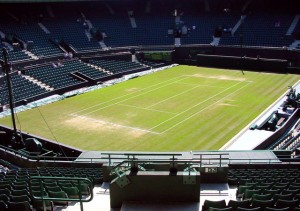
Wimbledon

Since the beginning, it has been conducted on the grounds of the All England Lawn Tennis and Croquet Club (1868), first at the Worple Road site, then to its present setting on Church Road in 1922. Last week in June-first week in July have been the dates for more than a century.

The first Centre Court seated about 4,000, grounds capacity 7,500. The present Centre, seating 9,989 in its 1922 debut, has held as many as 16,000, standing liberally permitted. But current law, eliminating standing, limits it to 13,802 seats. A new No. 1 Court (1997) seats 11,429. Intimate Court No. 2—the so-called “Graveyard of Champions”— held 1,900, losing its shape in a 2009 re-modeling.

Record one-day attendance on the grounds was 42,457, the first Wednesday of 2002. The tourney record for the fortnight (13 daytime sessions; no play on the middle Sunday) was 476,711 in 2001. (Overall, the record is 490,081 in 2001 when inclement weather made a 14th day necessary.) Estimates of the peak years at Worple Road range between 60,000 and 70,000. Rain, seemingly a constant antagonist, was at its worst in 1922, daily downpours pushing the conclusion to the third Wednesday. A retractable roof for Centre is to be in use by 2009.

Tennis was first played at the Club in 1875 and pretty much took over from the croquet-eers in 1882. A gathering of 200, paying about 20 cents apiece, witnessed two locals, among 22 entrants, jousting for the inaugural title, won by 27-year-old Spencer Gore, 6-1, 6-2, 6-4, over William Marshall, 28. Only 30 of the spectators were seated. Seven years later, in an intramural English clash, Maud Watson, 19, beat her 26-year-old sister, Lillian Watson, 6-8, 6-3, 6-3, and the women had their initial champ. Thirteen had entered.

The surface has always been God’s own sod: grass. The challenge round system was in force for men’s singles (1878 through 1921), women’s singles (1885 through 1921) and men’s doubles (1885 through 1921). It meant that the defending champion played only one match the following year, waiting for a challenger to emerge from the all-comers tournament. When the champion chose not to defend, the winner of the all-comers was the new champ.

In 1972, two years after the U.S. introduced the tie-breaker, Wimbledon accepted the novelty, but cautiously at 8-8 in games, not 6-6, and not the American “sudden death” style. But in 1979, Wimbledon conformed with the rest of the world at 6-6, and continued with the “lingering” ITF version, best-of-12-points, but a margin of two points required. However, the tie-breaker is not applied to ultimate sets, the fifth for men, third for women. Deuce sets, eliminating 6-5 set scores, were adopted in 1884, as were byes later than the first round.

Wimbledon had lobbied for “Open” tournaments, and welcomed pros and amateurs together in 1968, allotting $63,000 as prize money. Rod Laver got $4,800 as first prize, Billie Jean King $1,800. As the last major to offer equal prize money for men and women, the tournament in 2007 paid champs Roger Federer and Venus Williams $1.4 million apiece from of a pot of over $22.5 million. They also got to keep smaller replicas of the trophies: for men, the Challenge Cup engraved “The All England Lawn Tennis Club Single Handed Championship of the World” along with names of the champions; for women, the Rosewater Dish, engraved with names of the champions.

Unluckily for the natives, none has embraced these baubles since Virginia Wade in 1977 and Fred Perry in 1936.

Bud Collins reviews Isner-Mahut 2010 Wimbledon record-breaker as 2011 rematch manifests

June 17, 2011 by WTM

In an absolutely astonishing result of chance, John Isner and Nicolas Mahut, who last year played the epic 70-68 in the fifth-set, 11-hour first round match at Wimbledon have drawn each other AGAIN in the first round of 2011 Wimbledon.

Bud Collins, the world’s most famous tennis journalist and historian, reviews all the records set in last year’s epic in this excerpt below from his tennis encyclopedia and record book called THE BUD COLLINS HISTORY OF TENNIS ($35.95, New Chapter Press, order it here: http://ow.ly/5k2Cr

The excerpt below includes Bud’s compilation of all the records set during the epic Isner-Mahut marathon and also the list of all of the longest matches of all-time.

John Isner & Nicolas Mahut

For all the Wimbledon draws, go to www. Wimbledon.org.

John Isner’s 6-4, 3-6, 6-7(9-7), 7-6(7-3), 70-68 victory over Nicolas Mahut in the first round of Wimbledon in 2010 set the record for the longest ever tennis match in history in terms of number of games and duration.

The match stretched over three days, beginning at 6:08 pm on Tuesday, June 22 and was suspended due to darkness overnight at 9:03 pm at two-sets all. The match was resumed at 2:07 pm with the start of the fifth set on Wednesday, June 23 and was suspended again due to darkness 9:10 pm with the score at 6-4, 3-6, 6-7 (9-7), 7-6 (7-3), 59-59. The match again resumed at 3:42 pm on Thursday, June 24 and was completed at 4:48 pm.

The match lasted 11 hours, 5 minutes and totaled 183 games. The final set alone lasted 8 hours, 11 minutes. In comparison, the fewest games played through seven rounds to win a major singles title in the Open era (since 1968) in men’s singles title was 147, set by Guillermo Vilas at the 1977 US Open.

On Wednesday, Isner missed four match points in the fifth set, one at 10-9, two at 33-32, and one at 59-58. There were 168 consecutive service holds until the final game. The last previous break of serve had been in the second game of the second set when Isner was broken at 0-1. Mohamed Lahyani of Sweden was the chair umpire for the entire duration of the match and did not take a bathroom break during play.

Records broken during the epic include the following;

Longest match in time: 11 hours, 5 minutes

Previous record: 6 hours, 33 minutes, Fabrice Santoro def. Arnaud Clement, 6-4, 6-3, 6-7 (5), 3-6, 16-14, 2004 French Open first round

Longest match by games: 183

Previous record in singles: 126 games, Roger Taylor def. Wieslaw Gasiorek 27-29, 31-29, 6-4, King’s Cup, Warsaw, 1966

Previous record in doubles: 147 games, Dick Leach and Dick Dell def. Len Schloss and Tom Mozur, 3-6, 49-47, 22-20, Newport Invitational second round, 1967

Longest set in time: 8:11

Longest set by games: 138

Previous record: 96 games, Dick Leach and Dick Dell def. Len Schloss and Tom Mozur, 3-6, 49-47, 22-20, Newport Invitational second round, 1967

Most aces by player in a match: Isner: 113

Previous record: 78 aces, Ivo Karlovic, 2009 Davis Cup semifinal match vs. Radek Stepanek

Most aces overall in a match: 216 (Isner 113, Mahut 103)

Previous record: 96 aces, Ivo Karlovic (78 aces) and Radek Stepanek (18 aces) Davis Cup semifinal, 2009

Longest Matches of All-Time

Men’s Singles

11:05 John Isner d. Nicolas Mahut 6-4, 3-6, 6-7 (7), 7-6 (3), 70-68,

2010 Wimbledon first round

6:33 Fabrice Santoro d. Arnaud Clement 6-4, 6-3, 6-7 (5), 3-6,

16-14, 2004 French Open first round

6:22 John McEnroe d. Mats Wilander 9-7, 6-2, 15-17, 3-6, 8-6, 5th

rubber, Davis Cup Quarterfinal, St. Louis, Mo, 1982

Novak Djokovic’s win streak is nothing to this birthday girl

May 24, 2011 by WTM

So you think Novak Djokovic’s 40-match win streak is impressive? Well, this birthday girl – born today, May 24, in 1899, once won 182 straight matches from 1921 to 1926. Suzanne Lenglen, the woman whose name graces the second-biggest stadium on the grounds at Roland Garros was born 112 years ago Tuesday. Here’s how Hall of Fame tennis journalist Bud Collins describes her in his famous volume THE BUD COLLINS HISTORY OF TENNIS ($35.95, New Chapter Press, available for sale here: http://amzn.to/kLrGQn)

Suzanne Lenglen

France (1899–1938)

Hall of Fame—1978

In the days of ground-length tennis dresses, Suzanne Rachel Flore Lenglen played at Wimbledon with her dress cut just above the calf. She wept openly during matches, pouted and sipped brandy between sets. Some called her shocking and indecent, but she was merely ahead of her time, and she brought France the greatest global sports renown it had ever known.

Suzanne Lenglen and Bill Tilden

Right-hander Lenglen was No. 1 in 1925-26, the first years of world rankings. She won Wimbledon every year but one from 1919 through 1925, the exception being 1924, when illness led to her withdrawal after the fourth round. Her 1919 title match, at the age of 20, with 40-year-old Dorothea Douglass Chambers is one of the hallmarks of tennis history.

Chambers, the seven-time champion, was swathed in stays, petticoats, high-necked shirtwaist, and a long skirt that swept the court. The young Lenglen was in her revealing dress that shocked the British at the sight of calves and forearms. After the second set, Lenglen took some comfort from her brandy and won, 10-8, 4-6, 9-7, in a dramatic confrontation, rescuing two match points. After her victory, Lenglen became easily the greatest drawing card tennis had known, and she was one of those who made it a major box-office attraction. Along with a magnetic personality, grace and style, she was the best woman player the world had seen.

She had first attained prominence as a wonderchild at 15, winning a 1914 tournament called the World Hard Court [clay] Championships in Paris over Germaine Golding, 6-2, 6-1. However, World War I broke out shortly after that, and she had to wait five years to get to Wimbledon, which re-opened in 1919 ready for La Belle Suzanne’s takeover of the world stage.

She was golden at the 1920 Olympics, taking the singles over Brit Dorothy Holman, 6-3, 6-0, and the mixed with Max Decugis over Brits Kitty McKane (Godfree) and Max Woosnam, 6-4, 6-2. But she didn’t play the 1924 Games in Paris.

Lenglen, born May 24, 1899 in Paris, played an all-court game such as few had excelled at. She moved with rare grace, unencumbered by the tight layers of garments others wore. She had extraordinary accuracy with her classical, rhythmic groundstrokes. For hours daily, her father, Charles Lenglen, had her direct the ball at a handkerchief he moved from spot to spot. Her control was so unfailing that she thought it shameful to hit the ball into the net or beyond the lines. In addition, she had so keen a sense of anticipation that she invariably was in the right position to meet her opponent’s shot.

Her 1926 match against Helen Wills in a tournament at Cannes, France, caused a sensation, and world-wide attention and coverage. Tickets brought unheard-of wealth to scalpers, and the roofs and windows of apartments and hotels overlooking the court were crowded with fans. Lenglen was on the verge of collapse during the tense match, but was saved by smelling salts and brandy and defeated the 20-year-old Wills, 6-3, 8-6. Lenglen’s career was not free of setbacks, however. In the 1921 U.S. Championships, having lost the first set badly to Molla Mallory, Lenglen walked weeping and coughing to the umpire and said she could not continue, defaulting the match. She made up for it the next year at Wimbledon by defeating Mallory, 6-2, 6-0, in the final and did not lose another match for the remainder of her amateur career.

At Wimbledon in 1926, Lenglen had a terrifying ordeal. She kept Queen Mary waiting in the Royal Box for her appearance when, owing to a misunderstanding or a failure of communications, Lenglen did not have the correct information about the time she was to be on court. The ghastly error was too much. She fainted and Wimbledon saw her no more as a competitor. She withdrew from the tournament, and that year turned professional, going on tour of the U.S. with a troupe of newly-declared pros under the management of American promoter C.C. Pyle, winning all 38 matches against ex-U.S. champ, 35-year-old Mary K. Browne. It marked the beginning of professional tennis as a playing career.

Suzanne’s career numbers were staggering. According to the research of Wimbledon librarian Alan Little, in his biography, Suzanne Lenglen: Tennis Idol of the Twenties, she won 250 championships: 83 singles (7 without the loss of a game), 74 doubles, 93 mixed. Losing one singles match in eight years—that to Mallory at the U.S. of 1921—she was unbeaten in 1919 and 1920, 1922-23-24-25-26. Sandwiching the Mallory defeat were winning streaks of 116 matches before, and 182 after to the close of her amateur days. At Wimbledon, her greatest showplace, she won 90 of 92 matches—32-0 singles, 31-1 doubles, 27-1 mixed. She never married, despite many romances, the most serious with Baldwin Baldwin, an American millionaire who accompanied her on the professional tour.

At the age of 39, Lenglen died of pernicious anemia, July 4, 1938, in Paris. She was elected to the Hall of Fame in 1978. There was speculation that her health had been undermined by her long hours of practice as a young girl. But she had brought the glamour of the stage and the ballet to the court, and queues formed at tennis clubs where before there had been indifference. She had emancipated the female player from layers of starched clothing and set the short-hair style as well. She had brought tennis into a new era.

MAJOR TITLES (21)

French singles, 1925, 1926; Wimbledon singles, 1919, 1920, 1921, 1922, 1923, 1925; French doubles, 1925, 1926; Wimbledon doubles, 1919, 1920, 1921, 1922, 1923, 1925; French mixed, 1925, 1926; Wimbledon mixed, 1920, 1922, 1925.

SINGLES RECORD IN THE MAJORS

French (10-0), Wimbledon (32-0), US, (0-1).

Bud Collins reviews the history of Roland Garros

May 22, 2011 by WTM

The French Championships – or Roland Garros – is underway in Paris as the world’s top tennis players battle on the red clay to win one of the world’s most prestigious and historical tennis titles. Bud Collins, the world’s most famous tennis historian and journalist, profiles Roland Garros in his newly-updated book THE BUD COLLINS HISTORY OF TENNIS excerpted below. THE BUD COLLINS HISTORY OF TENNIS ($35.95, New Chapter Press, www.NewChapterMedia.com) also features all of the Roland Garros singles results from the quarterfinals, all doubles championship matches and tournament records – and the same for the other three major championships. Summaries of every year in tennis from 1919 to the present as well as player biographies, info on Davis Cup, Fed Cup, the Olympic Games – and so much more – are found in this 800-plus page volume that is a must for every tennis fan.

Roland Garros

Crimson clay has made the French Championship distinctive, the lone major contested on the footing beloved by dirt-kicking Europeans and Latin Americans. For 46 years (1928–74), Stade Roland Garros in Paris was an earthen oasis amid grass in the Australian, Wimbledon and U.S. Championships. Wimbledon retains its lawns, the Aussies and Yanks have paved their hard, unforgiving rectangles, but clay stays the French way.

Although dating back to 1891 (men) and 1897 (women), the French Championships welcomed only citizens and permanent residents. Not until 1925 was that restriction lifted, the rest of the world invited in, and the French would become the fourth of the major international championships, making a Grand Slam possible. Even so, the concept didn’t seem feasible until 1933 when an Aussie, Jack Crawford, having carried his homeland, became the first alien male to subdue Paris (8-6, 6-1, 6-3 over homeboy Henri Cochet). He went on to win Wimbledon but his bid for a Slam was jammed by Fred Perry in the U.S. final. Don Budge showed up in 1938 and was the first American guy to conquer the clay (6-3, 6-2, 6-4 over Czech Roderich Menzel), and was halfway to his pocketing of the initial Slam.

The most successful players in the French-only days were Cecilia Masson with six titles (1897–1900, 02-03) and Max Decugis with eight titles (1903-04, 07-09, 12-14). But leading foreigners did come to town for an international tournament entitled Championnats du Monde sur Terre Battue—terre battue the French term for clay—that ran in 1912- 13-14, 21, 23 in Paris (1922 in Brussels). After that, the label World Championships on Clay was dropped, but not before a small, dark-haired girl of 15 won it in 1914, and again in 1921 at 23. She was the unbeatable Suzanne Lenglen, who put France on the tennis map.

The 1924 Olympic Games in Paris gave the French another taste of internationalism, and the mood was “very insistent,” in the words of one writer, for the establishment of a French Championships (Championnats Internationaux de France) embracing players from wherever, joining the uppermost category. Thus France was in the exclusive four-member club, with four all-timers facing off for the introductory titles – Musketeers Rene (The Crocodile) Lacoste and Jean (Bounding Basque) Borotra, Lacoste winning, 7-5, 6-1, 6-4; La Lenglen beating the only nonnative, Brit Kitty McKane, 6-1, 6-2. First outlanders to enter the winners circle were Americans Vinnie Richards and Howard Kinsey in 1926 in men’s doubles, beating the other half of the illustrious Four Musketeers, Henri (Ball Boy of Lyon) Cochet and Jacques (Toto) Brugnon, 6-4, 6-1, 4-6, 6-4. First among visitors to seize a singles title was Kea Bouman of the Netherlands, 6-2, 6-4, over South African Irene Bowder Peacock in 1927.

In 1925 and 1927, the tournament was played at Stade Francais in St. Cloud, and in 1926, it was held at the Racing Club of Paris, neither venue holding more than 5,000. But the Musketeers’ lifting the Davis Cup from the U.S. in 1927 made a larger venue necessary for the 1928 Cup defense, as well as the Championships. Rising near the Bois de Boulogne was Stade Roland Garros, named for a heroic French aviator who died in World War I, and a Court Central seating 10,000. On the crushed brick surface, seldom adored by Americans, the French crushed Bill Tilden and the U.S., 4-1. World War II shut down the tournament as it did Wimbledon and the Australian and brought about a sad, grisly chapter in Roland Garros history. When the war began, the French government used it as a detention center for so-called dissidents and “other undesirables,” a number of them Jews who were at risk to be sent to the death camps when the Nazi invaders occupied Paris. One of the better known inmates, author Arthur Koestler (“Darkness at Noon”), wrote that, “We called ourselves cave dwellers, sleeping on wet straw beneath the stands which leaked.” Fortunately, he survived. In 1941, the Germans released the grounds to the French Federation, and the Championships resumed, obviously limited to locals and not included in official records. They resumed in 1946, with, appropriately, a native victor, unseeded Marcel Bernard over favored Czech Jaroslav Drobny, 3-6, 2-6, 6-1, 6-4, 6-3, an all-lefty finale. That French success didn’t recur for 37 years, until 1983 when Yannick Noah dethroned Swede Mats Wilander, 6-2, 7-5, 7-6 (7-3), to be handed the Coupe Mousquetaires. Female victory rates the Coupe Lenglen, won in the post-Lenglen time by citizens Simone Mathieu in 1938-1939 and Francoise Durr in 1967. After another long wait, 33 years, the Franco-American Mary Pierce cheered a Parisian crowd by beating Spaniard Conchina Martinez, 6-2, 7-5, in 2000.

First major to say “bienvenue” to the pros and “Opens,” the French offered a $25,000 pot in 1968. Ken Rosewall won $3,000 in an all-Aussie final over Rod Laver, 6-3, 6-1, 2-6, 6-2, but runner-up for the other title, left-handed Brit Ann Jones, got the first prize women’s check of $1,000, even though she lost to Texan Nancy Richey, 5-7, 6-4, 6-1. Nancy, fearful of giving up her amateur status in that uncertain new year of prize money, is alone in the majors as a title-winning amateur woman in the post-’68 era.

Cash earnings have has gone up considerably since: $1.4 million apiece to 2007 singles champs, Belgian Justine Henin and Spaniard Rafael Nadal, out of a $20.33 million kitty. The French was the second-to-last of the major championships to offer equal prize money to both men and women—offering equal prize money for both tournament champions in 2006 and awarding equal prize money across the board beginning in 2007.

The French has wandered on the calendar, but the dates have stood firmly (last week in May-first week in June) for decades. As interest has increased from 1960s doldrums, attendance and profits have gone up considerably, the scene improved. Court Central was enlarged, now holding 15,171 (named for Hall of Famer Philippe Chatrier, the driving force for modernization as French Tennis Federation president). A second stadium, the Court Suzanne Lenglen, holding 10,018, was added in 1995. A fan favorite, Court 1 (the intimate “bull ring”) accommodates 3,790.

In 2007, play began on the first of three Sundays, making the French, a daytime event, a 15-day show, the longest of the majors. A one-day attendance record, 35,750 on the grounds, was set on the first Saturday, 2007. The French tried night tennis in 1969, but wisely discarded the floodlights after that. Darkness doesn’t intrude until about 9:30 PM. The French Championships were the last major to accept the tie-breaker, 1973, but never for the ultimate sets, fifth for men, third for women.

Ready or not, Here we go Again – Can Anybody Block the 1-2 Punches of Monopolists Nadal and Federer?

January 11, 2011 by WTM

By Bud Collins


Can’t even fully digest 2010 as 2011 springs into view, the 44th year of open tennis –  or the 134th year since Wimbledon cranked up the original tournament.

Everybody ready?  Probably not.  Not enough recuperation time during another ridiculously brief off-season as the years bump together like pigs in a pen. Life on the road resumes, and few are lucky enough to occasionally play at home and eat Mom’s cooking (presuming she knows how to cook). Room service can be forbidding, though Pete Sampras made a pretty fair career on it.

The lure of the lined rectangle, whatever the inconveniences, is irresistible, and so the show goes on for the guys and dolls bashing away at each other across the planet.

For an amusing  moment I thought the season might be over before it began.  Something called The World Tennis Championship was happening in Abu Dhabi, one of those Emirates fat and bulging with cash.  Was the World Championship over  before the season even began?  Well, no, except in the huckstering eyes of the promoters.  Of course it was an exhibition, a demonstration of prowess by Nadal, Federer and some others of the elite, whose presence, win or lose, was gifted by lottery-style sums.  Guarantees.  A nice, conditioning romp in the desert sun.  Shake down a sheikh?

Roger Federer & Rafael Nadal

Nadal beat Federer in the final, but you and I  — and they — didn’t confuse it with a World Championship.  Such things are contested on the majors’ courts of Melbourne, Paris, London and New York. Not Abu Dhabi.

But the ATP should pay attention to all the men’s exos, to be sure the labeling doesn’t smack of pro-wrassling.  No inflated titles.  Use some imagination. That one could have been called the World Wallets Championship.

As 2011unfolds innumerable exams on court will provide answers to the most vexing questions.

Such as:

Will Rafael (Roundhouse Rafa) Nadal and Roger (Lord of the Swings) Federer maintain their iron curtain around the rest of the male population? The two of them have accounted for 21 of the last 23 majors.

Despite oft-injured Serena’s status as the finest of the women — winner of two of the three majors entered in 2010 — will she regain health and play enough to show off her greatness and return to No. 1?  What about Venus, who came so close in 2010 to replacing sidelined Serena as a U.S. Open champ?

Where do Justine Henin, Kim Clijsters, Caroline Wozniacki, Francesca Schiavone, Samantha Stosur, Maria Sharapova fit in?

Kim, Justine and Maria are headed for the Hall of Fame.  Peppery Schiavone could get there by adding one more major to her French of ’10.  But the crowds at the Aussie, the new year’s initial major, will be screaming for Slam Bam Sam to wham the curse that goes back to 1978 when Kim O’Neil was the last homegrown winner of the Australian prize.

How long can Wozniacki and her gorgeous sharpshooter’s blue eyes hang in at No. 1?  Something very un-rotten in Denmark, Hamlet might have said.  Not a lot of Danish in the  tennis history books, but, Caroline, losing to Clijsters, was merely the second of her country to make a major final, following from a great distance the Wimbledon runner up Kurt Nielsen of 1953 and 1955.

What’s become of the giant of ’09?  Wrist problems kept 6-foot-6 Juan Martine Del Potro from following up on his brilliant U.S. Open championship triumph over Federer.  Gone almost a year, can he find that thunder again?

Are the Americans factors again?  Andy Roddick has recovered from mono.  Mardy Fish, John Isner (he of the unending Wimbledon lifetime match) and Sam Querrey are to be watched, along with the teen rookie Ryan Harrison.  Another major would boost Roddick, owner of the 2003 U.S. Open, to the Hall someday.

Questions, questions.  Too many, it seems, but they’ll be worked on at Melbourne Park shortly.

A few days ago at the Doha shore,  pals Federer and Nadal, hit a few balls for the photographers on a court awash in the sea.  Were they running on water? One-hundred-twenty-six other male players wouldn’t doubt it.  Maybe the Nos. 1-2 guys will try it again on the Yarra River just beyond Rod Laver Arena where the titles will be decided.  Saltwater, river water?  What’s the difference when Rafa and Roger decide to pull a few of their miracles. END

Nothing Rotten in the State of Denmark

September 7, 2010 by WTM

NEW YORK – Through one of his characters, Marcellus, a scribbler named Shakespeare said there was “something rotten in the state of Denmark.”

But if the Bard had been among 20,000-or-so ticket-holders at an open-air theatre called Arthur Ashe Stadium yesterday, he might have reconsidered that line from his ancient soap, “Hamlet.”

He would have gazed down at a battleground of blue on which a fair lass named Caroline Wozniacki, was making friends for Denmark, her homeland.  But that doesn’t mean she wasn’t capable of doing rotten things to the other person sharing the US Open stage: Maria Sharapova.

A spot in the quarter-finals was at stake in this clash of gorgeous blondes, and Wozniacki – “I knew I could win, but I’d have to fight for every point” – jumped to a 3-1 lead and Sharapova could never catch up, 6-3, 6-4.  But it was a roarer for almost two hours, a high-powered slugfest in which Caroline was a rotten sport, committing 10 errors to Maria’s 36, rescuing eight of nine break points.  Not exactly a “Welcome to Denmark” banner waved at Sharapova, on her way to the Hall of Fame with Australian, Wimbledon, US titles and a previous 2-0 record against Wozniacki.

But it was kill or be killed with smoking rackets from the baseline.  Sharapova said, very softly, “She played well. The best she’s played against me.  Improved a lot.  She served better, was really smart on the big points. But I had a lot of chances. Being one out of eight break points is pretty bad.”

It’s easy to forget that top-seeded 20-year-old Wozniacki was a finalist last year.  She got lost in the maternal miracle of unseeded mom, Kim Clijsters, riding a wild card to the championship, as well as Serena’s semifinal mad scene.  Clijsters beat then teen Wozniacki, 7-5, 6-3.

“I knew,” said the greatest Dane, “I had to be ready for the first ball.  I knew she’d attack from the beginning, trying to be aggressive.  For me it was important to keep as many balls in the court, but still try to move her around and try to dictate as well.”

She kept the ball in play, often in double-digit rallies, striking for winners when she found openings to fortify her 12th straight victory.

Caroline has won four titles this year, the Canadian Open standing out.  In the majors she has made the French quarters and the Australian and Wimbledon fourth rounds.  She visits her money in Monte Carlo.

Her bloodline, Polish parentage, is athletic: coach/father Piotr was a professional soccer player in Poland and Denmark; mother Anna played volleyball for the Polish national team.

Has Denmark ever produced a winner of a major?  Not yet, but she’s a candidate. Kurt Nielsen was twice a Wimbledon finalist – 1953 to Vic Seixas; 1955 to Tony Trabert, both Americans.

The road to another US final for Wozniacki runs through tiny Slovak Dominika Cibulkova and the winner of Kaia Kanepi and Vera Zvonareva, Wimbledon finalist this year.

To be or not to be a tennis player didn’t seem to come into play.  Caroline, from a family of jocks, gravitated to a racket right away.  If Shakespeare could have imagined a sweet young thing making more than $ 4 million in prize money for playing a simple game, he might have given Hamlet this line to Ophelia: “Get thee to a tennis court!” rather than a nunnery.

Ophelia might have appealed even more to Hamlet if she’d worn yellow nail polish and undergarments like Caroline.

But Shakespeare wasn’t alone in his attention to little Denmark.  Too bad a local named Hans Christian Anderson is no longer around Copenhagen.  He’d write a fairy tale for Caroline (although she’s doing a pretty good job of it herself).  Maybe a sequel to his “The Little Match Girl” — in which Wozniacki sets the tennis world on fire.

How far up can Caroline go?  Denmark already has a queen, Margrethe II, but Caroline could be the next in line.

Next Page »

Primary Sidebar

Search the site

Randy Walker

Michael Zheng Caps Historic Sports Weekend For Columbia With NCAA Singles Title (Played In The Fall This Year)

November 24, 2024 By Admin

The Winding Final Year of Rafael Nadal’s Career Meets Its End In The Davis Cup Finals

November 19, 2024 By Admin

Ukraine Wins BJK Cup Match In Texas On Same Day When Russia Slams Their Nation With Over 200 Missiles

November 18, 2024 By Admin

Daniel Nestor Snubbed For Tennis Hall of Fame One Year After Slightly Less-Accomplished Leander Paes Gets Inducted

October 24, 2024 By Admin

More Posts from this Category

Sell your home fast in New York

Recent Posts

  • Neale Fraser Achieved (And Experienced) Things At The U.S. Championships That May Never Be Repeated
  • Common Racquet Mistakes
  • Juan Martin del Potro Bids Goodbye To Competitive Tennis In Exhibition Against Novak Djokovic

Popular Links

  • ATP World Tour
  • Tennis Grandstand
  • USTA
  • WTA Tour

Footer

Contact Us

c/o Randy Walker

Owner

1175 York Ave

Suite #3s

New York, NY 10065

Recent

  • Neale Fraser Achieved (And Experienced) Things At The U.S. Championships That May Never Be Repeated
  • Common Racquet Mistakes
  • Juan Martin del Potro Bids Goodbye To Competitive Tennis In Exhibition Against Novak Djokovic
  • Patrick Mouratouglou Talks About New Zephyrhills, Florida Tennis Academy
  • Juan Martin del Potro “Farewell Match” Against Novak Djokovic Sponsored By Aleph

Search

Copyright © World Tennis Magazine 2021 and beyond