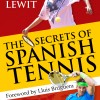
What makes Spanish tennis so unique and successful? What exactly are Spanish coaches doing so differently to develop superstars like Rafael Nadal and David Ferrer that other systems are not doing?
New York High Performance tennis pro Chris Lewit answers these questions in his book The Secrets of Spanish Tennis, which is the culmination of his eight years of study on the Spanish way of training. He visited many of the top Spanish academies and studied and interviewed some of the leading coaches in Spain to discern and distill this unique and special training methodology.
Perhaps the signature theme of the book is how the Spanish – in sports and in life – almost relish in “suffering.” As famed Spanish tennis coach said Pato Alvarez, “In order for a player to play well he or she needs to suffer.”
Lewit’s chapter on suffering from “The Secrets of Spanish Tennis” is excerpted below. To order the book, click here: http://www.amazon.com/Secrets-Spanish-Tennis-Chris-Lewit/dp/1937559491/ref=sr_1_1?ie=UTF8&qid=1425270070&sr=8-1&keywords=Secrets+of+spanish+tennis
After visiting academy after academy, and interviewing coach after coach, I was astounded at how one after another stressed the same principle: suffering.
Suffering to the Spanish means mental toughness, perseverance, and a fighting spirit. It is part of the tennis culture and every young Spanish player is expected to learn to fight and suffer on the red clay—to never give up. Rafael Nadal demonstrates this mental strength perhaps better than any other professional player. Sometimes it seems Nadal likes to suffer! But all Spanish professionals are taught to be fighters who never give up on the court. If a Spanish guy is your opponent, you may be bigger or stronger, but you know you are in for a dogfight and that the Spaniard will not tank or give in. Whether in practice or in a match, the same willingness to suffer is demanded by Spanish coaches of their players. Said Albert Costa, “What I’m trying to do is make them think that everyday they have to do something else. If they go to the edge one day, the next day they have to go a bit farther. Every day they have to go farther. When I was a player, I was a fighter. I know I had good quality tennis, but when I was practicing I was always going to the edge. Every day that you step up in the court, you have to do something else, or try to improve something.”
Spanish players are taught to be fighters but also to be humble sportsmen. There is beauty in the toughness yet humility and integrity that typifies the Spanish mentality Jose Higueras, who was himself a true fighter on the court, believes that the willingness to suffer and fight is one of the key elements missing in American juniors. In fact, the USTA has been sending squads of elite American players over to Barcelona Total Tennis (a leading Spanish academy) to learn how to train, and more importantly, suffer the Spanish way.
When Spanish coaches said to me quite earnestly, “We teach the players how to suffer,” I first wondered if they were serious. But the Spanish are very serious about training hard and setting up exercises to challenge a player’s courage and fighting spirit. Bruguera’s philosophy is this: “If a player isn’t willing to suffer, to sacrifice, it’s impossible to win.” When I asked him how he goes about achieving this with in his players at Top Team, he told me, “We force them.” Bruguera suggested spending 4-5 hours daily with your players (pushing them physically and mentally). Bruguera recommended a lot of drills: “More, more, more. That’s more difficult for the coach and player, but the result at the end is better.”
The long, classic Spanish drills, with repetitions of 20-60 balls or more—nonstop—are one of the classic ways that Spanish coaches force players to learn discipline and to never give up. There is nothing like hitting your 30th ball—legs burning, lungs on fire— only to realize that you still have 30 more shots left to go in the exercise! That teaches suffering better than any other drill I know.
Although some coaches can make drills tough with just 5-10 balls, it is the suffering that comes from stamina drilling of 20 or more that creates the mental toughness the Spanish coaches are looking for.
In Spain, of course, the running and conditioning (as mentioned in Chapter 5) are another important way of teaching players to learn how to suffer. Distance running and hill running are two ways to really simulate the pain and suffering that occurs in a five-set match at the French Open.
From the youngest years, players are taught, through drills and physical conditioning—and through the matches they play on the slow, red clay—that a tennis match is a fight to the death, and that they must never give up, and always embrace suffering. Suffering then becomes a way of life for Spanish players, and they have this tremendous grit that they can tap into during long, arduous matches.
I wondered if suffering came from the Spanish culture itself. I asked many coaches how Spanish tennis became associated with suffering. Emilio Sanchez pointedly mentioned that the whole country suffered for decades under totalitarian rule, so maybe there is a connection there. The theme of suffering is also a core part of the dominant Catholic religion in Spain.
Most coaches pointed out that the clay courts teach a player that suffering is necessary to win. A friend referenced the artwork of the Spanish painter Goya, who depicted suffering as a constant theme in his work—perhaps there was some cultural connection, some historical underpinning to this masochistic philosophy? I do not know the complete answer. But suffering is the simplest term to explain how Spanish players aspire to be the most mentally tough fighters in the tournament.
When I asked Pedro Rico, former coach of rising Spanish player Carlos Boluda, about Spanish players being more willing to suffer, he said, “No, they are not willing to suffer. They love to suffer. If they come out of the court with clay on their shoes, their socks, even if they fell—it’s even better. They’re happy.”
The fighting spirit and willingness to suffer are hallmarks of the Spanish mentality.
Drills To Learn How to Suffer:
• Pato Alvarez’s 100-Ball All-In-One Drill
• Cross courts and down the lines—the original suffering drill
• Mountain circuits
• Stair running
• Running distances above five miles and/or 30 minutes duration
Coaches, parents, and players can learn from the Spanish way of teaching players to suffer. Most importantly, understanding that stamina training, whether on court or off, has tremendous value, and should be used to develop mental toughness and concentration, not just for the more obvious physical benefits.
Endurance-type training has become out of style in recent years with trainers continuing to stress more short sprint work to mimic the ratio of rest/work in a typical tennis match.
Trainers argue that too much endurance work may make players slower—actually developing more slow twitch fibers in the muscles. But years of successful Spanish training has proven that this fear is overdone, and that long duration drilling and distance running are still a valuable means for training players, both for the physical and especially for the mental benefits.
Coaches, parents, and players can work to develop a strong values system, emphasizing the key psychological components of the Spanish method:
• Discipline
• Suffering
• Perseverance
• Fighting Spirit
• Concentration
• Pain tolerance
• Sportsmanship—respect for others, humility, and Teamwork